
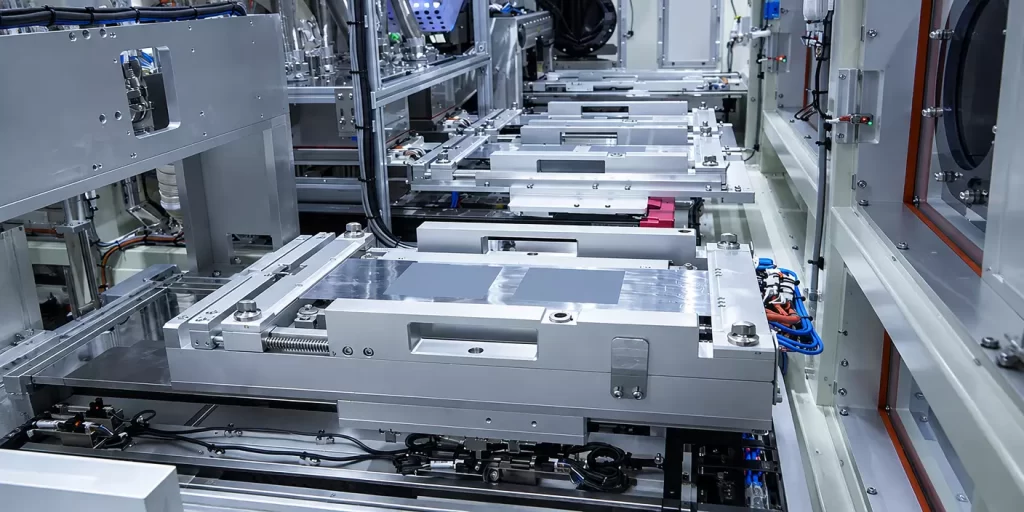
Table of Contents
The global solid-state battery market is growing rapidly, driven by demand for higher energy density and improved safety. According to Grand View Research, the market is projected to reach USD 15.7 billion by 2033, with a CAGR of 31.8% from 2026 to 2033. (Source: Grand View Research – Solid State Battery Market)
TrendForce forecasts that global solid-state battery demand, including semi-solid-state batteries, will exceed 206 GWh by 2030 and 740 GWh by 2035, highlighting the growing need for scalable manufacturing technologies such as warm isostatic pressing. (Source: TrendForce – Solid-State Battery Demand Forecast)
As solid-state batteries move toward gigawatt-hour (GWh)-scale manufacturing, achieving uniform densification and reliable solid-solid interfacial contact has become a critical process challenge. JUNJIE’s independently developed warm isostatic pressing equipment uses water or heat-transfer oil as the pressure-transmitting medium to deliver uniform, multidirectional pressure at temperatures of 80–150°C and pressures of 400–600 MPa.
With pressure fluctuations controlled within ±5 MPa, interlayer pressure deviation below 3% across multilayer cells, and a post-forming density gradient controlled within 1%, JUNJIE’s equipment supports consistent densification across complex workpieces. Its vertical and horizontal machine configurations cover the full production pathway, from laboratory research and pilot-scale validation to large-scale manufacturing, helping accelerate solid-state battery commercialization.
Two Key Challenges in Solid-State Battery Manufacturing
As solid-state battery production scales up, two major challenges remain.
First, both electrodes and solid electrolytes are rigid solids. Inadequate contact between these materials can lead to high interfacial resistance, limiting electrochemical performance.
Second, conventional uniaxial pressing and roll pressing apply pressure predominantly from one direction. This can create nonuniform density, with denser central regions and less compact edges. Such edge effects make it difficult to maintain consistent product quality across batches.
Warm Isostatic pressing technology addresses these challenges by applying pressure through a fluid medium within a sealed pressure vessel. Based on Pascal’s principle, pressure is transmitted throughout the medium in all directions, promoting more uniform compaction and improving particle-to-particle and solid-solid interfacial contact. This makes warm isostatic pressing technology a promising process route for addressing densification challenges in solid-state battery manufacturing.
JUNJIE Warm Isostatic Pressing Equipment: Core Technical Capabilities
Building on more than two decades of ultra-high-pressure precision manufacturing experience at its parent company, Zhuhai CTT Technology Co., Ltd., JUNJIE develops and manufactures its own high-pressure vessels, intensifier systems, sealing systems, and intelligent pressure-control systems. Its manufacturing and quality management processes are supported by ISO 9001 quality management system certification and ASME U-stamp pressure vessel certification.
High-Pressure System
JUNJIE warm isostatic pressing equipment delivers isotropic pressure in the 400–600 MPa range, with a maximum operating pressure of 600 MPa. This pressure range supports the processing requirements of various solid electrolyte systems, including sulfide-based, oxide-based, and polymer-based materials.
The system maintains pressure fluctuations within ±5 MPa. For multilayer cell processing, interlayer pressure deviation is controlled below 3%, while the post-forming density gradient is maintained within 1%, supporting uniform compaction and improved batch consistency.
Temperature Control System
The equipment operates within a temperature range of 80–150°C. Rather than heating the workpiece directly, the system transfers heat through the liquid pressure medium, either water or heat-transfer oil, which surrounds the workpiece and promotes uniform heating.
This approach helps reduce localized thermal stress and supports coordinated material softening, pore filling, and densification within a controlled process window.
An independent constant-temperature circulation unit works with precision temperature controls to maintain stable thermal conditions throughout the pressing cycle.
Pressure Vessel Specifications
The working vessel features an effective inner diameter of at least 400 mm and an effective length of at least 4,000 mm, with an approximate chamber volume of 500 L.
This configuration accommodates workpieces of different dimensions and supports batch processing requirements for high-throughput solid-state battery manufacturing. Final throughput depends on the workpiece configuration, loading arrangement, and validated process cycle.
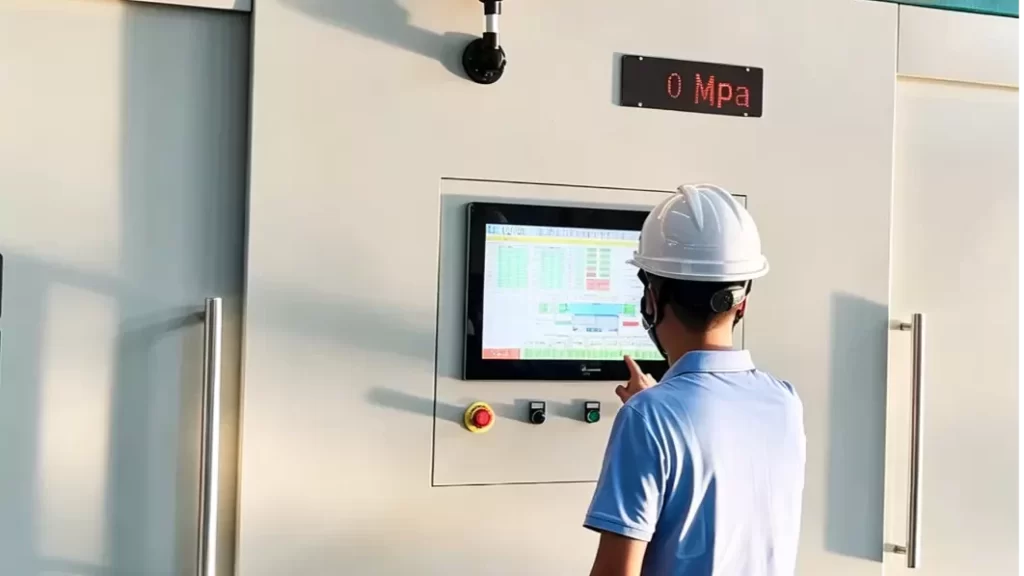
Engineered for GWh-Scale Solid-State Battery Production
Beyond core pressure and temperature performance, JUNJIE warm isostatic pressing equipment is designed to integrate with production-line takt time, automated material handling, and upstream and downstream processes. Three areas of optimization support the transition from pilot production to industrial-scale manufacturing.
Horizontal Production Systems for Automated Line Integration
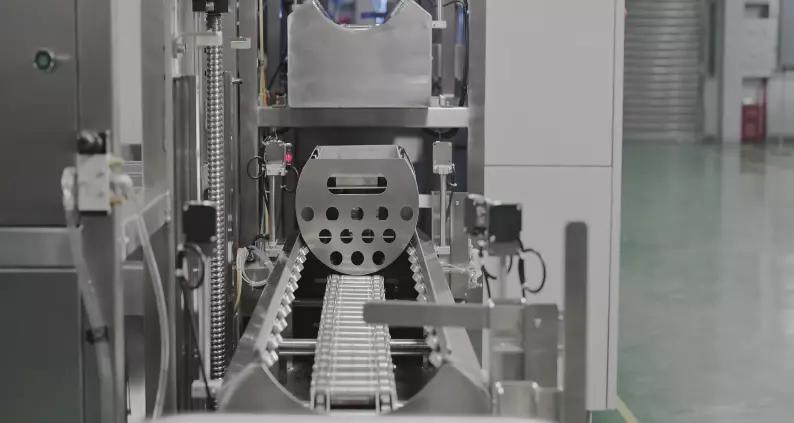
JUNJIE’s horizontal production configuration combines an in-house-developed high-pressure vessel with automated loading and unloading structures. Its horizontal layout helps reduce constraints associated with factory ceiling height and facilitates integration with automated material handling systems and robotic loading and unloading.
After electrode and solid electrolyte layers are stacked and assembled, the workpiece can be transferred into the pressure chamber for uniform isostatic compaction. This approach can reduce intermediate handling fixtures, simplify material flow, and support more continuous production operations.
Integrated Temperature and Pressure Automation for Batch Consistency
JUNJIE’s independently developed temperature-pressure coordination system integrates preheating, constant-temperature pressure holding, cooling and depressurization, automatic fixture handling, and closed-loop tray circulation.
The automated workflow covers loading, pretreatment, isostatic densification, and unloading and transfer. Pressure and temperature profiles can be programmed independently to accommodate different material systems and process requirements.
By reducing manual intervention and improving process repeatability, the system helps maintain consistent interfacial densification and supports more stable manufacturing yields across batches.
Multi-Layer Safety Protection for Long-Term Operation
Reliable high-pressure operation is essential for continuous industrial production. JUNJIE’s equipment incorporates multiple layers of safety monitoring and protection.
At the equipment level, dual-channel pressure and temperature monitoring provides real-time operating data, while redundant pressure-relief lines provide additional protection.
At the process level, vessel fatigue monitoring, abnormal-pressure alerts, and overtemperature interlocks help identify abnormal operating conditions and initiate protective responses. These measures support operational safety while maintaining controlled warm isostatic pressing conditions during extended production runs.
Advancing Solid-State Battery Industrialization with Integrated Equipment Solutions
Competition in solid-state battery commercialization is increasingly extending beyond material formulations to the core equipment and manufacturing processes that enable consistent production.
With independently developed core components, a dual-model portfolio of vertical and horizontal warm isostatic pressing equipment, and process data that can support transfer between compatible pressure vessels, JUNJIE provides an integrated approach to equipment, process development, and maintenance.
By combining equipment engineering with application-specific process optimization and lifecycle support, JUNJIE aims to help battery manufacturers address solid-solid interfacial contact and densification challenges while improving process repeatability and production readiness.
Looking ahead, JUNJIE will continue advancing warm isostatic pressing technology to support the transition from pilot-scale validation to stable GWh-scale solid-state battery manufacturing.