
Table of Contents
In advanced material processing, achieving precise particle size control is essential for improving product performance, stability, and functionality. From pharmaceutical nanoparticles and energy materials to food emulsions and cosmetic formulations, the ability to reduce and regulate particle size directly influences properties such as bioavailability, dispersion stability, conductivity, and product quality.
High pressure homogenization has become one of the most effective technologies for nanoscale particle size reduction and uniform dispersion. By forcing materials through a specially designed interaction chamber under extremely high pressure, this technology generates intense shear forces, cavitation effects, and high-speed impact collisions that break down particles and droplets into smaller sizes.
However, pressure is not simply a matter of “higher is better.” The relationship between pressure and particle size reduction depends on multiple factors, including material characteristics, processing cycles, equipment design, and the efficiency of the homogenization system.
A modern microfluidic homogenizer uses precisely engineered channels and interaction chambers to maximize energy transfer during processing, enabling researchers and manufacturers to achieve consistent particle size distribution from laboratory development to industrial-scale production.
What Happens to Particles During High Pressure Homogenization?
The principle of high pressure homogenization is based on converting hydraulic energy into mechanical forces that act on particles and droplets.
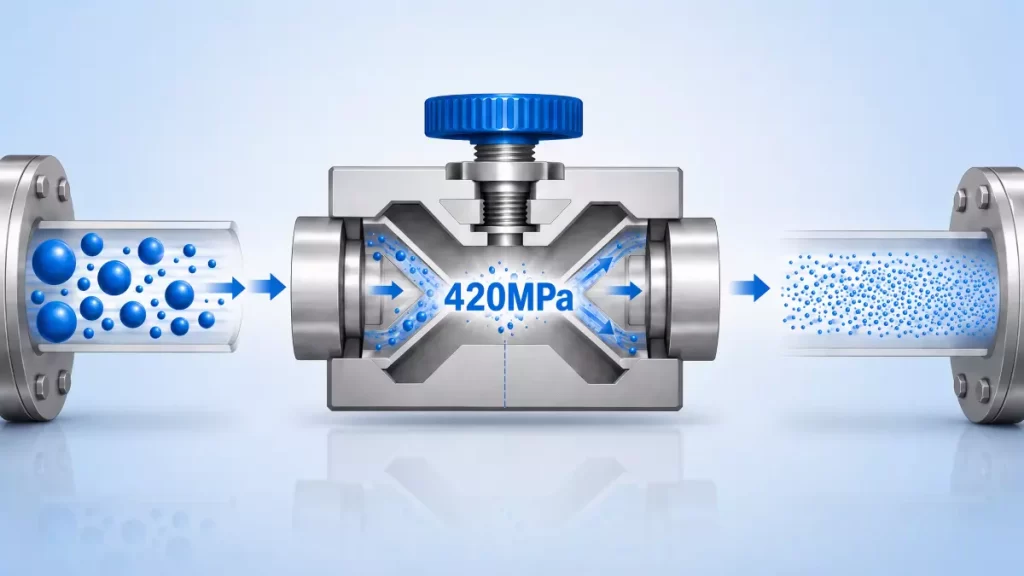
During processing, the material is pressurized by a high-pressure pump and accelerated through a micro-scale interaction chamber. As the fluid passes through this restricted area, several physical mechanisms occur:
1. High Shear Forces
When materials travel through narrow microchannels at extremely high velocity, strong velocity gradients generate intense shear forces. These forces stretch, deform, and break apart particles or droplets.
Shear stress is particularly important for:
- Breaking down agglomerated particles
- Reducing particle size distribution
- Improving dispersion uniformity
2. Cavitation Effects
When liquid pressure changes rapidly inside the interaction chamber, microscopic vapor bubbles can form and collapse. This cavitation phenomenon creates localized energy release, generating additional forces that contribute to particle disruption.
3. Particle Collision and Impact
High-speed fluid streams collide inside the interaction chamber, producing powerful impact forces. These collisions further reduce particle size and improve nanoscale dispersion.
A well-designed microfluidization system combines these mechanisms to achieve efficient particle size reduction while maintaining product quality.
How Pressure Influences Particle Size Reduction
Pressure is one of the most important parameters in high pressure homogenization. Generally, increasing processing pressure provides higher energy input, which leads to stronger particle disruption.
Low Pressure Processing: Initial Particle Breakdown
At relatively lower pressure levels, the applied energy mainly affects large particles and weak aggregates.
Typical effects include:
- Breaking loose agglomerates
- Improving initial dispersion
- Reducing large particle populations
This stage is commonly used during early formulation development or for materials that are sensitive to mechanical stress.
For example, in pharmaceutical formulations or nano-emulsions, low-pressure processing may help create a more uniform starting system before further size reduction.
Medium Pressure Processing: Efficient Particle Size Reduction
As pressure increases, stronger shear, cavitation, and impact forces are generated.
This results in:
- Smaller particle size
- Narrower particle size distribution
- Improved suspension stability
Medium-pressure processing is widely applied in:
- Food and beverage emulsions
- Cosmetic ingredients
- Biological formulations
- Chemical dispersions
A high-quality microfluidic homogenizer can precisely control pressure conditions to achieve repeatable particle size results.
High Pressure Processing: Achieving Nanoscale Dispersion
At higher pressure levels, the system provides significantly greater energy density, enabling difficult materials to reach nanoscale dispersion.
Applications include:
- Liposome preparation
- Nanoparticle formulation
- Battery material dispersion
- Advanced functional materials
For example, in new energy applications, high-pressure microfluidization can improve the dispersion uniformity of electrode materials, helping optimize conductivity and processing performance.
Why Higher Pressure Does Not Always Mean Smaller Particles
Although increasing pressure usually improves particle size reduction, the relationship is not linear.
Several factors determine the final particle size:
1. Material Properties
The effectiveness of high pressure homogenization is highly influenced by the physical and chemical characteristics of the processed material. Different materials respond differently to mechanical forces generated during homogenization, meaning that optimal processing conditions must be carefully adjusted based on the specific properties of each formulation. Factors such as hardness, viscosity, elasticity, particle structure, and chemical composition all affect how efficiently particles can be disrupted and dispersed.
For example, ceramic powders with rigid structures may require higher energy input to achieve uniform dispersion, while biological materials with more delicate structures require carefully controlled processing conditions to prevent unwanted degradation. Understanding material behavior is therefore essential for selecting the appropriate pressure range and processing strategy.
2. Number of Processing Passes
Particle size reduction in high pressure homogenization is not determined by pressure alone; the number of processing cycles also plays an important role. In many applications, multiple optimized passes at a suitable pressure level can achieve better and more consistent particle size reduction than a single pass under extremely high pressure.
A professional high pressure homogenizer enables precise control over key processing parameters, including pressure level, number of passes, flow rate, and temperature management. By optimizing these parameters together, manufacturers and researchers can achieve the desired particle size distribution while maintaining product stability and processing efficiency.
3. Interaction Chamber Design
The design of the interaction chamber is another critical factor that directly influences the efficiency of energy transfer during high pressure homogenization. While pressure provides the driving force, the interaction chamber determines how effectively that energy is converted into shear, cavitation, and impact forces that reduce particle size.
Advanced microfluidic homogenizer systems utilize optimized microchannel structures and diamond interaction chambers to ensure stable pressure distribution, efficient energy conversion, and highly reproducible particle size results. Therefore, achieving nanoscale dispersion requires not only sufficient pressure capability but also advanced equipment design and precise fluid dynamics control.
The Role of Microfluidization in Particle Size Control
Microfluidization is an advanced form of high pressure homogenization technology that uses engineered microchannels to create highly controlled processing environments.
Compared with traditional homogenization methods, microfluidization provides:
More Precise Particle Size Control
The microchannel structure creates predictable fluid dynamics, allowing more consistent particle reduction.
Better Batch-to-Batch Reproducibility
Stable processing conditions help maintain product consistency during scale-up.
Nanoscale Processing Capability
Microfluidization technology is widely used for applications requiring extremely small particle sizes, including:
- Nanomedicine
- Liposomes
- Nanomaterials
- Functional food ingredients
- Energy storage materials
A high-performance microfluidic homogenizer combines high pressure generation with precise fluid control, making it suitable for both research development and industrial manufacturing.
Applications of Pressure-Controlled High Pressure Homogenization
Pressure-controlled high pressure homogenization applications are expanding rapidly across industries that require precise particle size control, uniform dispersion, and enhanced product performance. By adjusting processing pressure and energy input, high pressure homogenization technology enables reliable solutions for advanced materials, pharmaceuticals, food, cosmetics, and other high-value applications. From laboratory research to industrial-scale manufacturing, optimized pressure control helps achieve consistent and scalable processing results.
Pharmaceutical and Biomedical Applications
In pharmaceutical research, particle size directly affects:
- Drug dissolution rate
- Absorption efficiency
- Delivery performance
High pressure homogenization is commonly used for:
- Lipid nanoparticles
- Nano drug delivery systems
- Injectable formulations
New Energy and Advanced Materials
Modern energy materials require highly uniform dispersion.
Applications include:
- Battery electrode materials
- Conductive materials
- Ceramic powders
- Functional nanomaterials
Precise particle size control improves:
- Material uniformity
- Electrochemical performance
- Manufacturing stability
Food and Beverage Processing
In food applications, smaller particle sizes improve:
- Emulsion stability
- Texture
- Mouthfeel
- Shelf-life performance
Common applications include:
- Plant-based beverages
- Dairy alternatives
- Nutritional emulsions
- Functional ingredients
Cosmetics and Personal Care
High pressure homogenization helps create stable and smooth formulations by reducing particle size and improving ingredient dispersion.
Applications include:
- Nano emulsions
- Active ingredient delivery systems
- Skincare formulations
How to Select the Right Pressure for Your Application
Choosing the correct processing pressure requires a comprehensive understanding of:
- Target particle size
- Material characteristics
- Production capacity
- Temperature sensitivity
- Required dispersion quality
A professional solution should include:
Customized Process Development
Different materials require different pressure ranges and processing parameters.
Laboratory-to-Industrial Scalability
The same homogenization principle should be maintained from small-scale experiments to commercial production.
Advanced Equipment Capability
A reliable system should provide:
- Stable pressure control
- High-efficiency interaction chamber
- Precise process monitoring
- Long-term operational reliability
Advanced High Pressure Homogenization Solutions for Nanoscale Processing
As industries continue moving toward advanced materials and precision manufacturing, particle size control has become increasingly important.
Modern high pressure homogenization technology provides a powerful platform for achieving nanoscale dispersion through controlled pressure, optimized fluid dynamics, and advanced interaction chamber design.
With independently developed core components, including high-pressure intensifiers and diamond interaction chambers, advanced microfluidic homogenizer systems enable researchers and manufacturers to bridge the gap between laboratory innovation and industrial-scale production.
From pharmaceutical nanoparticles and new energy materials to food, cosmetics, and chemical applications, precise pressure control provides the foundation for reliable and scalable particle processing solutions.
Conclusion
Pressure plays a critical role in determining particle size reduction efficiency in high pressure homogenization. Increasing pressure can enhance shear forces, cavitation, and particle collision effects, but optimal results depend on a combination of pressure parameters, material characteristics, processing cycles, and equipment design.
Through advanced microfluidization technology and precision-engineered microfluidic homogenizer systems, manufacturers and research institutions can achieve consistent nanoscale dispersion and accelerate innovation across multiple industries.
