
Table of Contents
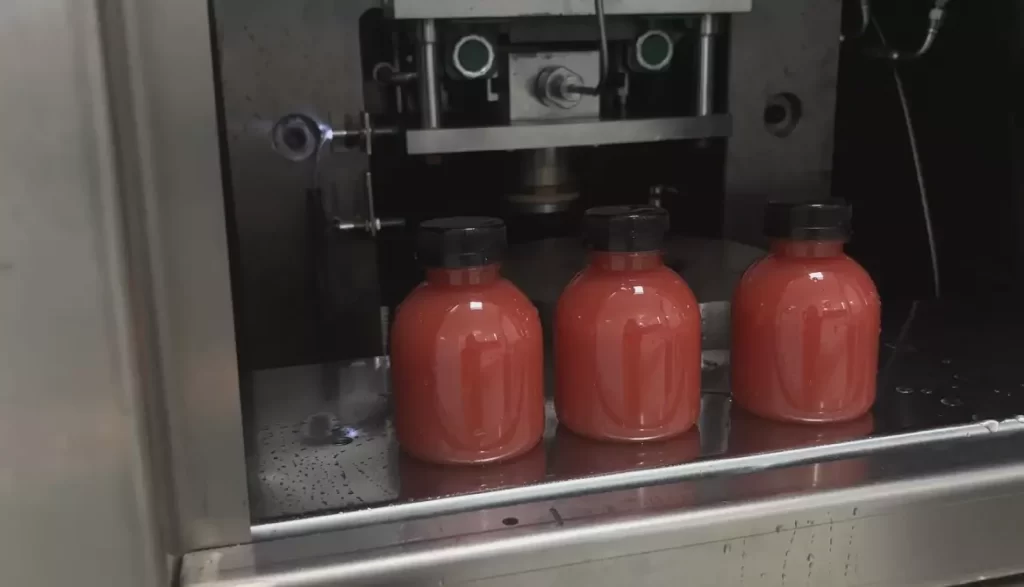
Consumers expect bottled juice to remain smooth, uniform, and stable throughout its shelf life. However, juice separation and sedimentation remain common challenges for many manufacturers.
During storage, heavier particles may settle while lighter components separate, affecting product appearance, texture, and overall quality. Traditional mixing can provide temporary dispersion but may not ensure long-term stability, especially in products containing pulp, fiber, proteins, or plant extracts.
This is where a high-pressure microfluidizer offers an advanced solution. Using microfluidic technology and ultra-high-pressure energy, it can reduce particle size and improve particle distribution for smoother, more uniform, and stable juice products.
But why does juice separation occur, and how can high-pressure microfluidic homogenization help solve it?
The Main Factors Behind Juice Separation
Several factors can influence beverage stability.
Particle Size
Particle size is one of the most important factors. Large particles tend to settle more easily under the influence of gravity. They may also create a rougher mouthfeel and visible sediment. Reducing particle size can help improve the physical stability of the beverage.
Particle Size Distribution
Average particle size is important, but distribution also matters.
A beverage containing particles with highly inconsistent sizes may be more likely to experience instability. A narrow and uniform particle size distribution can help improve dispersion consistency.
Density Differences
Different ingredients have different densities.
For example, fruit pulp and insoluble plant materials may have a higher density than the surrounding liquid.
Over time, gravity can cause these particles to settle.
Aggregation
Small particles can sometimes collide and form larger aggregates. These larger structures may settle more rapidly and increase visible sediment. A stable dispersion requires not only particle size reduction but also effective particle distribution.
Insufficient Homogenization
Conventional mixing may distribute ingredients throughout a beverage, but the mixing energy may not be sufficient to break down fine particles or aggregates.
For challenging formulations, manufacturers may need more advanced processing technologies.
What Is a High-Pressure Microfluidizer?
An high-pressure microfluidizer is an advanced homogenization system that uses ultra-high pressure—up to 420 MPa—as its core driving force. The material is pressurized and then rapidly forced through extremely fine microchannels within specially designed diamond interaction chambers.
As the material passes through these precision microchannels at extremely high velocity, it is subjected to three powerful forces: intense shear generated by high-speed flow, direct jet collision, and the impact created by the rapid formation and collapse of microscopic bubbles (cavitation). These forces work together to efficiently reduce materials to the nanoscale while achieving an exceptionally uniform dispersion.
Unlike conventional mixing and mechanical shear processes, which often provide relatively broad and less controlled particle size reduction, a high-pressure microfluidizer enables precise particle size control and improved batch-to-batch consistency.
This technology is widely used across multiple industries, including:
- Biopharmaceuticals: liposome preparation and nanomedicine development
- Food and Beverages: plant-based emulsions and nano fish oil
- Cosmetics: nanoemulsions and advanced cream formulations
- New Materials: graphene and other nanomaterial dispersions
From laboratory-scale research and process development to pilot testing and industrial-scale production, high-pressure microfluidic technology provides scalable, end-to-end solutions for advanced material processing and nano-scale dispersion.
How Does Microfluidic Technology Work?
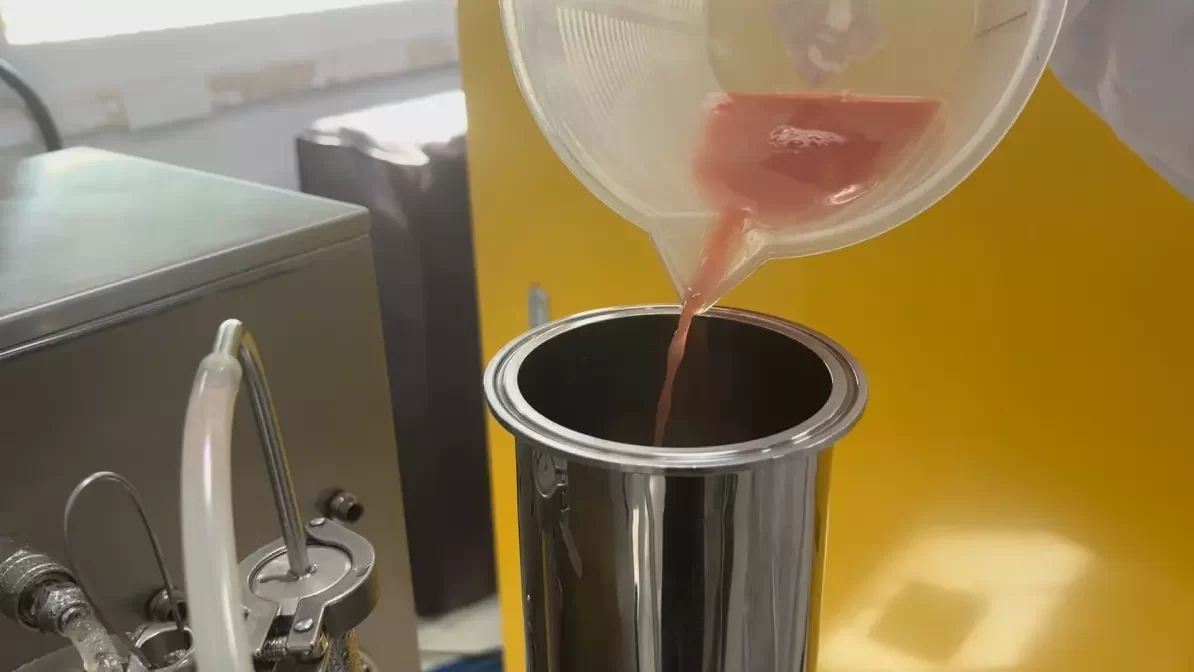
The core principle of a high-pressure microfluidizer is to use an ultra-high-pressure pump to deliver juice through specially designed microchannel structures, where extreme pressures of 300–400 MPa generate high-velocity fluid jets. Within these micron-scale flow channels, the fluid is subjected to intense shear forces, cavitation, and high-frequency collisions, breaking down pulp fibers and suspended particles to the nanoscale, typically below 200 nm.
Unlike conventional mechanical size reduction, this technology does not rely on high temperatures or chemical additives. Instead, it uses physical processing to achieve precise control of particle size. For example, when juice is processed, pectin molecular chains can be selectively modified, helping maintain heat-sensitive components such as vitamin C while significantly reducing the risk of phase separation.
During this process, the geometric parameters of the microfluidic interaction chamber and the pressure gradient are optimized together to improve energy transfer efficiency and ensure stable, repeatable processing. This provides a reliable foundation for continuous industrial-scale production.
How a Microfluidizer Helps Solve Juice Separation
1. Reducing Particle Size
One of the primary benefits of a microfluidizer is its ability to reduce particle size.
Large pulp particles and suspended solids can be broken into smaller particles.
Smaller particles generally move more slowly under the influence of gravity.
As a result, reducing particle size can help slow sedimentation.
For juice manufacturers, this can mean:
- Less visible sediment
- Improved product uniformity
- Smoother texture
- Better appearance
2. Improving Particle Distribution
Particle size reduction alone is not enough.
The particles must also be distributed uniformly throughout the liquid.
Microfluidic processing applies intense energy throughout the material, helping disperse particles more effectively.
A more uniform dispersion can improve product consistency from bottle to bottle.
3. Breaking Down Agglomerates
Natural ingredients often contain particles that can form clusters.
These agglomerates can increase particle size and contribute to sediment formation.
The high-energy processing environment inside a microfluidizer can break down these particle clusters.
This creates a more refined and stable dispersion.
4. Creating a Smoother Mouthfeel
Consumers often associate smooth texture with premium beverage quality.
Large particles can create a gritty or rough sensation.
By reducing particle size, microfluidic technology can help create a smoother mouthfeel.
This is particularly valuable for:
- Fruit juices with pulp
- Vegetable juices
- Plant-based beverages
- Functional drinks
- Nutritional beverages
Applications Beyond Juice
Although juice separation is an important application, microfluidic technology can also be used in many other industries.
Functional Beverages
Functional beverages often contain:
- Vitamins
- Minerals
- Proteins
- Botanical extracts
- Nutraceutical ingredients
These materials can create dispersion challenges.
A microfluidizer can help improve ingredient distribution and product uniformity.
Plant-Based Beverages
Plant-based beverages often contain proteins, fibers, and plant particles.
Maintaining a stable suspension can be challenging.
High-pressure microfluidic processing can help reduce particle size and improve dispersion.
Dairy and Nutritional Products
Microfluidic technology can also be applied to:
- Dairy products
- Protein beverages
- Nutritional drinks
- Emulsions
Particle size control and uniform dispersion can play an important role in product quality.
Core Technologies Behind High-Performance Microfluidizers
For high-pressure microfluidic processing, several components are particularly important.
High-Pressure Intensifier
The intensifier generates the pressure required for high-energy material processing.
Stable pressure output is essential for consistent processing results.
Homogenization Valve and Interaction Chamber
These components directly influence how energy is applied to the material.
Precision flow channel design can create controlled processing conditions and improve repeatability.
Advanced diamond interaction chambers can provide excellent wear resistance and durability.
Precision Manufacturing
Microchannels operate under demanding high-pressure conditions.
Small differences in geometry can influence fluid behavior and processing performance.
Precision machining is therefore essential.
Intelligent Control Systems
Modern microfluidizers increasingly use digital control technologies.
These systems can monitor and control:
- Processing pressure
- Flow rate
- Temperature
- Operating time
- System status
Accurate process control can help improve repeatability and support product development.
JUNJIE – Customized Microfluidic Homogenization Solutions
With high-pressure microfluidic technology at its core, JUNJIE enables precise control of particle sizes from the nanoscale to the microscale, helping ensure excellent material uniformity and processing consistency.
Guided by an on-demand customization philosophy, JUNJIE provides precise and efficient homogenization solutions for every stage of development and production—from laboratory-scale research and pilot testing to industrial-scale manufacturing.
Our customization capabilities include:
Core Operating Parameters: Processing pressure and flow rate can be configured according to specific material characteristics and production capacity requirements, ensuring the system is properly matched to different applications.
Material Contact Components: Material-contact components can be customized using 316L stainless steel, food-grade sealing materials, corrosion-resistant coatings, and other specialized materials to meet the requirements of industries such as pharmaceuticals, food and beverages, and advanced materials.
Functional Modules: Additional functional modules can be integrated based on application requirements. For example, intelligent control systems can enable remote monitoring, while aseptic processing modules can support sterile homogenization requirements in biopharmaceutical applications.
Customization for Specialized Requirements
Pressure and Flow Rate: Pressure ratings up to 420 MPa and corresponding processing flow rates can be customized based on material characteristics and production capacity targets.
Materials and Modules: Materials such as 316L stainless steel, food-grade/pharmaceutical-grade seals, and corrosion-resistant alloys are available; optional add-ons include CIP/SIP in-place cleaning systems, remote monitoring modules, and explosion-proof configurations.
Functional Extensions: Intelligent features such as data traceability, AI-based pressure compensation algorithms, and energy recovery systems can be integrated to enhance process stability and energy efficiency.
End-to-End Service and Technical Support
Preliminary Planning: Based on the customer’s process objectives and workshop layout, we provide customized production line designs and equipment selection recommendations.
Testing and Validation: We offer free sample testing services (such as particle size verification and material compatibility testing) to determine the optimal process parameters.
Installation and Maintenance: We provide installation and commissioning, staff training, regular maintenance, and a supply of genuine spare parts to ensure the long-term, stable operation of the equipment.
Technical Problem-Solving: For special materials or process bottlenecks, our R&D team provides long-term follow-up and support to tackle challenges.
The Future of Juice Processing: Smaller Particles, Better Stability
Consumer expectations for beverages continue to evolve. The market increasingly demands products that offer:
- Smooth texture
- Natural ingredients
- Functional benefits
- Premium quality
- Stable appearance
At the same time, manufacturers are developing increasingly complex beverage formulations. These products may contain more functional ingredients, plant extracts, proteins, fibers, and natural components.
As formulation complexity increases, maintaining physical stability becomes more challenging. Microfluidic technology provides an advanced processing platform for addressing these challenges. By enabling precise particle size reduction and highly uniform dispersion, a high-pressure microfluidizer can help manufacturers develop more stable and higher-quality beverages.
Conclusion: A Smarter Solution to Juice Separation
Juice separation and sedimentation are often caused by large particles, uneven particle distribution, density differences, and particle aggregation. A high-pressure microfluidizer uses precisely controlled microfluidic technology to reduce particle size, improve dispersion, and create smoother, more stable juice products. However, achieving optimal results requires the right combination of pressure, interaction chamber design, processing parameters, and material-specific process optimization.
For manufacturers, the right partner provides more than equipment. JUNJIE’s customized services go beyond simply adjusting parameters, considering material characteristics, process objectives, production capacity, and compliance requirements to deliver one-stop, turnkey solutions—from laboratory testing and core homogenization units to industrial-scale production line integration. With independently developed core components, precision manufacturing, and scale-up support, JUNJIE helps manufacturers develop more uniform, stable, and competitive beverage products.
