
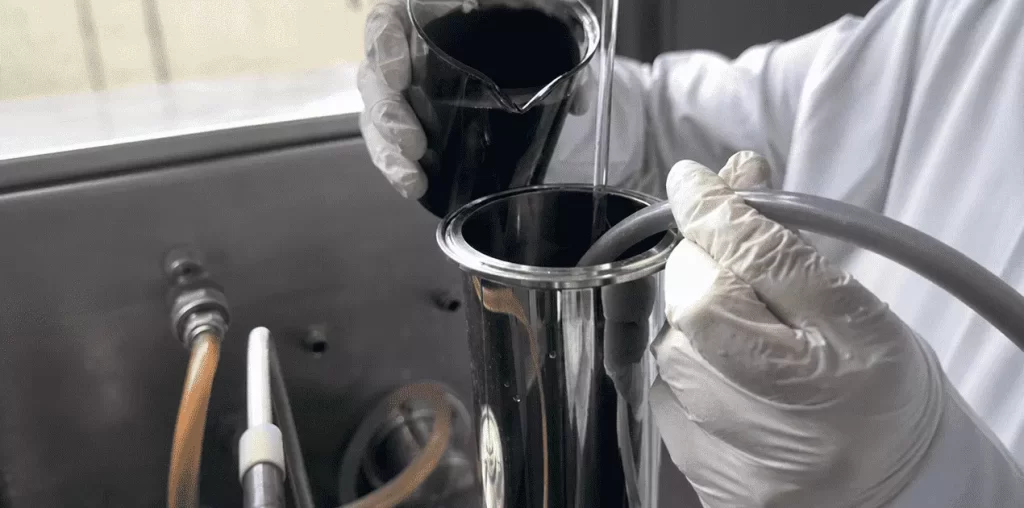
Graphene has attracted significant attention as an advanced lubricant additive due to its unique two-dimensional structure, low interlayer shear resistance, and potential to reduce friction and wear. However, achieving these benefits depends heavily on dispersion quality. Poorly dispersed graphene can aggregate and sediment, leading to uneven additive distribution, unstable rheological properties, and inconsistent tribological performance.
Microfluidic technology provides an effective solution by using controlled high pressure, intense shear, impact, and micro-mixing forces within engineered microchannels to break down agglomerates and improve graphene dispersion. For researchers and manufacturers, the goal is not simply smaller particles, but a uniform, stable, repeatable, and scalable dispersion process from laboratory development to industrial production.
Why Graphene Is Attractive for Advanced Lubricants
Graphene is a two-dimensional carbon material composed of an atomically thin layered structure. Its unique structure allows graphene sheets to slide relative to one another, making graphene-based materials particularly interesting for friction and wear reduction.
Several mechanisms have been proposed to explain the lubrication behavior of graphene, including:
- Interlayer sliding
- Formation of protective tribofilms
- Surface adsorption
- Filling or smoothing of microscopic surface irregularities
- Synergistic interactions with conventional lubricant additives
Recent research supports the potential of graphene nanoplatelets and graphene derivatives as lubricant additives. For example, a 2024 study reported that functionalized graphene nanoplatelets added to fully formulated engine oil reduced friction under both boundary and elastohydrodynamic lubrication conditions and provided evidence of carbon-based tribofilm formation.
Another study investigating graphene nanoplatelets in commercial oil and bio-lubricant blends found that graphene concentration had a significant influence on tribological performance. Importantly, the study also showed that increasing graphene concentration beyond an optimum level could deteriorate friction and wear performance.
This highlights an important principle:
The quality of graphene dispersion and the interaction between graphene, the base fluid, and the tribological system can be just as important as the nominal graphene concentration.
The Core Challenge: Graphene Lubricant Dispersion
Why Does Graphene Agglomerate?
Graphene has a very high specific surface area. When individual graphene sheets or nanoplatelets come into contact, attractive forces can cause them to stack or form clusters.
In a lubricant, this can create several problems:
Sedimentation
Large agglomerates can settle over time, causing the graphene concentration to vary throughout the lubricant.
The lubricant at the top of a container may therefore have a different graphene concentration from the material at the bottom.
Non-Uniform Additive Distribution
If graphene is not evenly distributed, different components of a mechanical system may receive different amounts of graphene additive.
This makes tribological performance less predictable.
Reduced Effective Surface Area
When graphene sheets form large aggregates, a significant portion of their surface area becomes inaccessible to the surrounding lubricant and tribological interfaces.
The effective function of the graphene additive may therefore be reduced.
Processing and Rheological Changes
Poorly dispersed nanomaterials can also affect viscosity and flow behavior. Excessive aggregation may increase viscosity or create unstable flow characteristics.
Reproducibility Problems in R&D
For universities, research institutes, and industrial laboratories, dispersion inconsistency can make experimental results difficult to reproduce.
A formulation may appear successful in one batch but perform differently in another because the dispersion process was not sufficiently controlled.
For this reason, graphene dispersion should be treated as a process engineering problem rather than simply a formulation problem.
How Microfluidic Technology Improves Graphene Dispersion
Microfluidic technology provides a fundamentally different approach to dispersion.
Instead of relying primarily on mechanical stirring, the material is driven through precisely engineered microchannels under high pressure.
Inside the processing chamber, the fluid experiences extremely high local shear, rapid changes in velocity, impact forces, turbulence, and intensive micro-mixing.
Commercial Microfluidizer® technology, for example, uses a constant-pressure pumping system to drive material through a fixed-geometry Interaction Chamber, where high shear and impact forces contribute to particle-size reduction and dispersion.
For graphene lubricant processing, the underlying concept is straightforward:
High-pressure pumping → microchannel acceleration → intense shear and impact → agglomerate breakup → improved dispersion → more uniform graphene distribution
The exact processing conditions must be optimized according to graphene morphology, concentration, base oil chemistry, viscosity, target dispersion stability, and downstream application.
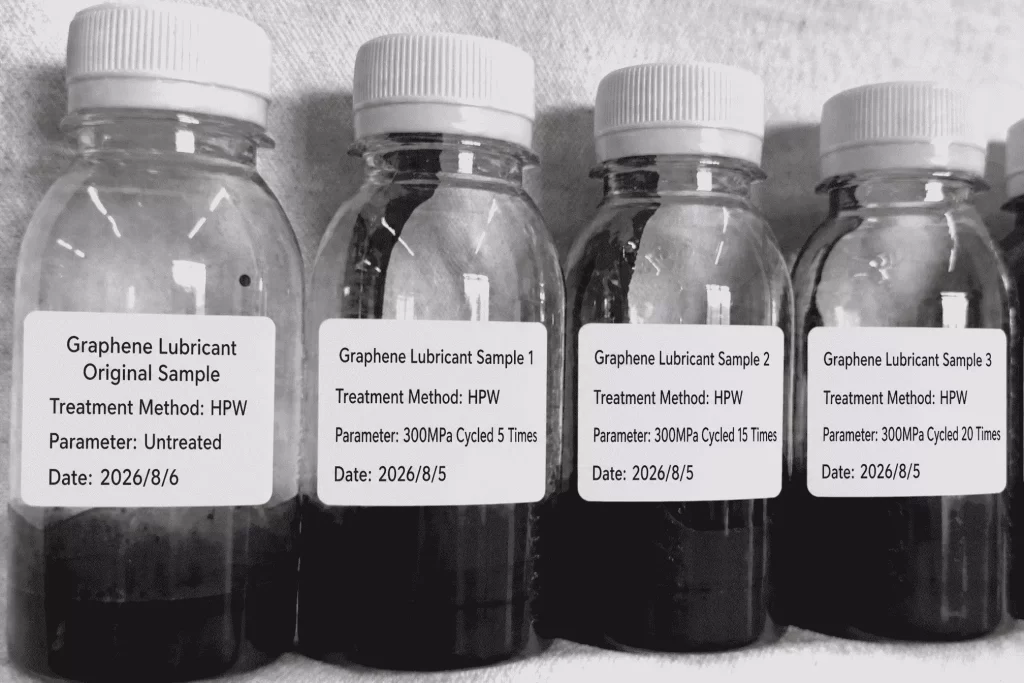
Microfluidic Technology vs. Conventional Mixing for Graphene Lubricants
Conventional mechanical agitation can be useful during premixing, but it may struggle to consistently break down nanoscale graphene agglomerates.
A high-pressure microfluidizer or microfluidic homogenizer introduces a more controlled energy-delivery mechanism.
Conventional Mechanical Mixing
Typical mechanical mixing relies on:
- Impeller movement
- Macroscopic turbulence
- Longer processing times
- Relatively broad energy distribution
- Multiple processing variables
This can be sufficient for initial wetting and premixing but may not provide the high local stresses required for difficult nanoscale agglomerates.
Microfluidic High-Pressure Processing
Microfluidic processing instead uses:
- Precisely defined microchannels
- High-pressure fluid acceleration
- High shear forces
- Impact forces
- Controlled micro-mixing
- Repeatable processing conditions
The Microfluidics technology platform describes its fixed-geometry Interaction Chamber as a key component for producing consistent high shear and particle-size reduction, while maintaining repeatable processing conditions across scales.
For graphene lubricant development, this can provide a more controllable route to deagglomeration and uniform dispersion.
Why Fixed-Geometry Microchannels Matter
One of the most important characteristics of microfluidic processing is the use of engineered flow geometry.
In a fixed-geometry interaction chamber, the processing environment is precisely designed rather than relying on the unpredictable flow patterns typically generated by conventional mixing equipment. As graphene-containing lubricants pass through the microchannels at high velocity, they experience intense local shear and collision forces, which help break down graphene agglomerates, redistribute graphene nanosheets or nanoplatelets, improve contact between graphene and the lubricant phase, and achieve a more homogeneous dispersion.
Microfluidic processors can also incorporate wear-resistant ceramic or diamond interaction chambers for demanding high-shear applications. For advanced nanomaterial processing, the interaction chamber is therefore more than a replaceable component—it is a critical element in energy transfer, deagglomeration, and dispersion performance.
Dispersion Quality Matters More Than Simply Reducing Particle Size
A common misunderstanding in nanomaterial processing is that successful dispersion means achieving the smallest possible particle size.
For graphene lubricants, this is not always the correct objective.
Graphene is fundamentally different from spherical nanoparticles. Its performance can depend on:
- Number of graphene layers
- Lateral dimensions
- Aspect ratio
- Surface chemistry
- Defect structure
- Degree of exfoliation
- Agglomeration state
- Concentration
- Interaction with the base lubricant
Therefore, excessive mechanical energy may not automatically produce a better lubricant.
The goal should instead be:
Controlled deagglomeration without unnecessarily damaging the functional structure of graphene.
This is why process optimization is essential.
Researchers should evaluate the relationship between:
Pressure + number of passes + temperature + graphene concentration + base fluid + dispersant + chamber geometry
and measurable outcomes such as:
Particle-size distribution + dispersion stability + viscosity + sedimentation + friction coefficient + wear rate
Microfluidic Technology for More Stable Graphene Lubricants
Dispersion stability is one of the most important challenges in graphene lubricant development.
A graphene lubricant may initially appear homogeneous after mixing but gradually separate during storage.
Research has demonstrated that chemical modification and dispersant strategies can substantially improve graphene stability in oils. One study reported that modified graphene combined with a dispersant achieved extended stability in PAO-6 base oil while also improving tribological performance.
Microfluidic processing can complement these formulation strategies.
It does not replace the need for appropriate surface modification or dispersants. Instead, it can improve the physical distribution of the graphene phase and reduce larger agglomerates before or during formulation.
A practical formulation strategy may therefore involve:
Step 1 — Graphene material selection
Choose graphene nanoplatelets, graphene oxide, reduced graphene oxide, or functionalized graphene according to the target lubricant system.
Step 2 — Premixing
Combine graphene with the selected base fluid and, where appropriate, dispersants or surface modifiers.
Step 3 — High-pressure microfluidic processing
Process the premix through a microfluidic homogenizer under controlled pressure and temperature.
Step 4 — Characterization
Evaluate particle-size distribution, sedimentation behavior, viscosity, morphology, and stability.
Step 5 — Tribological testing
Measure friction coefficient, wear scar, load-carrying capacity, and other application-specific parameters.
Step 6 — Process optimization
Adjust pressure, passes, concentration, and formulation parameters based on the test results.
How JUNJIE Supports Advanced Graphene Dispersion
Technical Principle: JUNJIE utilizes ultra-high-pressure microfluidic technology, with a maximum design pressure of up to 420 MPa. Under ultra-high pressure, the material passes through micron-scale channels, where the shear forces and cavitation effects generated by high-speed fluid collisions enable the physical exfoliation and dispersion of graphene. This is a purely physical processing method that helps avoid chemical contamination.
Applicable Equipment: JUNJIE offers a complete range of equipment to ensure the linear scalability of process parameters:
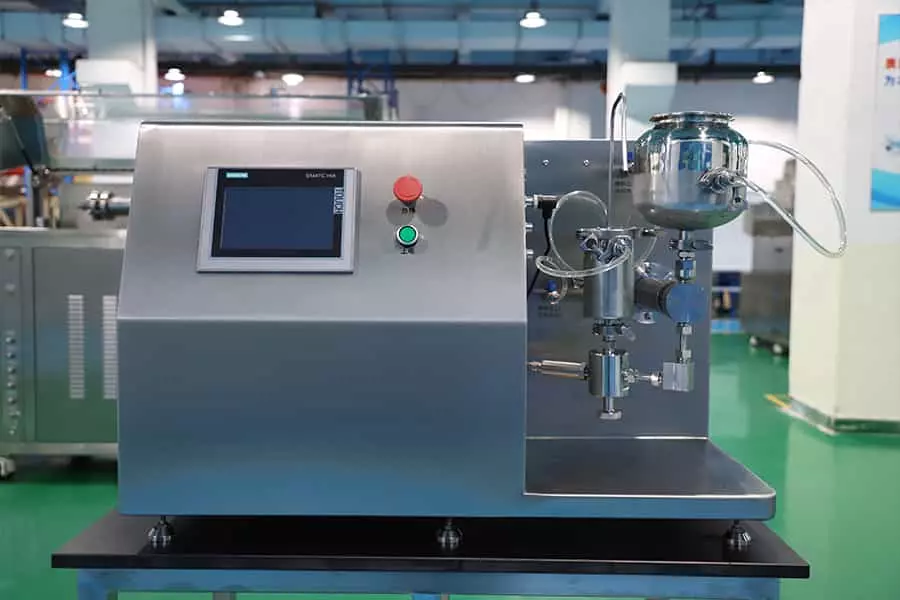
- Laboratory Scale (HPW-10): Designed for validating graphene exfoliation and dispersion processes during the R&D stage.
- Pilot Scale (HPW-250): Bridges laboratory research and mass production, enabling scale-up validation.
- Production Scale (HPW-500): Supports high-volume continuous production to meet industrial manufacturing requirements.
Key Advantages:
- Efficient Exfoliation: The synergistic effects of cavitation and shear forces enable physical exfoliation while minimizing damage to the material’s crystal structure.
- Contamination-Free Processing: A fully enclosed fluid pathway combined with a diamond interaction chamber helps eliminate metal contamination at the source.
- Controllable Particle Size: Precisely adjustable pressure enables uniform nanoscale dispersion with a narrow particle-size distribution.
- Scalable Process: All equipment models feature a unified 420 MPa design pressure, allowing process parameters developed at the laboratory scale to be transferred directly to pilot and production systems, reducing development time and trial-and-error cycles.
Service & Support:JUNJIE operates a dedicated Microfluidic Nano-Homogenization Materials Laboratory, providing customers with pre-sales process validation and sample testing services:
- Sample Testing & Process Validation: Customers can send their materials to JUNJIE. Application engineers evaluate the material and determine suitable pressure parameters and interaction chamber configurations, then provide particle-size distribution reports and process parameter recommendations.
- Process Scale-Up Data Transfer: Process parameters validated on laboratory-scale equipment can be transferred to pilot-scale systems for further scale-up validation, helping confirm the feasibility of linear process scaling from laboratory research to industrial production.
Conclusion
Graphene has strong potential as an advanced lubricant additive, but its performance depends heavily on dispersion quality. Microfluidic technology uses ultra-high pressure, engineered microchannels, intense shear, impact, and micro-mixing to achieve controlled deagglomeration and more uniform graphene dispersion, improving stability and process repeatability.
JUNJIE offers a comprehensive solution for graphene lubricant dispersion, using ultra-high-pressure microjet technology for efficient, pollution-free physical exfoliation and dispersion. With a full range of equipment and laboratory testing services, JUNJIE supports a smooth transition from R&D to pilot scale and mass production.