

The global biopharmaceutical industry is accelerating the development of nanomedicine and advanced drug delivery systems. As pharmaceutical researchers increasingly explore lipid nanoparticles, liposomes, nanoemulsions, nanocrystals, and polymeric nanoparticles, the ability to precisely control formulation properties has become increasingly important.
According to Coherent Market Insights, the global nanotechnology drug delivery market is estimated to reach approximately USD 108.08 billion in 2025 and is projected to reach USD 228.82 billion by 2032, representing a compound annual growth rate (CAGR) of 11.3% from 2025 to 2032.
This rapid market expansion is creating new requirements for pharmaceutical processing technologies. Researchers need manufacturing approaches that can deliver more consistent particle size, narrower particle size distribution, better dispersion uniformity, and improved process reproducibility while also providing a practical pathway from laboratory-scale formulation development to pilot and commercial production.
Microfluidic technology is emerging as a promising approach to address several of these processing challenges.
Challenges in Biopharmaceutical Nanoformulation Development
Nanomedicine offers significant opportunities for improving drug delivery. By engineering materials at the nanoscale, pharmaceutical developers can modify properties such as solubility, surface characteristics, circulation behavior, drug loading, and release profiles.
However, producing a nanoformulation with the desired characteristics is not simply a matter of reducing particles to a smaller size.
Particle size and particle size distribution can significantly affect the physical properties and performance of nano-enabled drug products. FDA notes that nanomaterial products require comprehensive characterization because properties such as particle size and size distribution can influence product quality and potentially affect safety and efficacy.
Several challenges commonly appear during formulation development:
- Inconsistent particle size between batches
- Broad particle size distribution
- Particle aggregation or agglomeration
- Formulation instability during storage
- Insufficient dispersion of active or functional ingredients
- Difficulty maintaining process parameters during scale-up
- Differences between laboratory and production-scale results
- Complex characterization and quality-control requirements
These challenges become particularly important for biopharmaceutical systems containing sensitive active ingredients, lipids, polymers, proteins, nucleic acids, or other functional components.
For developers, therefore, the objective is not simply to achieve nanoscale particles. The more important goal is to establish a repeatable and controllable process that consistently produces the required critical quality attributes.
How Microfluidic Technology Works
Microfluidic technology uses engineered microchannels to control the movement and interaction of fluids at a highly localized scale.
When a formulation passes through a microfluidic device, carefully designed flow channels can generate controlled shear, collision, turbulence, and mixing effects. These interactions can promote particle size reduction, improve dispersion, and facilitate more uniform processing.
Compared with conventional mixing technologies, microfluidic processing provides a more controlled environment for manipulating fluid flow. The geometry of the interaction channel, pressure, flow conditions, formulation composition, and processing parameters can all influence the resulting particle characteristics.
A microfluidic homogenizer applies this principle to high-pressure processing. Under elevated pressure, the formulation is forced through a specialized interaction chamber or microchannel. The resulting high-speed fluid interaction can produce intense energy dissipation and controlled particle disruption.
This makes microfluidic homogenization particularly relevant to formulations where particle size and dispersion uniformity are important process parameters.
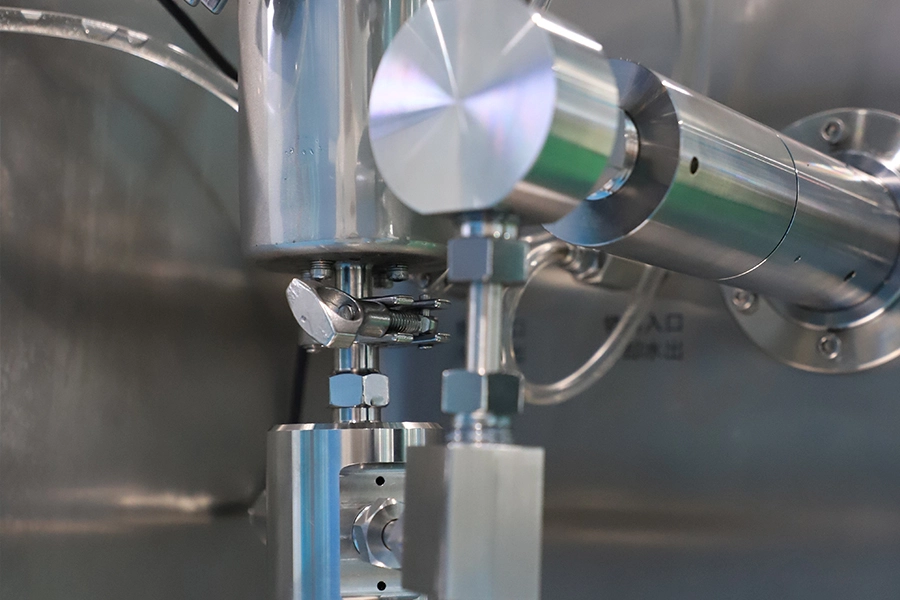
Microfluidic Homogenization for Nanomedicine
Microfluidic homogenization can support the development of several types of nanoformulations used in pharmaceutical and biopharmaceutical research.
Lipid Nanoparticles
Lipid nanoparticles (LNPs) have become an important platform for delivering nucleic acids and other therapeutic payloads.
The performance of an LNP formulation can depend on particle size, size distribution, morphology, lipid composition, surface characteristics, and encapsulation efficiency. Consistent processing conditions are therefore important during formulation development and process optimization.
Microfluidic processing can provide controlled fluid interactions that help researchers develop reproducible nanoscale dispersions and evaluate how processing parameters influence formulation characteristics.
Liposomes
Liposomes are another established nanocarrier platform used to encapsulate and deliver active pharmaceutical ingredients.
FDA specifically identifies liposomes and other nanomaterial-containing drug products as requiring appropriate characterization and quality controls. Properties such as particle size, size distribution, morphology, lipid composition, and encapsulated drug characteristics can be relevant to product quality.
Microfluidic homogenization can be incorporated into liposome processing workflows where controlled particle-size reduction and dispersion are required.
Nanoemulsions
Nanoemulsions are widely investigated for improving the delivery of poorly water-soluble compounds and other active ingredients.
Their stability can be influenced by droplet size, size distribution, interfacial properties, formulation composition, and processing conditions. High-pressure microfluidic processing can generate intense fluid interactions that promote droplet disruption and more uniform dispersion.
This makes microfluidic homogenizers useful for formulation screening and optimization of nanoemulsion-based drug delivery systems.
Polymeric Nanoparticles and Nanocrystals
Microfluidic processing can also be explored for polymeric nanoparticles, nanosuspensions, nanocrystals, and other particulate drug delivery systems.
For these systems, controlling particle characteristics can help researchers investigate relationships between formulation parameters and properties such as dissolution, dispersion stability, drug loading, and release behavior.
Importantly, microfluidic homogenization should be viewed as a process-enabling technology, rather than a standalone solution for every formulation challenge. The final performance of a nanoformulation depends on the active ingredient, excipients, formulation composition, processing conditions, and downstream manufacturing steps.
Improving Reproducibility During Formulation Development
One of the key advantages of microfluidic technology is process controllability.
In conventional laboratory mixing, changes in vessel geometry, mixing speed, batch volume, and operating conditions can influence the final formulation. These variables can become more difficult to control as batch size increases.
Microfluidic systems approach the problem differently by defining fluid interactions through engineered channel geometries and controlled operating conditions.
This can help researchers establish a clearer relationship between:
Process Parameters → Particle Characteristics → Formulation Performance
For example, researchers can systematically investigate how pressure, flow conditions, formulation composition, and processing passes affect particle size and distribution.
Such process understanding can be valuable when developing a robust formulation and identifying critical process parameters.
Supporting Scale-Up from Laboratory to Production
Scale-up remains one of the most important challenges in nanomedicine manufacturing.
A formulation that performs well at laboratory scale may not behave identically when transferred to a larger production system. Changes in mixing conditions, energy input, residence time, and equipment configuration can affect the final product.
FDA specifically highlights that nanomaterials may be sensitive to process conditions and scale-up, making it important for manufacturers to identify critical quality attributes and establish appropriate process controls.
A microfluidic processing platform can help address this challenge when the equipment architecture allows process parameters to be transferred systematically between scales.
Instead of completely redesigning the process for every production volume, manufacturers can seek to maintain key parameters such as pressure, flow conditions, and interaction geometry.
This approach can help create a more predictable transition from:
Laboratory Research → Pilot Development → Commercial Manufacturing
The ability to maintain comparable process conditions is particularly valuable for pharmaceutical companies seeking to reduce development time and minimize unexpected changes during scale-up.
From Particle Size Reduction to Process Control
The value of microfluidic homogenization extends beyond simply reducing particle size.
Modern nanomedicine development increasingly emphasizes quality by design, process understanding, and control of critical quality attributes. Particle size is only one component of this broader framework.
Depending on the formulation, researchers may also evaluate:
- Particle size distribution
- Polydispersity
- Zeta potential
- Morphology
- Encapsulation efficiency
- Drug loading
- Physical stability
- Chemical stability
- Aggregation behavior
- Release characteristics
Microfluidic processing can provide a controllable processing environment that helps researchers investigate how manufacturing parameters influence these formulation characteristics.
This process-focused approach is consistent with the broader regulatory emphasis on understanding the relationship between nanomaterial properties, product quality, and performance. FDA guidance states that drug products containing nanomaterials should be evaluated with consideration of characterization, controls, testing, and qualification of relevant nanomaterial components.
Growing Commercialization of Nanomedicine
The increasing number of nano-enabled pharmaceutical products reaching the market further demonstrates the importance of scalable manufacturing technologies.
A recent review reported that approximately 91 nano-based products had been approved and reached the market by 2025. These products include different platforms such as protein nanoparticles, polymeric systems, polymeric micelles, nanogels, nanocrystals, and nanoemulsions.
This commercialization trend creates a growing need for manufacturing processes that are not only effective in laboratory research but can also meet requirements for reproducibility, quality control, process validation, and scale-up.
For pharmaceutical and biotechnology companies, equipment selection therefore becomes an important part of process development strategy.
The ideal processing platform should support formulation experimentation at early development stages while providing a realistic path toward pilot and commercial manufacturing.
JUNJIE Microfluidic Devices for Biopharmaceutical Applications
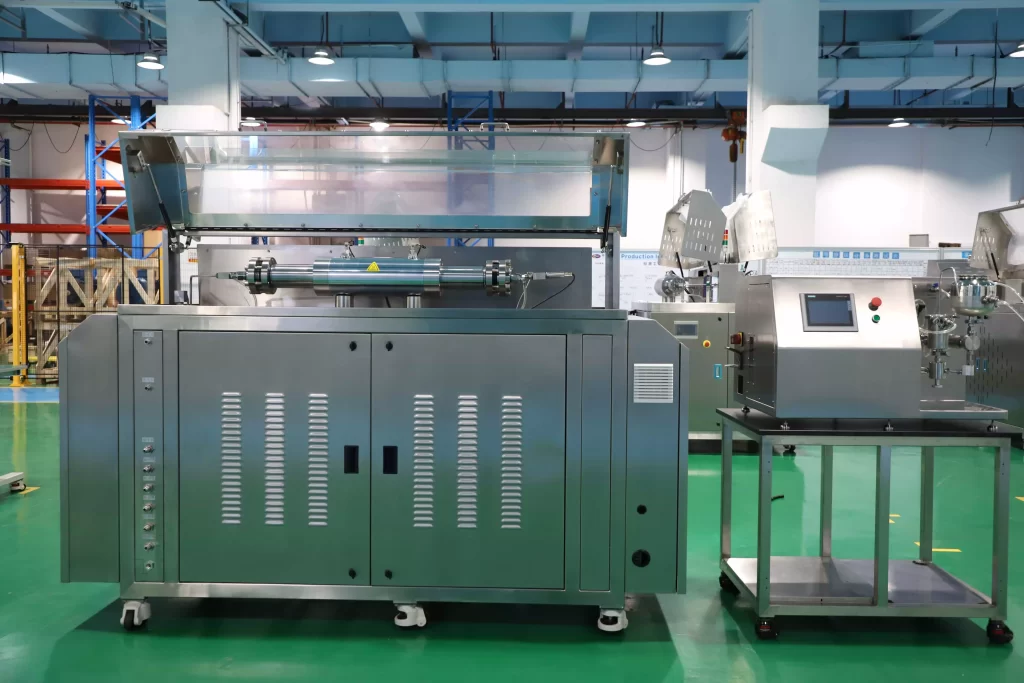
JUNJIE specializes in high-pressure microfluidic technology and provides microfluidic devices designed for particle-size reduction, dispersion, emulsification, and nanoformulation processing.
The company integrates R&D, manufacturing, sales, and technical service, with core components—including the pressure intensifier, homogenization valve, and diamond interaction chamber—developed and manufactured in-house.
JUNJIE equipment is designed to operate at pressures of up to 420 MPa, providing a high-pressure processing platform for demanding formulation applications.
Its microfluidic homogenizer product line covers different processing scales, including:
- HPW-10L – laboratory-scale processing
- HPW-250L – pilot-scale processing
- HPW-500L – production-scale processing
This equipment configuration is designed to support the systematic transfer of process parameters from laboratory research to pilot development and larger-scale production.
For pharmaceutical and biotechnology researchers, this scale-oriented approach can simplify process development by allowing formulation parameters established during early-stage experiments to serve as a foundation for subsequent scale-up studies.
JUNJIE provides process support across university research, biopharmaceuticals, new materials, new energy, food, and chemical applications, covering the development cycle from sample testing and formulation evaluation to larger-scale production.
A More Controllable Path for Next-Generation Nanoformulations
As nanomedicine moves from laboratory research toward broader commercialization, the challenges facing pharmaceutical developers are becoming increasingly process-oriented.
The ability to create nanoscale particles is no longer sufficient by itself. Developers need to understand how particle characteristics are generated, how those characteristics influence formulation performance, and how the process can be reproduced consistently at larger scales.
Microfluidic technology offers a potential solution by providing controlled fluid interactions, defined processing environments, and scalable equipment architectures.
For lipid nanoparticles, liposomes, nanoemulsions, polymeric nanoparticles, nanocrystals, and other nanoformulations, microfluidic homogenization can support particle-size control, dispersion uniformity, formulation optimization, and process reproducibility.
At the same time, it is important to recognize that equipment alone does not determine final drug-product quality. Formulation composition, raw-material quality, process parameters, downstream processing, analytical characterization, and regulatory requirements must all be considered as part of an integrated development strategy.
As demand for targeted delivery, biologics, gene-based therapies, and other advanced pharmaceutical products continues to increase, process technologies that improve control and scalability will become increasingly important.
Microfluidic homogenization is therefore positioned not merely as a particle-processing technology, but as an enabling platform for building more reproducible and scalable nanomedicine development processes.