
Table of Contents
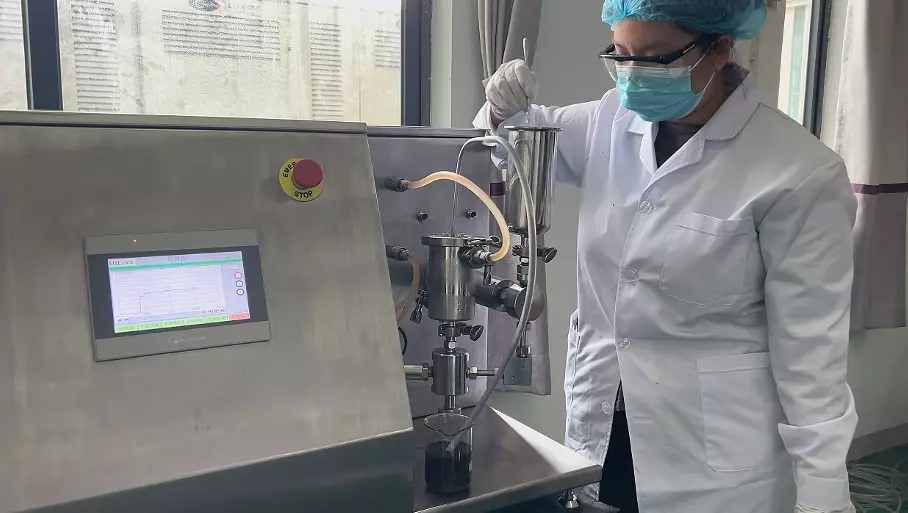
As all-solid-state batteries move from laboratory research toward pilot production and commercial scale-up, manufacturers face a critical challenge: translating promising material performance into consistent, repeatable manufacturing processes. Beyond selecting the right electrolyte chemistry, achieving stable slurry dispersion is essential for downstream coating, layer formation, and battery consistency. Microfluidic nano-homogenization technology offers a potential approach to improving particle dispersion and evaluating process parameters before production scale-up.
Why Is Solid-State Electrolyte Slurry Difficult to Disperse?
Common solid-state electrolyte systems include sulfide-based, oxide-based, polymer-based, and composite electrolytes. Although these materials differ in composition and processing requirements, they can share a common challenge during slurry preparation: fine particles with high specific surface areas tend to agglomerate.
Even when the primary particle size is sufficiently small, particles may form secondary agglomerates in liquid media if the dispersant, solvent system, solids loading, and processing conditions are not properly matched. An acceptable D50 value alone does not guarantee a satisfactory particle size distribution, as larger particles or agglomerates may remain in the D90 or D99 range.
These agglomerates can affect coating uniformity, electrolyte layer density, and interfacial contact, potentially compromising battery consistency and stability. Therefore, evaluating electrolyte slurry dispersion requires more than simply reducing particle size. Particle size distribution, polydispersity index (PDI), viscosity, sedimentation behavior, and storage stability should also be considered.
What Can Microfluidic Nano-Homogenization Technology Achieve?
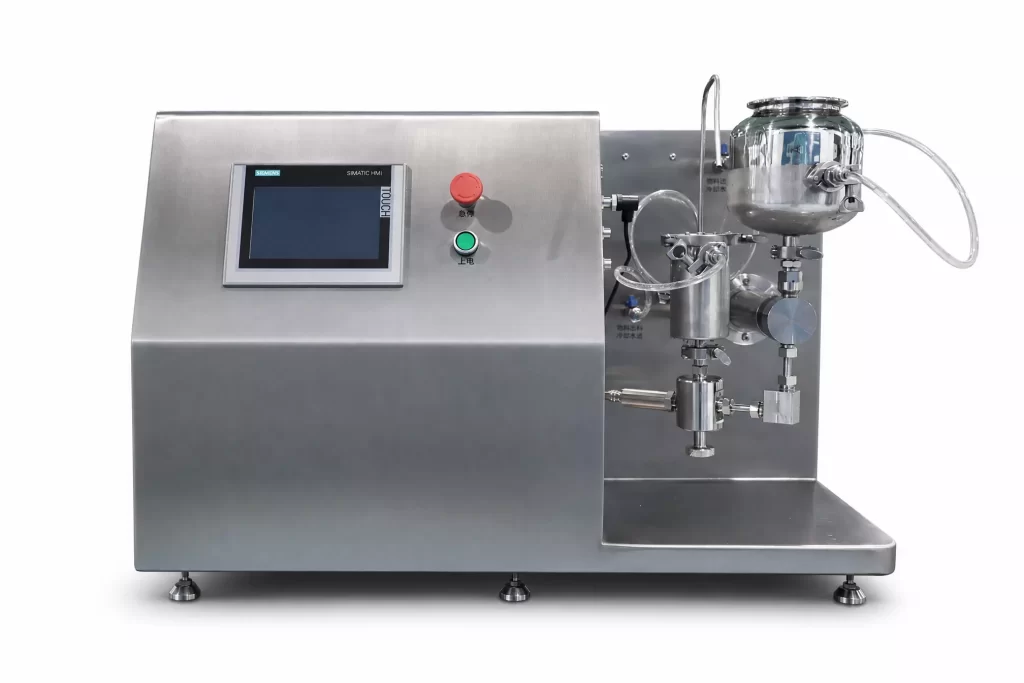
Microfluidic nano-homogenization technology uses high-pressure processing to generate intense shear, impact, turbulence, and, depending on operating conditions, cavitation. These forces can help break down secondary agglomerates and improve particle distribution within a slurry.
Compared with conventional stirring and some traditional dispersion methods, a properly configured microfluidic homogenizer may offer advantages for formulations requiring tighter particle size distributions and more consistent dispersion.
For solid-state battery electrolyte slurries, its potential value can be evaluated in three key areas.
1. Breaking down secondary agglomerates
High-pressure processing can help reduce agglomeration and control the coarse-particle tail of the size distribution, depending on the material and formulation.
2. Improving dispersion uniformity
More uniform particle distribution may provide a more consistent starting point for downstream coating and layer formation. Actual improvements should be verified through particle size analysis and application-specific testing.
3. Establishing a suitable process window
By testing different pressures, processing cycles, and temperature-control strategies, manufacturers can identify conditions that balance dispersion performance with material stability and process requirements.
However, higher pressure does not necessarily produce better results. Some solid-state electrolyte materials are sensitive to moisture, oxygen, temperature increases, or excessive mechanical stress. Process development must therefore account for electrolyte chemistry, solvent compatibility, solids loading, viscosity, environmental controls, and temperature limits.
Why Is Small-Scale Process Validation Necessary Before Scale-Up?
Solid-state battery slurries vary significantly in their processing requirements, depending on the electrolyte chemistry and formulation.
- Sulfide-based electrolytes: Moisture sensitivity and the need for controlled processing environments may be critical considerations.
- Oxide-based electrolytes: Hard agglomerates, coarse particles, and the mechanical characteristics of the powder may require particular attention.
- Polymer-based and composite electrolytes: Dispersion uniformity must be balanced with viscosity, flow behavior, and coating compatibility.
For these reasons, choosing a microfluidic homogenizer or evaluating microfluidic homogenizer manufacturer should involve more than comparing maximum operating pressure or equipment specifications. The manufacturer’s ability to conduct sample testing, optimize parameters, and provide reproducible process data is equally important.
A practical validation program should compare the slurry before and after treatment using several indicators:
- D50, D90, and, where appropriate, D99 particle size distribution
- PDI and dispersion uniformity
- Viscosity and flow behavior
- Sedimentation and storage stability
- Coating performance and layer uniformity
- Particle size rebound or re-agglomeration after storage
These measurements help determine whether a dispersion process delivers meaningful improvements and whether those improvements can be maintained under relevant production conditions.
Scale-up should also consider throughput, temperature control, material compatibility, cleaning requirements, and the repeatability of operating parameters. Laboratory results provide a starting point, but pilot-scale validation is necessary before drawing conclusions about commercial production performance.
JUNJIE Microfluidic Nano-Homogenization Technology for Solid-State Battery Slurry Testing
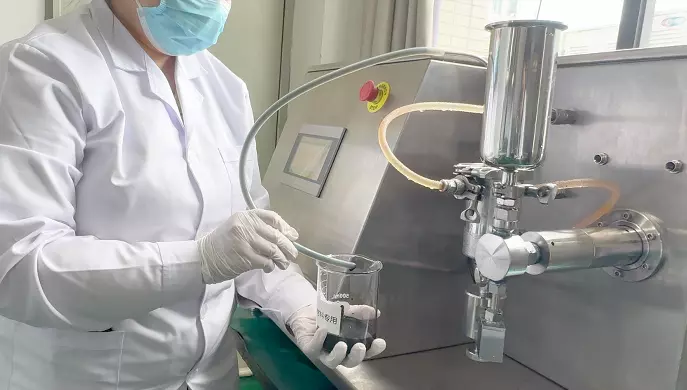
JUNJIE provides sample testing and process parameter validation for solid-state battery electrolyte slurries, conductive slurries, and nanoceramic suspensions.
Based on each customer’s material chemistry, solvent system, solids loading, viscosity, target particle size, and temperature requirements, JUNJIE can develop comparative test plans involving different pressure settings, processing cycles, and operating conditions.
Testing can be used to evaluate changes in particle size distribution, viscosity, sedimentation behavior, and application performance. These results help customers assess the suitability of microfluidic nano-homogenization technology for their specific formulations and identify conditions for further pilot-scale validation.
As a supplier of high-pressure microfluidic homogenization equipment, JUNJIE focuses not only on equipment performance but also on the practical requirements of precision dispersion, process repeatability, and application-specific verification.
Conclusion: Turning Dispersion Performance into a Scalable Manufacturing Process
As solid-state batteries progress toward industrialization, reliable slurry preparation will be an important part of translating advanced electrolyte materials into repeatable manufacturing processes. Microfluidic nano-homogenization technology provides a potential route for controlling agglomeration, improving dispersion uniformity, and establishing suitable processing conditions—but its effectiveness must be demonstrated for each material system.
For battery manufacturers, the next step is not simply to select a high-pressure microfluidic homogenizer based on its maximum pressure rating. It is to validate particle size distribution, rheological behavior, storage stability, and coating performance using representative samples before committing to scale-up.
JUNJIE supports this process through sample testing and parameter evaluation, helping customers move from initial dispersion trials toward evidence-based process development and pilot-scale verification.