
Table of Contents
In advanced materials, new energy, semiconductor chemical mechanical planarization (CMP) slurries, lipid nanoparticles (LNPs) for biopharmaceutical applications, advanced ceramic slurries, and cosmetic emulsions, dispersion technology plays a critical role in determining particle size distribution, material purity, formulation stability, functional activity, and manufacturing yield.
Four widely used approaches for nanoscale dispersion are ultrasonication, ball milling, bead milling, and high-pressure microfluidization.
R&D and manufacturing teams often encounter a common challenge: a formulation performs well during laboratory trials but becomes unstable during pilot-scale testing or mass production. Common issues include particle agglomeration, contamination, broad particle size distributions, loss of biological activity, and batch-to-batch variability. These problems often arise when the selected process is poorly matched to the material, when inherent process limitations are overlooked, or when laboratory results are assumed to translate directly to industrial production.
This article compares the four technologies across seven dimensions: operating principles, particle size performance, material purity, functional activity retention, cost, scalability, and application suitability. Drawing on common industry challenges and JUNJIE’s media-free microfluidic nano-homogenization technology, it provides a practical framework for selecting dispersion processes for research, development, and industrial manufacturing.
How the Four Nano-Dispersion Technologies Work
Each technology relies on a different physical mechanism. Understanding these mechanisms is essential for evaluating performance, limitations, and suitability for specific materials.
Ultrasonic Dispersion
Ultrasonic dispersion uses acoustic cavitation in liquids. High-frequency sound waves generate microscopic bubbles that grow and collapse, producing localized shear forces and pressure fluctuations that can break up soft particle agglomerates.
Because it does not require grinding media, ultrasonication can minimize contamination from milling media and is useful for preliminary laboratory dispersion. However, its performance can be limited for highly viscous formulations, high-solids slurries, and strongly bonded agglomerates. Prolonged treatment may also cause heating or damage sensitive materials.
Ball Milling
Ball milling relies on the impact, friction, and shear generated by grinding balls moving inside a milling chamber. These mechanical forces break down agglomerates and can reduce particle size through repeated collisions.
It is a well-established media-based grinding technology for powder processing. However, long processing times, wear of grinding media and chamber surfaces, and potentially broad particle size distributions can present challenges for high-purity or highly sensitive applications.
Bead Milling
Bead milling, also known as sand milling in some industrial contexts, uses small grinding beads—often zirconia—to generate intensive shear and repeated collisions within a liquid suspension.
Compared with conventional ball milling, smaller beads provide more frequent contact events and can improve dispersion efficiency for many industrial slurries. Bead milling is widely used in coatings, pigments, and chemical formulations. Its limitations may include bead wear, contamination risks, heat generation, and difficulty achieving the narrow particle size distributions required by certain advanced applications.
High-Pressure Microfluidization: JUNJIE Microfluidic Technology
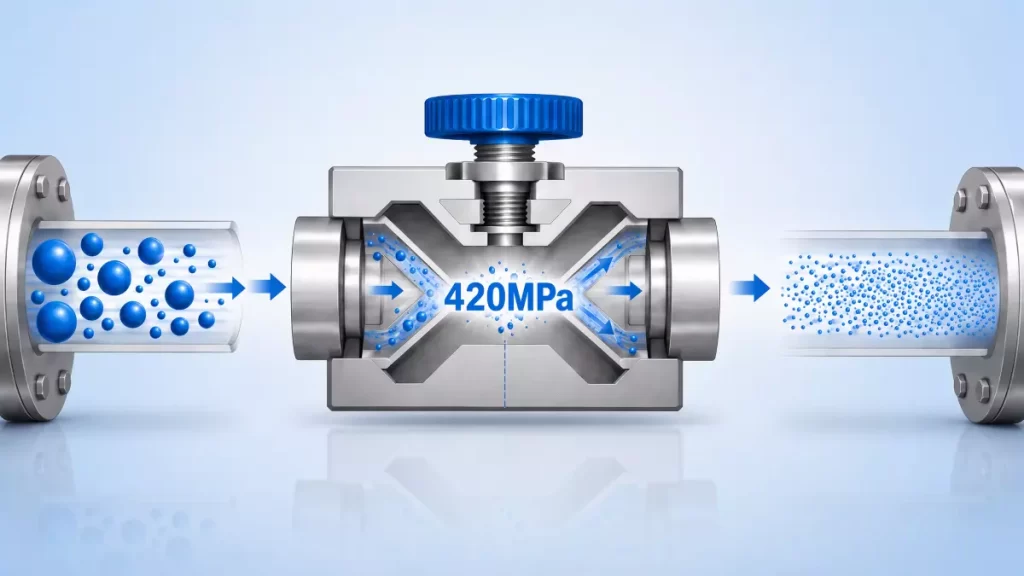
High-pressure microfluidization uses controlled fluid forces rather than grinding media to process materials. The formulation is pressurized and driven through specially engineered interaction chambers, where high-velocity flow generates intense shear, particle collisions, and cavitation-related effects.
JUNJIE microfluidic nano-homogenization technology uses proprietary diamond interaction chambers with engineered flow channels. Depending on the model and application, operating pressures can reach 420 MPa (approximately 60,000 psi). The combination of controlled flow and repeated interactions helps disrupt agglomerates, refine dispersions, and improve formulation uniformity without conventional grinding beads.
The resulting particle size and distribution depend on the formulation, initial particle characteristics, processing pressure, number of passes, and chamber configuration. Application-specific trials are essential to establish the appropriate operating window.
Comprehensive Comparison of the Four Technologies
Particle Size Reduction and Distribution
Ultrasonic dispersion: Often effective for breaking up soft agglomerates and preparing small laboratory samples. Results depend on the material, energy input, probe geometry, and processing time. Achieving consistently narrow nanoscale distributions can be challenging for strongly agglomerated or complex formulations.
Ball milling: Can reduce particle size through repeated mechanical impacts and friction. However, the final distribution may contain both fine particles and larger residual particles, particularly when the material is difficult to grind or the process is not optimized.
Bead milling: Often offers better dispersion efficiency and finer particle sizes than conventional ball milling for suitable liquid formulations. Nevertheless, particle size distribution and residual coarse particles remain dependent on bead size, formulation properties, equipment configuration, and processing conditions.
Microfluidic processing: High-pressure microfluidization can provide controlled, repeatable fluid processing for particle deagglomeration and size reduction. With an appropriately selected interaction chamber and optimized processing parameters, it can help narrow particle size distributions and control metrics such as D50, D90, D99, and polydispersity index (PDI). Actual performance must be verified through particle size analysis for each formulation.
Material Purity and Contamination Control
Ultrasonic dispersion: Avoids grinding-media wear and can be suitable for high-purity laboratory samples. However, probe-based systems may introduce contamination through probe erosion, while other wetted components can also contribute impurities. High-solids or highly viscous materials may present additional processing challenges.
Ball and bead milling: Repeated mechanical contact can wear grinding media and chamber surfaces, potentially releasing particles or metal ions into the formulation. Depending on the materials and contamination limits, this can be a concern for semiconductor CMP slurries, biopharmaceutical formulations, and high-purity advanced materials.
Microfluidic processing: Media-free processing eliminates the need for conventional grinding beads, reducing contamination risks associated with bead wear. JUNJIE’s engineered diamond interaction chambers are designed for demanding applications where purity and process consistency are important. Actual contamination performance depends on the complete wetted flow path, seals, fittings, materials, and maintenance practices; media-free processing alone does not guarantee zero contamination.
Functional Activity and Structural Preservation
Ultrasonic dispersion: Localized heating, cavitation, and high shear can affect sensitive materials. Excessive energy input or prolonged processing may damage certain polymers, biological molecules, or delicate structures.
Ball and bead milling: Mechanical impacts, friction, and heat can alter crystal structures, damage layered materials, or affect sensitive biological components. The extent of damage depends on the material, grinding intensity, temperature, and exposure time.
Microfluidic processing: Controlled high-pressure fluid interactions offer an alternative to prolonged media-based grinding. For suitable formulations, process optimization can help balance dispersion efficiency with preservation of biological activity, molecular structure, or functional properties. LNP formulations, mRNA-related materials, graphene dispersions, and battery slurries may benefit from application-specific evaluation. Pressure and shear can still affect sensitive materials, so activity retention must be measured rather than assumed.
Process Stability and Batch-to-Batch Consistency
Ultrasonic, ball milling, and bead milling: Reproducibility depends on equipment configuration, energy input, media condition, temperature, processing time, and material loading. Changes in probe condition, grinding-media wear, or operating parameters may influence the final dispersion.
Microfluidic processing: Engineered interaction chambers and controlled operating parameters can support repeatable processing conditions. JUNJIE systems combine defined flow-path geometry with pressure control to improve process consistency. Reproducibility still depends on formulation preparation, temperature management, flow rate, number of passes, equipment maintenance, and quality control.
For high-value applications, batch consistency should be demonstrated through validated process parameters and analytical measurements rather than inferred from equipment design alone.
Scalability: From Laboratory Trials to Industrial Production
Ultrasonic dispersion: Particularly useful for small-scale formulation screening and laboratory sample preparation. Scaling up may require changes in probe geometry, power density, vessel design, and cooling, which can make direct transfer of laboratory conditions difficult.
Ball and bead milling: Both technologies can be used in industrial production, but scale-up requires careful optimization of media size, energy input, residence time, cooling, and material circulation. A process that works in a small unit may require substantial adjustment when transferred to larger equipment.
Microfluidic processing: Scale-up can be supported by maintaining comparable processing principles and carefully controlling pressure, flow, chamber geometry, and the number of passes. JUNJIE’s high pressure microfluidizer portfolio is designed to support laboratory research, pilot testing, and industrial processing using related core technology. Transferability must be confirmed for each formulation and equipment configuration; identical or similar hardware does not automatically guarantee identical results at every scale.
Processing Efficiency and Total Production Cost
Ultrasonic dispersion: Convenient for preliminary laboratory work but may be inefficient for larger volumes or difficult formulations. Processing time, energy consumption, and cooling requirements can increase as the process becomes more demanding.
Ball milling: May require hours or longer for certain materials. Energy consumption, grinding-media replacement, equipment maintenance, and downstream separation can contribute to total production costs.
Bead milling: Often improves throughput relative to conventional ball milling for suitable slurries. However, grinding-media consumption, wear-related maintenance, cooling, filtration, and contamination control may add operating costs.
Microfluidic processing: Can reduce reliance on grinding consumables and simplify certain downstream operations. Processing time and energy consumption depend on the material, throughput, operating pressure, and number of passes. JUNJIE high pressure microfluidizer may offer efficiency advantages in suitable applications, but total cost should be assessed using measured throughput, energy consumption, maintenance requirements, yield, and product quality.
Which Nano-Dispersion Technology Is Best for Your Application?
The best process depends on the target particle size, acceptable contamination levels, material sensitivity, viscosity, solids content, production volume, and total cost requirements.
Ultrasonic Dispersion: Preliminary Laboratory Preparation
Best suited for small-volume experiments, low-viscosity liquids, and initial formulation screening where breaking up soft agglomerates is sufficient.
It is generally less suitable as a stand-alone solution when strongly bonded agglomerates, highly concentrated slurries, tightly controlled nanoscale distributions, or high-throughput manufacturing are required.
Ball Milling: Conventional Powder Grinding
Suitable for conventional powder grinding and applications where the required particle size, purity, and functional performance can be achieved economically through mechanical milling.
For semiconductor, biopharmaceutical, battery, and other high-purity applications, material compatibility and contamination limits should be carefully assessed before selecting a milling process.
Bead Milling: Industrial Dispersion of Conventional Slurries
Widely used for paints, coatings, pigments, and many chemical formulations that require efficient particle size reduction and dispersion at industrial scale.
For demanding advanced materials, manufacturers should evaluate whether bead wear, contamination risk, temperature rise, and achievable particle size distribution meet the product’s specifications.
Microfluidic Nano-Homogenization: An Option for Advanced Materials and Precision Formulations
Microfluidic processing is worth evaluating when manufacturers need controlled dispersion, reduced dependence on grinding media, repeatable processing conditions, or scalable formulation development.
Potential applications include:
- Biopharmaceuticals: LNP formulations, liposomes, and selected drug delivery systems.
- Semiconductors: CMP slurries and other high-purity dispersion systems.
- Advanced ceramics: Ceramic slurries for multilayer ceramic capacitors (MLCCs) and other precision components.
- New energy: Graphene dispersions, battery materials, and selected electrode or electrolyte formulations.
- Cosmetics: Selected active-ingredient emulsions, liposomes, and fine dispersions.
- Specialty chemicals: High-purity formulations requiring controlled particle size and dispersion stability.
JUNJIE’s microfluidic nano-homogenization technology is designed to support research and production across these demanding applications. Suitability should be established through material-specific testing, particularly where biological activity, chemical compatibility, particle integrity, or strict contamination limits are involved.
Common Mistakes When Selecting a Nano-Dispersion Process
Mistake 1: Assuming Bead Milling Can Meet Every High-Purity Dispersion Requirement
Bead milling is an effective industrial technology, but media wear and particle size distribution can present challenges for applications with stringent purity and consistency requirements. Evaluate contamination limits, particle size specifications, and downstream quality requirements before choosing a process.
Mistake 2: Assuming Successful Ultrasonic Trials Guarantee Production-Scale Performance
Laboratory ultrasonication can be useful for initial formulation screening, but larger-scale processing may introduce differences in energy distribution, temperature control, and treatment uniformity. Pilot-scale validation is essential before committing to industrial production.
Mistake 3: Assuming Higher Pressure Always Produces Better Dispersion
Higher pressure does not automatically produce better results. Excessive processing intensity may damage sensitive materials, change particle structures, or increase energy consumption. The optimal operating window depends on the formulation, target particle size, and functional requirements.
JUNJIE microfluidic systems allow processing parameters to be adjusted for different applications, helping manufacturers balance dispersion performance, material integrity, and operating efficiency.
Mistake 4: Ignoring D99 and the Coarse-Particle Tail
D50 alone does not fully describe a particle size distribution. Even when the median particle size meets specifications, a small fraction of oversized particles may affect product stability or downstream performance.
For example, coarse particles or agglomerates in CMP slurries may contribute to surface defects under certain processing conditions. Manufacturers should evaluate D90, D99, distribution width, and other application-specific quality indicators alongside D50.
Microfluidic processing can help control the overall particle size distribution when the material and process are appropriately optimized. Analytical verification remains essential.
Conclusion: Microfluidic Nano-Homogenization for Advanced Manufacturing
Ultrasonication, ball milling, bead milling, and high-pressure microfluidization each have distinct advantages and limitations. No single technology is universally optimal for every material or production requirement. Ultrasonication is useful for preliminary laboratory work, ball milling for conventional powder grinding, and bead milling for many industrial slurry applications. High-pressure microfluidization offers an additional option for formulations requiring controlled dispersion, reduced reliance on grinding media, and a structured path from laboratory development to industrial production.
JUNJIE’s microfluidic nano-homogenization technology combines media-free fluid processing, engineered diamond interaction chambers, adjustable pressure control, and a product portfolio designed for different production scales. These capabilities make it worth evaluating for high-purity advanced materials, semiconductor CMP slurries, biopharmaceutical formulations, advanced ceramics, battery materials, and selected cosmetic applications.
From laboratory experiments and pilot-scale validation to industrial manufacturing, the right process should be selected based on measurable particle size results, contamination limits, functional performance, reproducibility, and total cost of ownership.