
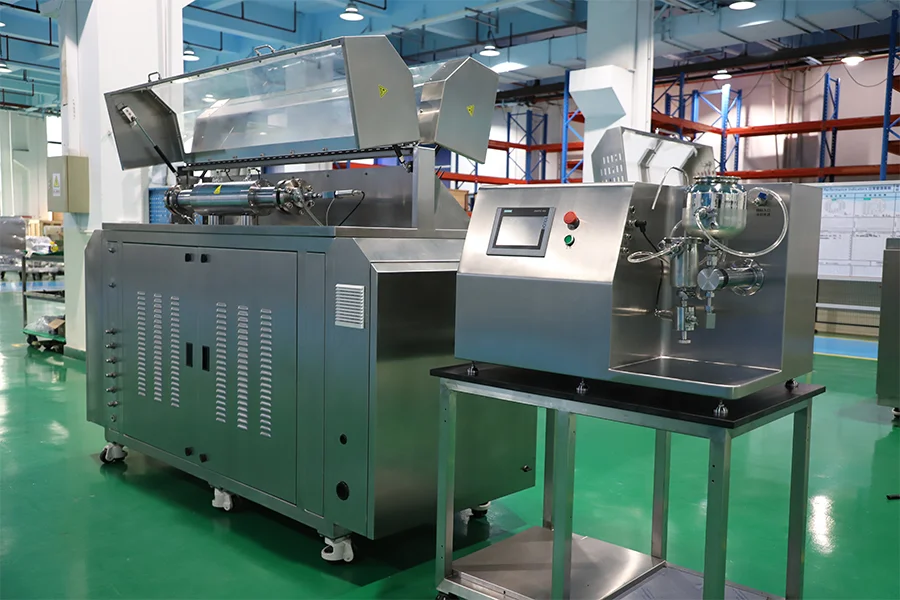
In industries driven by nanotechnology, advanced materials, biotechnology, pharmaceuticals, and food innovation, achieving precise particle size control and stable dispersion has become a critical requirement. A microfluidizer provides an advanced solution by using extremely high shear forces, impact forces, and cavitation effects to break down particles and droplets into nanoscale structures.
However, when selecting a microfluidic processing system, many researchers and manufacturers face a key decision:
Should you choose a laboratory microfluidizer or an industrial microfluidizer?
Although both systems are based on the same microfluidic homogenization principle, they are designed for completely different production goals. Laboratory models focus on research, formulation development, and small-volume experiments, while industrial models are engineered for continuous operation, high throughput, and commercial-scale production.
Understanding the differences between these two types of equipment helps companies avoid unnecessary investment and select the right high pressure homogenization equipment for their specific application.
Laboratory Microfluidizer: Designed for Research and Development
A laboratory microfluidizer is mainly designed for universities, research institutes, and product development teams.
Its primary purpose is to help engineers and scientists:
- Develop new formulations
- Optimize processing parameters
- Evaluate material behavior
- Conduct small-batch experiments
- Validate production feasibility
Key Features of Laboratory Models
Small Processing Volume
Laboratory microfluidizers are specifically designed for small-volume processing, making them ideal for early-stage research, formulation development, and proof-of-concept studies. Researchers can efficiently evaluate different materials and processing conditions while minimizing the consumption of expensive raw materials. This enables faster experimentation and reduces development costs during the R&D phase.
Flexible Parameter Adjustment
One of the greatest advantages of laboratory models is their flexibility in process optimization. Users can precisely adjust processing pressure, flow rate, number of passes, and temperature conditions to evaluate how each parameter affects particle size, dispersion uniformity, and product stability. This level of control helps researchers establish the optimal process before scaling up to industrial production.
Compact Design and Lower Investment
Compared with industrial systems, laboratory microfluidizers feature a compact footprint, lower power consumption, and reduced operating costs. They require minimal installation space and can be easily integrated into research laboratories or pilot facilities. Their affordable investment makes them an excellent choice for universities, research institutes, startups, and companies developing new products.
Reliable Scale-Up Foundation
A laboratory microfluidizer is not only a research tool but also the first step toward commercial manufacturing. By generating accurate processing data and validating formulation performance under controlled conditions, laboratory equipment provides a reliable foundation for pilot-scale testing and industrial production. This significantly reduces scale-up risks while ensuring process consistency as production capacity increases.
Industrial Microfluidizer: Built for Commercial Production
An industrial microfluidizer is designed for companies that require stable, continuous, and large-scale manufacturing.
Unlike laboratory equipment, industrial systems must meet strict requirements for:
- Production capacity
- Long-term operation
- Process consistency
- Automation
- Maintenance efficiency
Industrial microfluidizers are commonly used in:
- Pharmaceutical manufacturing
- Large-scale nano material production
- Food and beverage processing
- Cosmetic manufacturing
- Battery material preparation
Key Advantages of Industrial Microfluidizers
High Throughput Production
Industrial microfluidizers are engineered for continuous, high-capacity processing, making them ideal for commercial manufacturing environments. Compared with laboratory systems, they can handle significantly larger batch sizes and higher flow rates while maintaining consistent processing performance. This enables manufacturers to increase production efficiency, reduce processing time, and meet growing market demand without compromising product quality.
Exceptional Process Consistency
Maintaining uniform product quality across every production batch is essential in industries such as pharmaceuticals, food processing, cosmetics, and advanced materials. Industrial microfluidizers provide precise pressure control and stable energy input, ensuring consistent particle size distribution, emulsion quality, and dispersion performance. This high level of repeatability helps manufacturers comply with strict quality standards and improve overall product reliability.
Intelligent Automation and Process Control
Modern industrial microfluidizers are equipped with advanced automation technologies, including PLC control systems, touchscreen interfaces, real-time process monitoring, and data recording functions. These intelligent features simplify equipment operation, reduce manual intervention, and enable manufacturers to monitor key processing parameters throughout production. As a result, production efficiency is improved while operational errors and downtime are minimized.
Long-Term Reliability and Scalability
Industrial microfluidizers are designed for demanding production environments that require continuous operation and long service life. Built with robust high-pressure components and durable interaction chambers, they deliver reliable performance even under intensive operating conditions. In addition to supporting current production needs, industrial systems can be customized and expanded as manufacturing capacity grows, providing a scalable solution for companies transitioning from pilot production to full-scale commercial manufacturing.
Lab vs Industrial Microfluidizer: Key Differences
| Comparison | Laboratory Microfluidizer | Industrial Microfluidizer |
|---|---|---|
| Main Purpose | Research and formulation development | Commercial production |
| Processing Volume | Small-scale | Medium to large-scale |
| Application Stage | R&D and validation | Mass manufacturing |
| Operation Mode | Batch processing | Continuous processing |
| Automation Level | Basic control | Advanced automation |
| Investment Level | Lower | Higher |
| Scalability | Limited | Designed for expansion |
| Maintenance Requirements | Simple | Industrial-grade service |
How to Choose the Right Microfluidizer
Selecting between laboratory and industrial equipment depends on several factors.
Consider Your Production Stage
Choose a Laboratory Microfluidizer If:
You are:
- Developing a new formulation
- Conducting scientific research
- Testing different materials
- Optimizing process parameters
A lab system allows rapid experimentation with minimal material consumption.
Choose an Industrial Microfluidizer If:
You are:
- Entering commercial production
- Scaling up an existing process
- Requiring consistent output
- Manufacturing large volumes
Industrial equipment provides the reliability needed for continuous manufacturing.
Evaluate Required Processing Capacity
Before purchasing equipment, consider:
- Daily production volume
- Target throughput
- Operating hours
- Future expansion plans
A common mistake is selecting equipment based only on current demand. Companies planning rapid growth should consider scalability from the beginning.
Analyze Material Characteristics
Different materials require different processing conditions.
Important factors include:
- Initial particle size
- Desired final particle size
- Material viscosity
- Temperature sensitivity
- Required stability
For example:
- Nanoparticle drug delivery systems may require extremely precise processing control.
- Battery materials may require strong dispersion capability.
- Food emulsions may prioritize stability and texture improvement.
A professional microfluidic homogenizer supplier can help optimize these parameters.
From Lab Innovation to Industrial Production
The ideal equipment strategy is not simply choosing between a lab or industrial model. Instead, companies should consider the complete development pathway:
Laboratory Research → Pilot Testing → Scale-Up Validation → Industrial Production
A well-designed microfluidic processing solution allows companies to maintain consistent results throughout every stage.
For emerging technologies such as nanomedicine, advanced materials, and next-generation food processing, this scalability is essential.
JUNJIE Microfluidizer: Your Trusted Partner from Lab Research to Commercial Production
Choosing a microfluidizer is not just about comparing specifications—it’s about selecting a complete solution that supports your entire journey from R&D to large-scale manufacturing.
If you’re looking for the right microfluidic homogenizer, JUNJIE Microfluidic Nano Homogenizers offer industry-leading capabilities designed for both laboratory research and industrial production:
- Unified design pressure across the entire product range, with a maximum design pressure of 420 MPa.
- Diamond interaction chambers are used as the core processing unit. The same channel geometry is maintained from laboratory models to industrial systems, enabling seamless linear scale-up of process parameters.
- Pressure control accuracy of ±0.8%, ensuring excellent batch-to-batch consistency.
- The HPW-10 laboratory model processes sample volumes as small as 5 mL, with a residual volume of less than 1 mL, making it ideal for high-value materials.
- Equipped with a standard cooling jacket and industrial chiller, providing precise temperature control within ±1°C.
- Supports touchscreen operation, automatic data logging, recipe management, and GMP/GLP-compliant data export for efficient process management and regulatory compliance.
Not sure whether your material is suitable for microfluidic processing?
JUNJIE offers free sample testing to help evaluate your application before investment. Simply send us your samples, and our experts will provide processing results and data-driven recommendations—so you can make decisions based on real performance, not assumptions.
Conclusion
Choosing between a laboratory and industrial microfluidizer depends on your application goals, production requirements, and future development plans.
A laboratory model is the right choice for research, experimentation, and formulation optimization. An industrial microfluidizer is designed for manufacturers requiring high throughput, automation, and stable commercial production.
By working with an experienced high pressure homogenizer manufacturer, companies can develop a complete microfluidic homogenization solution—from early laboratory testing to full-scale manufacturing.
The right equipment choice today can determine the efficiency, reliability, and scalability of your production tomorrow.