
Table of Contents
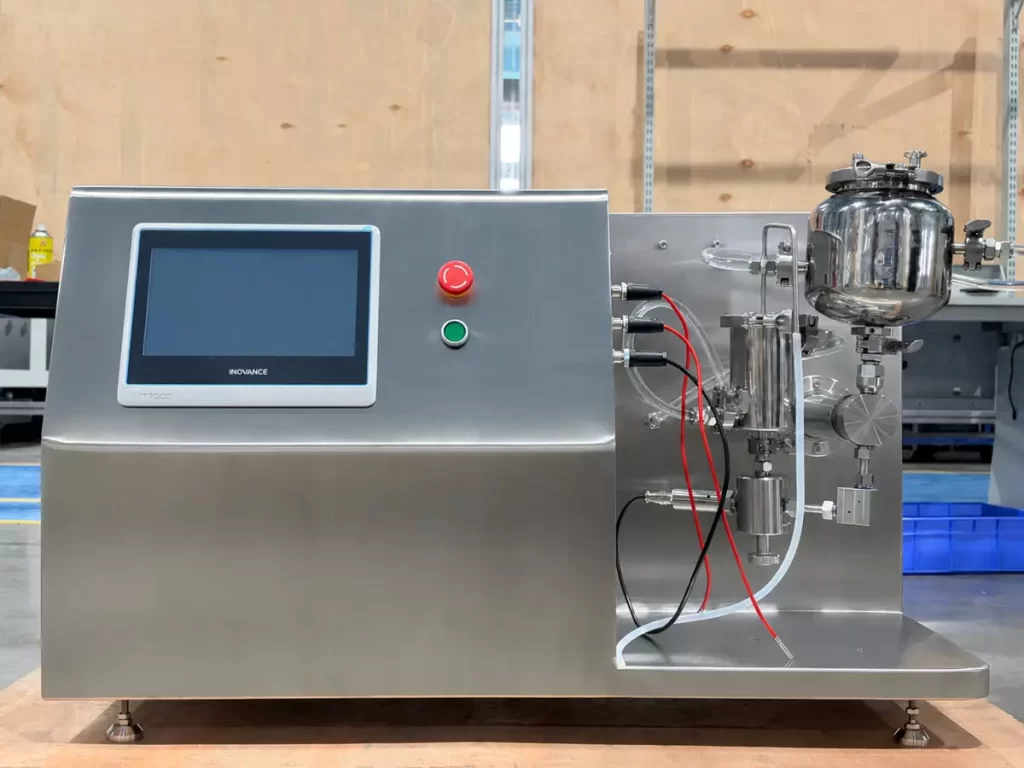
For university laboratories, pharmaceutical R&D centers, and new materials research institutes, a lab scale high pressure homogenizer is an essential fluid-processing tool for applications such as liposome preparation, cell disruption, graphene exfoliation, and nanoemulsion development.
When selecting laboratory homogenization equipment, many researchers focus only on the maximum pressure while overlooking five critical factors: minimum sample volume, pressure stability, interaction chamber design, temperature control, data traceability, and scale-up capability. Ignoring these factors can lead to sample loss, thermal degradation, inconsistent particle size, and difficulties transferring laboratory processes to pilot or production systems.
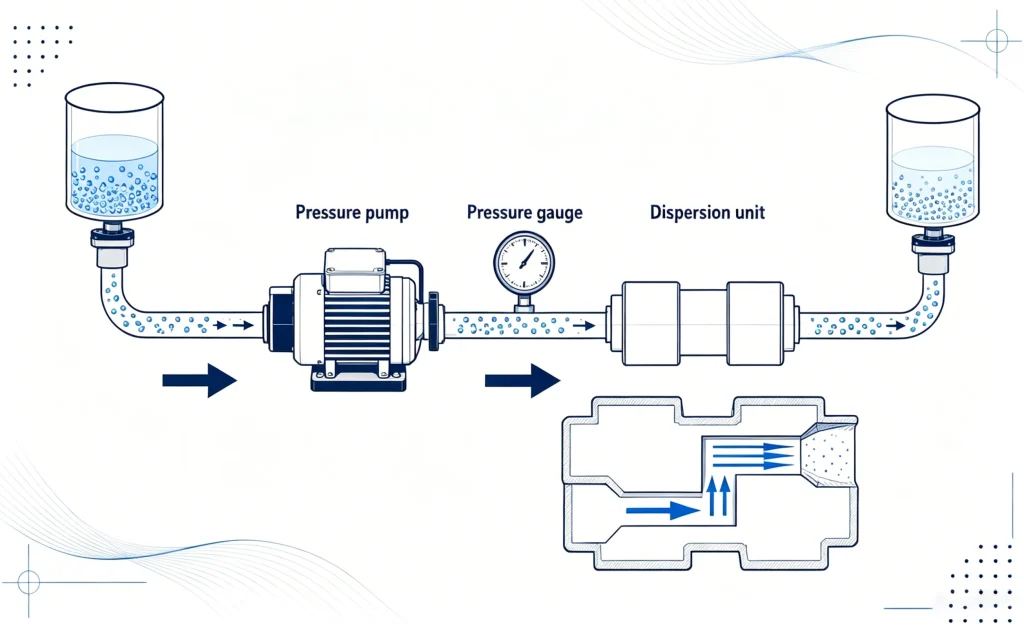
Traditional valve-type high pressure homogenizers may have relatively high residual volume and pressure fluctuations. In contrast, a microfluidics homogenizer uses a fixed microchannel interaction chamber to create intense shear, high-velocity impingement, and controlled cavitation. These mechanisms can provide efficient particle size reduction and dispersion, making microfluidic processing particularly suitable for valuable, small-volume research samples.
However, specifications vary considerably between laboratory homogenizer models. Understanding the following key criteria can help researchers select equipment that matches their experimental requirements.
Five Key Selection Criteria for a Lab Scale High Pressure Homogenizer
1. Minimum Processing Volume and Volume
Match the equipment to valuable micro-scale samples.
Laboratory research materials often include expensive reagents, drug-development materials, custom nanomaterials, and biological samples. In many experiments, the available sample volume may be only several tens of milliliters. Excessive internal volume can therefore result in significant material loss and higher experimental costs.
Key selection criteria:
- Prioritize a laboratory homogenizer with a minimum processing volume of 20 mL or less when working with valuable samples.
- Check the internal tubing and chamber volume rather than looking only at the nominal processing capacity.
- Low-residual-volume designs are particularly important for liposomes, proteins, active pharmaceutical ingredients, and other high-value materials.
The JUNJIE HPW-10 laboratory microfluidic homogenizer supports a minimum sample volume of 20 mL and uses a low-residual-volume fluid path designed for small-volume research applications.
Common pitfall:
Some conventional laboratory homogenizers require 50–100 mL or more per run. For micro-scale experiments, researchers may have to dilute or increase the sample volume, potentially changing the original formulation and affecting experimental results.
Typical applications include:
- mRNA and lipid nanoparticle development
- Cell disruption of limited biological samples
- Precious-metal catalyst dispersion
- Encapsulation of high-value cosmetic active ingredients
2. Pressure Range and Pressure Stability
Pressure stability directly affects homogenization performance and repeatability.
Homogenization pressure can influence particle size reduction, dispersion efficiency, exfoliation, and emulsification. However, simply choosing the highest-pressure machine is not always appropriate. Excessive pressure or unstable operation can increase thermal load, damage sensitive materials, and reduce batch-to-batch reproducibility.
For a versatile lab scale high pressure homogenizer, a wide adjustable pressure range can support different experimental processes.
Typical development ranges may include:
- 80–180 MPa: emulsification and encapsulation of cosmetic or plant-protein formulations
- 150–280 MPa: cell disruption and protein extraction
- 300–420 MPa: graphene exfoliation and deagglomeration of high-solid or advanced-material slurries
Beyond maximum pressure, researchers should examine pressure stability, repeatability, and actual operating pressure under continuous processing.
The JUNJIE HPW series uses a self-developed pressure-boosting system designed for stable high-pressure operation. Consistent pressure during repeated passes can help improve process reproducibility and particle-size consistency.
Common pitfall:
A machine may advertise a high peak pressure but fail to maintain that pressure during continuous operation. Large pressure fluctuations can produce inconsistent particle-size distributions between experiments and make published process parameters difficult to reproduce.
3. Interaction Chamber Material and Geometry
The interaction chamber is one of the most important components of a microfluidics homogenizer.
Its material, internal geometry, and flow path directly influence dispersion performance, wear resistance, contamination control, and particle-size distribution.
For pharmaceutical, biotechnology, electronics, and advanced-material applications, chamber material deserves particular attention.
Chamber material
Diamond interaction chambers can provide high wear resistance and stable microchannel geometry for demanding applications. For applications with strict contamination requirements, the wetted fluid path can also be designed with 316L stainless steel components.
Researchers should evaluate:
- Chamber wear resistance
- Potential particle contamination
- Chemical compatibility
- Wetted-material specifications
- Cleaning and sterilization requirements
Chamber geometry
Different interaction geometries can provide different processing characteristics.
- Y-type chambers: suitable for relatively controlled emulsification and dispersion processes.
- Z-type chambers: suitable for intensive shear, particle deagglomeration, and difficult-to-disperse materials.
- Modular chamber configurations: allow researchers to adapt the processing chamber to different materials and experimental objectives.
For applications involving pharmaceuticals, biological materials, semiconductor materials, or high-value formulations, chamber material and contamination control should be evaluated together rather than considering maximum pressure alone.
4. Online Low-Temperature Control
Temperature management helps protect heat-sensitive materials.
High-pressure homogenization involves rapid fluid acceleration and intense energy dissipation. Depending on pressure, formulation, flow rate, and number of passes, the processed material can experience a temperature increase.
This is particularly important for:
- Proteins and enzymes
- Probiotics
- Lipid nanoparticles
- mRNA formulations
- Hyaluronic acid
- Plant-derived active ingredients
When selecting a lab scale high pressure homogenizer, consider whether the system provides an integrated or external cooling solution.
Recommended features include:
- An external circulating cooling system or heat exchanger
- Real-time inlet and outlet temperature monitoring
- Temperature control during repeated processing
- Compatibility with low-temperature water baths or chillers
The JUNJIE HPW-10 can be equipped with an integrated online cooling module. The cooling circuit is designed to help manage temperature throughout high-pressure processing, making it suitable for laboratory applications involving temperature-sensitive materials.
For experiments requiring strict temperature control, researchers should evaluate the actual temperature rise under their intended pressure, flow rate, formulation, and number of passes rather than relying only on the cooling system’s nominal specification.
5. Data Traceability and Scale-Up Capability
Laboratory equipment should support both scientific reproducibility and future process development.
Many basic laboratory homogenizers can perform the required homogenization process but provide limited process-data recording or scale-up support. This can create problems when a validated laboratory process needs to be transferred to pilot or industrial equipment.
A modern lab scale high pressure homogenizer should ideally provide:
- PLC or touchscreen control
- Pressure monitoring
- Temperature monitoring
- Cycle/pass recording
- Process parameter storage
- Time-stamped process records
- Exportable experimental data
These functions can help researchers establish reproducible process conditions and maintain better experimental records for research projects, publications, and process-development programs.
Scale-Up from Laboratory to Production
Scale-up is another important factor when selecting a high pressure homogenizer manufacturer.
A manufacturer with laboratory, pilot, and production equipment can provide a more consistent development pathway.
JUNJIE offers a product range covering:
- HPW-10: laboratory-scale systems
- HPW-250: pilot-scale system
- HPW-500: production-scale system
The equipment platform uses a consistent design pressure of up to 420 MPa, with corresponding processing technologies developed across different equipment scales.
This allows process-development teams to establish pressure, pass number, temperature, and formulation parameters at laboratory scale before evaluating their transfer to pilot and production equipment.
However, actual scale-up should still be validated experimentally because flow rate, chamber configuration, residence time, cooling capacity, and material characteristics can change with equipment size.
Lab Scale High Pressure Homogenizer Selection by Application
Different laboratories have different requirements. The following framework can help narrow down the equipment configuration.
Pharmaceutical and Biotechnology Laboratories
For liposomes, cell disruption, lipid nanoparticles, and vaccine-adjuvant development, consider:
- Minimum sample volume around 20 mL
- Low residual volume
- Wear-resistant interaction chamber
- Temperature control
- Process-data recording
- Hygienic fluid-path design
- Optional SIP/CIP capabilities where required
The JUNJIE HPW-10 is designed for small-volume laboratory research and process-development applications.
New Energy and Advanced Materials Laboratories
For graphene, carbon nanotubes, ceramic slurries, and MLCC materials, consider:
- High-pressure operation up to 420 MPa
- Appropriate high-shear interaction chamber
- High wear resistance
- Material compatibility
- Particle-size repeatability
The chamber configuration should be selected according to the hardness, concentration, viscosity, and dispersion requirements of the material.
Cosmetics and Food R&D Laboratories
For plant proteins, nanoemulsions, functional ingredients, and active cosmetic formulations, consider:
- Controlled pressure
- Low temperature rise
- Appropriate Y-type interaction chamber
- Easy cleaning
- Low residual volume
- Repeatable processing conditions
These features can help researchers develop emulsification and dispersion processes while minimizing thermal impact on sensitive ingredients.
University and Multi-Disciplinary Research Laboratories
For laboratories supporting multiple research projects, flexibility is often more important than a single maximum-performance specification.
Consider:
- Small minimum sample volume
- Adjustable pressure
- Interchangeable interaction chambers
- Simple operation
- Data recording
- Easy maintenance
- Pilot and production equipment available from the same manufacturer
A modular laboratory system can allow one platform to support multiple research directions without requiring separate equipment for every application.
How to Choose the Right Laboratory Homogenizer
Selecting a laboratory homogenizer should not be based only on equipment price or maximum pressure. Researchers should evaluate the complete processing system, including:
- Minimum processing volume and volume
- Pressure range and pressure stability
- Interaction chamber material and geometry
- Temperature-control capability
- Process-data traceability
- Laboratory-to-pilot-to-production scale-up capability
For valuable or limited samples, low residual volume can directly affect experimental cost. For sensitive biological materials, temperature control may be critical. For advanced materials, chamber wear resistance and flow geometry may have a greater impact. For research programs targeting commercialization, scale-up compatibility should be considered from the beginning.
As a high pressure homogenizer manufacturer, JUNJIE provides laboratory, pilot, and production-scale systems for research and industrial process development.
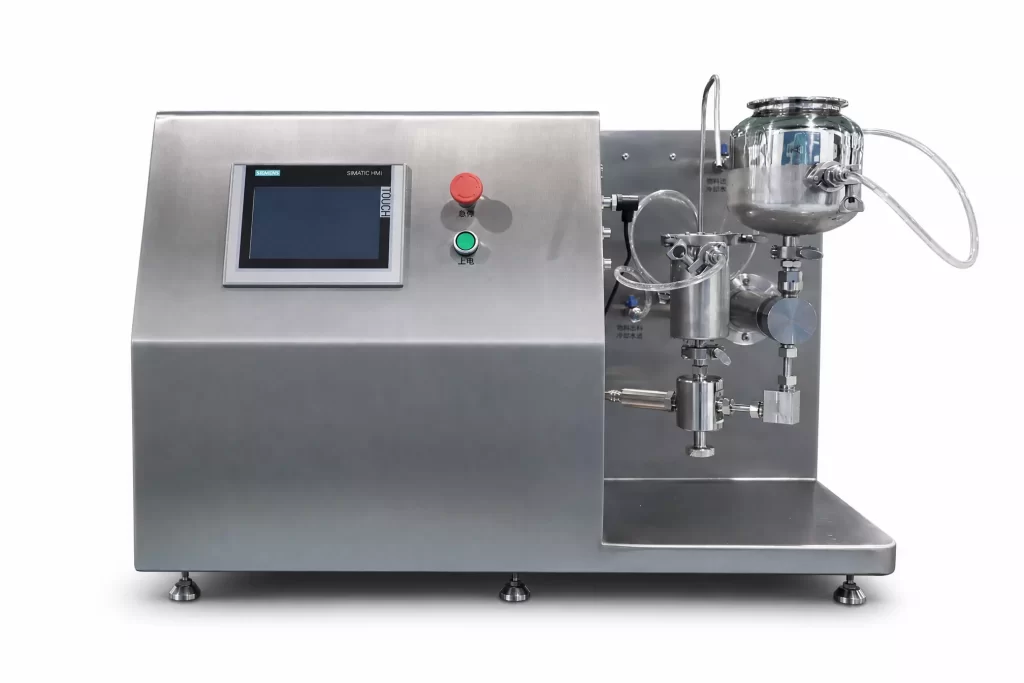
The HPW-10 laboratory system supports small-volume processing down to 20 mL and pressure operation up to 420 MPa. Combined with appropriate interaction chambers, online cooling, and process-data management, it can support research in pharmaceuticals, biotechnology, new energy materials, cosmetics, food, and specialty chemicals.
JUNJIE also provides HPW-10 laboratory systems, HPW-250 pilot systems, and HPW-500 production systems, creating a pathway from laboratory process development to pilot validation and industrial production.
For researchers who are evaluating a lab scale high pressure homogenizer, material testing before purchase can help verify whether the selected pressure, chamber configuration, temperature-control strategy, and number of passes are appropriate for the specific formulation.
JUNJIE provides material sample testing and process-development support to help customers evaluate homogenization performance before equipment selection.
