
Table of Contents
In the biopharmaceutical industry, high-pressure microfluidizers have become an important processing technology for advanced applications such as lipid nanoparticles (LNPs), nanoemulsions, cell disruption, protein formulation, and sterile pharmaceutical production.
But how do you choose the right high-pressure microfluidizer for your application?
This guide provides a practical framework for selecting a microfluidizer for biopharmaceutical applications, covering four key areas: process requirements, core performance, compliance, and technical support. It also highlights JUNJIE’s technology and equipment capabilities to help pharmaceutical companies, biotechnology companies, universities, and research institutions make a more informed equipment decision.
1. Define Your Process Requirements: What Is Your Application?
Biopharmaceutical applications have highly specific processing requirements. Before selecting a microfluidizer, clearly define the intended application and desired product quality.
| Application | Typical Process | Key Requirements |
|---|---|---|
| Nanodrug Delivery Systems | LNP preparation, nanoemulsion and nanosuspension development | Particle size <100 nm, PDI <0.15, high encapsulation efficiency |
| Biomolecule Processing | Cell disruption, viral vector homogenization | Efficient disruption, high recovery of active components, gentle processing |
| Protein Drug Optimization | Protein deagglomeration and redispersion, pretreatment for immobilization | Preserve biological activity and restore a monodisperse state |
| Sterile Formulation Production | Sterile homogenization, in-line cleaning | CIP/SIP capability, GMP compliance, precise temperature control |
Equipment Selection by Development Stage:
For R&D, laboratory-scale equipment is generally preferred. JUNJIE’s laboratory system supports small-volume processing, with a minimum sample volume of approximately 20 mL, making it suitable for valuable or limited research samples.
For pilot-scale development, focus on the linear scalability of process parameters and whether laboratory results can be reliably transferred to larger equipment.
For commercial production, prioritize high throughput, long-term operating stability, process consistency, automation, and pharmaceutical-grade compliance.
The ideal platform should therefore provide a clear path from:
Laboratory R&D → Pilot Scale → Commercial Production
2. Core Performance: JUNJIE Technology Advantages
When selecting a high-pressure microfluidizer, several technical specifications directly determine whether the equipment can meet your process requirements.
| Parameter | Typical Requirement | JUNJIE Advantage |
|---|---|---|
| Maximum Working Pressure | Up to 420 MPa | Ultra-high-pressure microfluidization technology with pressure up to 420 MPa for nanoscale size reduction and uniform dispersion |
| Pressure Control Accuracy | ±1.0% | Intelligent high-pressure control system for consistent processing between batches |
| Minimum Sample Volume | 10–20 mL | HPW-10 laboratory model supports small-volume samples down to approximately 20 mL |
| Residual Volume | <2 mL | Precision flow-path design minimizes valuable material loss |
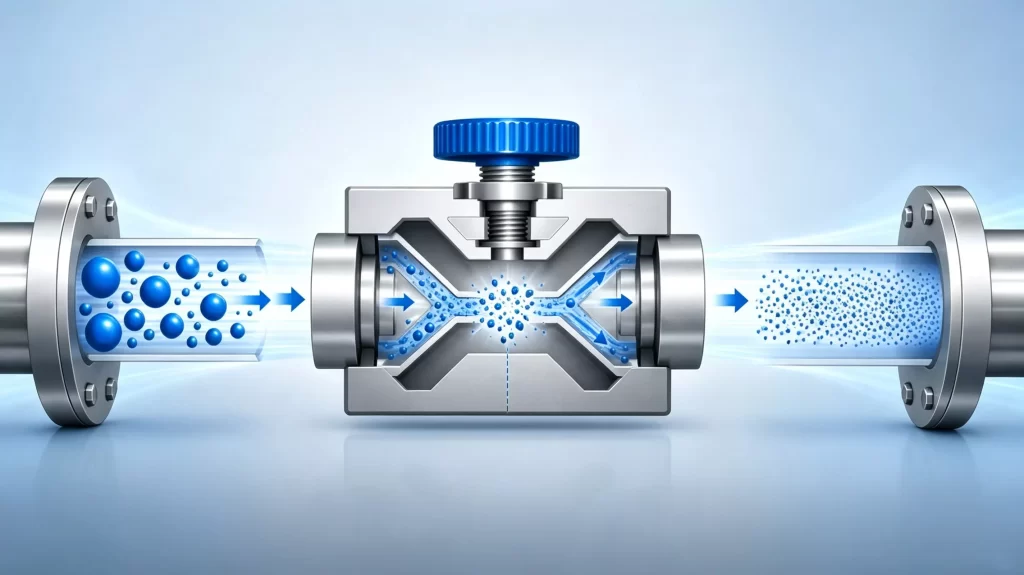
| Particle Size Control | Micron to nanoscale | Diamond interaction chamber technology uses intense shear, collision, and cavitation effects for precise particle-size control |
| Temperature Control | Full-process temperature control | Optional cooling systems help protect temperature-sensitive biological materials |
JUNJIE’s Core Technology:
Diamond Interaction Chamber
JUNJIE uses diamond interaction chamber technology to provide excellent wear resistance and corrosion resistance. The diamond chamber also helps reduce the risk of metal contamination, supporting high-purity processing requirements.
Servo-Electric-Cylinder Drive for Laboratory Models
The laboratory system uses a servo-electric-cylinder drive for quieter operation, making it suitable for laboratory and research environments.
Hydraulic Drive for Pilot and Production Models
Pilot- and production-scale systems use hydraulic drive technology with powerful drive units designed to handle high-viscosity and highly agglomerated materials.
Integrated CIP/SIP In-Situ Backflush System
Selected pilot and production systems can integrate CIP/SIP in-situ backflushing, enabling efficient cleaning and sterilization while helping reduce clogging risks and unplanned downtime.
3. Compliance Requirements: A Critical Consideration for Pharmaceutical Applications
Biopharmaceutical production has stringent requirements for equipment hygiene, materials, process control, and traceability.
JUNJIE provides several features designed to support pharmaceutical processing requirements.
Cleaning and Sterilization
CIP/SIP Capability: The HPW-250 pilot-scale and HPW-500 production-scale models can integrate CIP/SIP in-situ backflushing systems, enabling rapid in-line cleaning and helping minimize production downtime.
Hygienic Flow-Path Design: Optimized flow-path structures help minimize dead zones and improve cleanability, supporting hygienic processing requirements.
GMP-Oriented Configuration: Equipment configurations can be designed to support GMP-oriented pharmaceutical production requirements, depending on the application and customer’s validation requirements.
Material Compliance
Product-Contact Materials: Core wetted components can use high-quality stainless steel and diamond materials to help minimize contamination risks and ensure material compatibility.
High-Pressure Chamber: The high-pressure chamber uses aerospace-grade 15-5 stainless steel forgings, providing high fatigue resistance and corrosion resistance. The chamber is designed for a service life of up to 200,000 cycles, supporting long-term high-pressure operation.
Certification System
JUNJIE’s manufacturing capabilities are supported by:
- ISO 9001 – Quality Management System
- ISO 14001 – Environmental Management System
- ASME U – American Society of Mechanical Engineers certification
These certifications demonstrate JUNJIE’s commitment to quality management, environmental management, and international manufacturing standards.
Process Data Traceability
An automated PLC monitoring system can record critical process parameters in real time, including:
- Pressure
- Temperature
- Holding time
- Processing status
The system can support process data recording and batch traceability, helping meet the data-management requirements of pharmaceutical manufacturing.
4. JUNJIE Microfluidizer Product Range: From R&D to Production
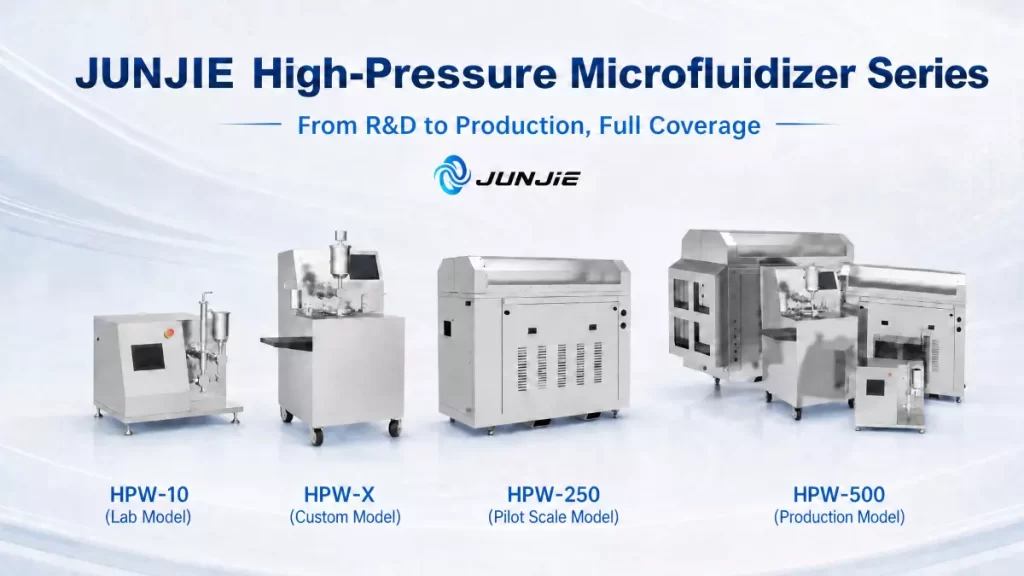
JUNJIE provides a range of high-pressure microfluidizer systems designed to cover different stages of process development and production.
| Model | Type | Processing Capacity | Drive System | Typical Application |
|---|---|---|---|---|
| HPW-10 | Laboratory | 10 L | Servo-electric cylinder | Laboratory R&D, small-batch preparation, valuable sample processing |
| HPW-250 | Pilot | 250 L | Hydraulic, 37 kW | Pilot production and process scale-up validation |
| HPW-500 | Production | 500 L | Hydraulic, 75 kW | Large-scale continuous production, 24/7 operation |
| HPW-X | Customized | Customized | Customized | Special processes and application-specific requirements |
HPW-10 Laboratory Microfluidizer
Designed for laboratory research, small-batch preparation, and valuable or limited samples.
Key advantages include:
- Small-volume processing
- Diamond interaction chamber
- Servo-electric-cylinder drive
- Quiet laboratory operation
- Flexible process development
HPW-250 Pilot Microfluidizer
Designed for pilot-scale production and process scale-up.
Key features include:
- 250 L processing capacity
- 37 kW hydraulic drive
- CIP/SIP capability
- GMP-oriented configuration
- Process scale-up validation
HPW-500 Production Microfluidizer
Designed for high-volume industrial production.
Key features include:
- 500 L processing capacity
- 75 kW hydraulic drive
- High processing capacity
- Continuous operation capability
- Automated process monitoring
HPW-X Customized Microfluidizer
For applications requiring non-standard pressure, flow rate, materials, processing capacity, or system configuration, JUNJIE can provide customized equipment and integrated process solutions.
5. JUNJIE Service Advantages: An Integrated Turnkey Solution
Selecting a microfluidizer is only the beginning. Application support, process validation, equipment integration, and after-sales service can be equally important for successful implementation.
JUNJIE provides integrated support throughout the equipment lifecycle.
Free Sample Testing and Process Validation
Customers can send samples to the JUNJIE laboratory for process feasibility testing.
Testing can help evaluate parameters such as:
- Particle size
- Homogeneity
- Processing pressure
- Temperature
- Processing cycles
- Process stability
Test results can provide practical data before customers make a final equipment investment.
Process Database Covering 1,000+ Materials
Based on years of application experience, JUNJIE has established a process database covering more than 1,000 types of materials.
The database can help engineers identify suitable process conditions, including:
- Pressure
- Processing time
- Temperature
- Number of passes
- Other application-specific parameters
This experience can shorten process-development cycles and improve equipment-selection accuracy.
Customized Production Line Design
JUNJIE can design customized processing solutions based on:
- Product characteristics
- Target capacity
- Factory layout
- Packaging requirements
- Cleaning requirements
- Automation requirements
Solutions can include:
Raw Material Pretreatment → High-Pressure Microfluidization → Post-Processing → Packaging
CIP/SIP systems, special packaging interfaces, and automated process-control functions can also be integrated according to project requirements.
Full-Lifecycle Technical Service
Pre-Sales
- Free sample testing
- Process feasibility evaluation
- Customized equipment selection
- Production-line planning
During Installation
- Standardized equipment installation
- Commissioning
- Multi-level operator training
- On-site support during initial production
After-Sales
- Direct supply of proprietary core components
- 24-hour technical response
- Intelligent equipment monitoring
- Predictive maintenance support
6. JUNJIE’s Manufacturing Strength
JUNJIE is supported by the manufacturing capabilities of ZHUHAI CTT TECHNOLOGY CO., LTD., with more than 20 years of precision manufacturing experience.
The company has:
- More than 40 core patents
- More than 100 equipment units delivered
- An R&D team representing approximately 30% of employees
- Multidisciplinary expertise in mechanical engineering, high-pressure fluid technology, materials, and process engineering
- Products delivered to more than 10 countries and regions
- Experience serving companies, universities, research institutions, and other organizations
JUNJIE integrates R&D, manufacturing, sales, application engineering, and technical service, providing customers with a complete high-pressure microfluidization solution rather than simply supplying a standalone machine.
7. Microfluidizer Selection Guide: Match the Equipment to Your Application
| Application | Recommended Model | Key Configuration | Why Choose It |
|---|---|---|---|
| LNP / Nanoemulsion R&D | HPW-10 | Diamond chamber, small-volume processing, data traceability | Supports small samples and quiet laboratory operation |
| Cell Disruption / Protein Optimization | HPW-10 / HPW-250 | Temperature control, CIP/SIP | Enables process development from laboratory to pilot scale |
| Sterile Formulation Pilot Production | HPW-250 | CIP/SIP, GMP-oriented configuration | 37 kW hydraulic drive and integrated backflushing support stable pilot production |
| Biopharmaceutical Production | HPW-500 | High-capacity processing, remote monitoring | 75 kW drive and continuous operation capability for large-scale production |
| Special Process Requirements | HPW-X | Customized pressure, flow rate, materials, and configuration | Flexible solution for application-specific requirements |
The key principle is simple: Choose the equipment according to the process—not simply according to the equipment model.
8. Future Trends: Intelligent Microfluidization
As biopharmaceutical manufacturing becomes more digital and automated, intelligent equipment is becoming increasingly important.
JUNJIE continues to develop intelligent processing technologies in several areas.
Real-Time Monitoring
Pressure, temperature, holding time, and other critical parameters can be monitored in real time, with process data available for traceability.
Predictive Maintenance
Intelligent monitoring can help identify equipment conditions and potential maintenance requirements, reducing unexpected downtime.
Modular Design
High integration and modular architecture can simplify maintenance and reduce the cost and time associated with replacing individual components.
Energy-Efficient Design
Energy-saving approaches such as water-circulation systems can help improve equipment efficiency and support more sustainable production.
Conclusion
The core principle of selecting a microfluidizer for biopharmaceutical applications is: Process requirements first, technical support second. The right equipment should match the entire processing workflow.
For R&D, flexibility, small sample volumes, and precise process control are often the priorities.
For pilot-scale production, process repeatability and scale-up capability become increasingly important.
For commercial biopharmaceutical production, throughput, process stability, GMP-oriented design, cleaning and sterilization, data traceability, and automation may become critical requirements.
Most importantly, the best microfluidizer is not necessarily the machine with the highest pressure. It is the system that can consistently achieve the required product quality under a controlled, reproducible, and scalable process.
For biopharmaceutical companies and research institutions, choosing a manufacturer with in-house capabilities in core high-pressure components—including the booster, homogenization valve, and interaction chamber—can provide greater flexibility for process development, customization, and long-term technical support.
JUNJIE specializes in high-pressure microfluidization technology, integrating proprietary R&D, manufacturing, application development, and technical service to provide nanoscale material dispersion and processing solution for biopharmaceuticals.
If you are selecting a microfluidizer for a biopharmaceutical formulation, start by defining your target particle size, sample volume, formulation characteristics, processing capacity, and scale-up requirements. Application testing with real samples can then help identify the optimal equipment and process parameters before making the final investment.