
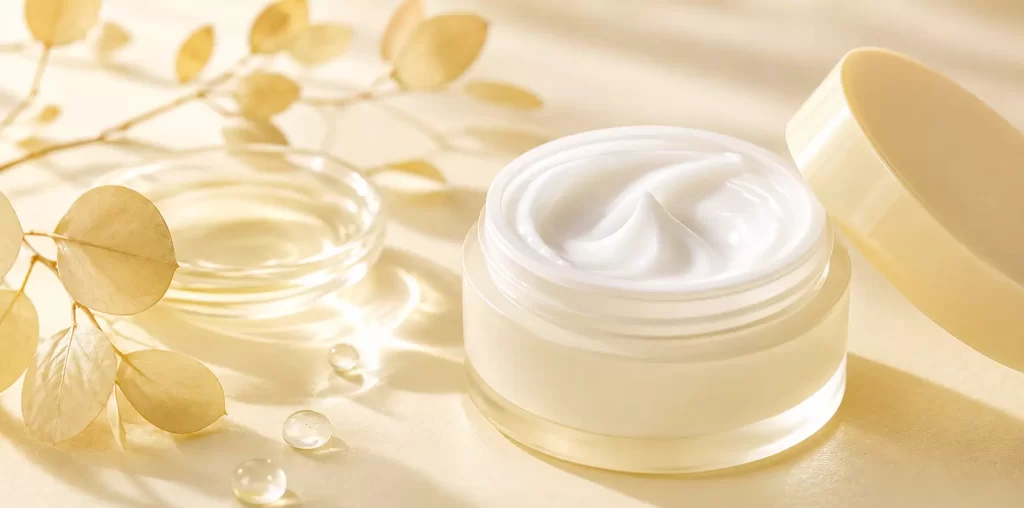
The skincare industry is moving toward increasingly sophisticated formulations that combine high-performance active ingredients, improved sensory properties, enhanced stability, and more efficient delivery systems.
Among these technologies, nanoemulsions are attracting growing attention because their extremely fine droplet sizes can provide advantages over conventional emulsions, including improved physical stability, transparency or translucency in some systems, enhanced spreading properties, and more effective incorporation of certain poorly water-soluble active ingredients.
But producing a high-quality nanoemulsion is not simply a matter of mixing oil and water more aggressively.
The key lies in controlling droplet size, particle size distribution, interfacial structure, energy input, and formulation composition.
This is where microfluidization become particularly valuable.
By forcing a formulation through specially designed microchannels at very high pressure, microfluidization generates intense shear, impact, turbulence, and cavitation effects. These mechanisms can break down larger droplets into much smaller and more uniformly distributed droplets.
For cosmetic manufacturers, this creates a pathway from traditional emulsionsv toward more refined nano-scale skincare formulations.
What Is a Conventional Emulsion in Skincare?
An emulsion is a system in which two normally immiscible liquids—typically oil and water—are dispersed within one another.
Common skincare emulsions include:
- Oil-in-water (O/W) emulsions
- Water-in-oil (W/O) emulsions
- Multiple emulsions
- Creams and lotions
- Serums
- Sunscreen formulations
- Moisturizers
- Cleansing products
In a conventional emulsion, one phase is dispersed as droplets within another continuous phase.
For example, in an oil-in-water emulsion, small oil droplets are distributed throughout a water-based continuous phase.
Surfactants and emulsifiers help stabilize the interface between the two phases.
However, conventional high-shear mixing may have limitations when manufacturers need to achieve extremely small and uniform droplets.
The resulting formulation may contain a relatively broad droplet size distribution, which can affect:
- Long-term physical stability
- Appearance
- Texture
- Spreadability
- Sedimentation or creaming behavior
- Active ingredient distribution
- Consumer sensory experience
As formulation requirements become more demanding, simply increasing conventional mixing speed may no longer provide sufficient control.
What Is a Nanoemulsion?
A nanoemulsion is an emulsion characterized by droplets typically within the nanometer-scale range.
Unlike conventional emulsions, nanoemulsions are engineered to achieve significantly smaller dispersed-phase droplets and, ideally, a narrow particle or droplet size distribution.
This smaller scale can influence the physical and sensory characteristics of a skincare formulation.
Potential advantages include:
Smaller droplet size
Microfluidization can reduce relatively large droplets into much smaller structures.
More uniform dispersion
A narrower size distribution can help create a more consistent formulation.
Improved physical stability
Reducing droplet size can decrease the tendency toward certain destabilization mechanisms such as creaming, although the actual stability depends strongly on formulation chemistry and processing conditions.
Enhanced sensory properties
Fine droplets can contribute to smoother textures, easier spreading, and a lighter skin feel in appropriately designed formulations.
Improved incorporation of certain active ingredients
Nanoemulsion systems can provide useful delivery platforms for selected lipophilic or poorly water-soluble cosmetic ingredients.
However, nanoemulsion performance is not determined by particle size alone.
The final result depends on the interaction between formulation composition and processing technology.
Why Conventional High-Shear Mixing May Not Be Enough
Traditional emulsification commonly relies on rotor-stator mixers, high-speed agitators, or other mechanical systems.
These technologies can effectively create conventional emulsions, but achieving consistently small droplets at industrial scale can become increasingly challenging.
One important limitation is the distribution of mechanical energy throughout the product.
In conventional mixing systems, different regions of the processing chamber can experience different shear conditions. This may result in a relatively broad droplet size distribution.
For premium skincare formulations, manufacturers increasingly need more precise control over the microstructure.
This is one reason microfluidization have become important technologies in advanced formulation development.
How Microfluidization Creates Nanoemulsions
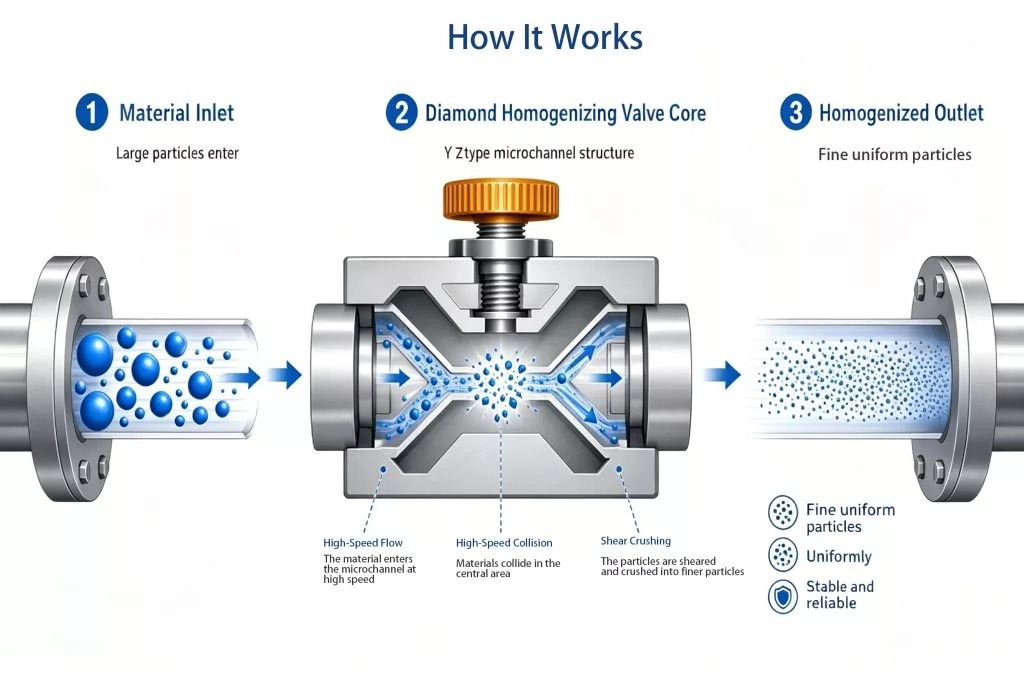
JUNJIE’s high-pressure microfluidic homogenization and emulsification technology is based on the principles of fluid dynamics. Through four key processes—pressurization, jetting, collision, and homogenization—the technology harnesses the synergistic effects of multiple physical forces to achieve ultrafine processing of raw materials. The entire process requires no chemical additives, providing a safe and gentle approach to emulsification.
1. High-Pressure Pressurization and Energy Storage
Mixed materials such as aqueous and oil phases are pressurized to hundreds of megapascals by the pump system, allowing the materials to accumulate sufficient pressure potential energy to provide the driving force for subsequent refinement. The working pressure can reach 420 MPa.
2. High-Speed Jetting Through Microchannels
The high-pressure material is forced through micron-scale microchannels made of diamond. As the flow space contracts dramatically, the material is instantaneously accelerated to an ultra-high-speed state of hundreds of meters per second.
3. Multi-Force Fragmentation and Refinement
High-speed fluid jets collide within the interaction chamber while simultaneously being subjected to intense shear forces, cavitation effects, and turbulent impact. Large oil droplets and active ingredients are rapidly broken down into tiny droplets at the nanoscale.
4. Uniform Dispersion and Nanoemulsion Formation
After refinement, the tiny droplets are uniformly dispersed throughout the system, forming a nanoemulsion with a narrow particle-size distribution. The entire process is completed almost instantaneously, helping effectively preserve the activity of heat-sensitive ingredients such as sodium hyaluronate and active peptides.
The equipment utilizes a fixed geometric structure with diamond microchannels, ensuring that each batch of material is subjected to consistent forces. This delivers stable, reproducible emulsification performance and makes the technology highly suitable for the large-scale production of skincare products.
Four Core Advantages Over Traditional Emulsification Processes
Compared with conventional emulsification methods such as traditional stirring and standard homogenization, JUNJIE’s high-pressure microfluidic homogenization and emulsification technology offers significant advantages in particle size, penetration, stability, and formulation compatibility, directly addressing key challenges in modern skincare formulation.
1. Nano-Scale Particle Size for Significantly Enhanced Penetration
The droplet size of skincare formulations processed using this technology can be stably controlled within 50–200 nm, significantly smaller than that of conventional emulsions.
These ultra-fine droplets provide an extremely large specific surface area, helping active ingredients interact more effectively with the skin surface and supporting enhanced delivery through the stratum corneum. This helps move beyond the limitations of conventional formulations that tend to remain on the skin surface, while improving active-ingredient delivery and maintaining a lightweight, elegant skin feel.
2. Highly Stable Systems with Reduced Phase Separation and Sedimentation
Nanoemulsions feature a fine and uniform structure and are less prone to flocculation, sedimentation, and phase separation, helping retain active ingredients over extended periods.
Even when multiple oils and active ingredients are incorporated into the formulation, the technology can achieve highly uniform dispersion and compatibility. This can contribute to longer product shelf life and more consistent performance throughout the product lifecycle.
3. Simplified Formulations with Gentle, Low-Irritation Characteristics
The technology provides highly efficient emulsification, allowing large amounts of oil-phase ingredients to be stably emulsified with only a small amount of emulsifier. This helps reduce the reliance on chemical processing aids.
The resulting formulations can maintain a gentle product profile while preserving the intrinsic skincare activity of the raw materials.
4. Supports Skin Barrier Care and Additional Skincare Benefits
Special nanoemulsion systems may provide additional functional benefits by helping reduce transepidermal water loss (TEWL). While facilitating the delivery of functional ingredients, the system can also support skin barrier care, creating a dual approach that combines active-ingredient delivery with skin barrier support.
Applications: Empowering Mainstream Skincare Products
Leveraging mature application and process-development capabilities, JUNJIE has applied high-pressure microfluidic homogenization and emulsification technology to two popular skincare ingredient and formulation categories: sodium hyaluronate and serum concentrates.
Case Study 1: Sodium Hyaluronate (Hyaluronic Acid) Products
Conventional high-molecular-weight hyaluronic acid has a relatively large molecular size and primarily provides surface-level moisturizing benefits. At high concentrations, formulations may also become viscous, form lumps, and become difficult to spread.
After processing with JUNJIE’s technology:
- The median particle size D50 can be stably controlled below 200 nm, supporting enhanced interaction and delivery at the skin surface;
- High-concentration formulations of ≥1.5% can maintain good storage stability with reduced phase separation and sedimentation, while offering improved spreadability;
- Hyaluronic acid with different molecular weights can be uniformly dispersed, helping combine surface-level moisture retention with deeper hydration support for longer-lasting moisturizing performance.
Case Study 2: Multi-Functional Serum Concentrates
JUNJIE can develop customized emulsification processes for different serum formulations. Low-temperature, rapid processing helps minimize thermal exposure to active ingredients such as niacinamide, vitamins, and botanical extracts.
Following nano-homogenization, the formulation can achieve a clearer, finer, and more uniform texture:
- Heat-sensitive ingredients such as niacinamide and vitamin C derivatives can achieve a retention rate of ≥95%, while minimizing the loss of active botanical ingredients;
- Multi-phase systems can achieve a PDI <0.2, providing uniform dispersion and a clear serum concentrate with minimal visible suspended matter;
- Nano-scale dispersion can help improve the transdermal delivery efficiency of active ingredients.
Strong Technical Capabilities for Reliable Technology Implementation
As a professional brand specializing in high-pressure microfluidic emulsification, JUNJIE integrates technology development, equipment manufacturing, formulation implementation, and process optimization to help advance cosmetic and skincare ingredient technologies.
Technology Development
JUNJIE has developed extensive expertise in high-pressure microfluidic emulsification. Customized emulsification processes can be developed according to different skincare ingredients and formulation types, providing flexible solutions for the processing and upgrading of serum concentrates, emulsions, facial masks, and other skincare formulations.
Equipment and Production
JUNJIE develops and manufactures its own high-pressure microfluidic homogenization equipment, equipped with wear-resistant diamond microchannels as standard. The systems are designed for stable operation and high processing capacity.
The platform enables seamless transition from laboratory-scale sample development to pilot testing and large-scale production. Processing parameters can be scaled up in a controlled and linear manner, helping maintain consistent product quality across batches.
Comprehensive Technical Services
With extensive application experience, JUNJIE provides integrated solutions covering technical consultation, process commissioning, formulation optimization, and equipment configuration.
These services help skincare manufacturers upgrade traditional formulations, optimize production processes, and develop differentiated, high-performance skincare products.
High-pressure microfluidic homogenization and emulsification is transforming functional skincare manufacturing—from improving active-ingredient delivery and enhancing formulation performance to optimizing skin feel and strengthening formulation stability.
From Conventional Emulsions to Next-Generation Nanoemulsions
The transition from conventional emulsions to nanoemulsions reflects a broader transformation in cosmetic manufacturing.
Traditional mixing focuses primarily on combining ingredients.
Modern high-pressure processing focuses on controlling what happens to those ingredients at the micro- and nano-scale.
With microfluidization, high-pressure fluid dynamics can be used to generate extremely fine droplets and more uniform dispersions.
With advanced microfluidic technology, manufacturers can gain greater control over the physical structure of complex formulations.
And with a properly engineered high pressure homogenizer, these processes can potentially be translated from laboratory research into scalable industrial production.
For skincare manufacturers, this means that nanoemulsion technology is not simply about making smaller droplets.
It is about creating more precisely engineered formulations with greater control over performance, stability, and sensory characteristics.
Conclusion
For companies developing next-generation premium skincare formulations, equipment performance and process consistency are closely interconnected. JUNJIE’s high-pressure microfluidic homogenization and emulsification technology is transforming functional skincare production by improving absorption, enhancing efficacy, optimizing skin feel, and increasing formulation stability.
