
Table of Contents
As cosmetic formulations become more sophisticated, finer dispersion, greater stability, and better control of active ingredients are increasingly important. This has made homogenization in the cosmetics industry a key technology for advanced formulation development.
Conventional emulsification can produce stable creams and lotions, but may offer limited control over droplet size and distribution. Microfluidic homogenizers provide a more precise approach to producing fine, uniform emulsions and nanoemulsions.
Market Growth and Demand for Advanced Cosmetic Formulations
The global beauty market continues to expand, reaching an estimated €290 billion+ in 2025, with approximately 3.5% year-over-year growth. Skincare remains the largest category, accounting for 39% of the global beauty market, highlighting the strong demand for advanced skincare formulations such as serums, creams, and other emulsion-based products.
As cosmetic formulations become increasingly sophisticated, manufacturers are placing greater emphasis on droplet-size control, emulsion stability, formulation consistency, and controlled ingredient delivery. These requirements are driving interest in advanced processing technologies, microfluidic homogenization, which can provide greater control over dispersion and formulation microstructure.
( Source: L’Oréal Finance, 2025 Beauty Market.)
Limitations of Conventional Emulsions
Conventional emulsions are commonly produced by combining an oil phase and an aqueous phase using mechanical stirring, high-speed shear mixing, or conventional homogenization.
These methods remain effective for many everyday cosmetic products. However, when formulators pursue smaller droplets, narrower particle-size distributions, higher physical stability, and more controlled active-ingredient delivery, conventional emulsification processes may present several challenges.
Larger Droplets Can Limit Fine Dispersion
Conventional emulsification may produce relatively large droplets with a broader size distribution. Larger droplets provide less interfacial area relative to their volume and can influence how oil-soluble ingredients are distributed throughout the formulation.
For cosmetic products containing sensitive or poorly water-soluble active ingredients, achieving a sufficiently fine and uniform dispersion can therefore become an important formulation objective.
For high-value serums, functional lotions, and advanced skincare products, simply forming an emulsion may not be enough. Formulators increasingly need greater control over droplet size and droplet-size distribution.
Broad Droplet-Size Distribution Can Affect Physical Stability
When an emulsion contains droplets with significantly different sizes, the system may be more susceptible to physical instability mechanisms such as flocculation, coalescence, creaming, or phase separation.
At the same time, some cosmetic active ingredients are inherently sensitive to environmental conditions.
Examples include certain:
- Vitamins and vitamin derivatives
- Retinoids
- Botanical actives
- Peptides
- Other bioactive ingredients
Their stability can be influenced by oxygen, light, temperature, pH, and interactions with other formulation components.
A well-controlled dispersion can therefore be important not only for the initial appearance of a product, but also for maintaining formulation consistency throughout storage.
Limited Dispersion Control Can Affect Texture and Formulation Uniformity
When droplet size and distribution are not sufficiently controlled, the microscopic structure of an emulsion can vary considerably.
This may influence several product characteristics, including:
- Ingredient distribution
- Appearance
- Viscosity
- Spreadability
- Skin feel
- Physical stability
- Long-term formulation consistency
For premium skincare products, consumers increasingly expect formulations that feel lightweight, smooth, uniform, and easy to spread.
As a result, advanced cosmetic formulation is moving beyond simply asking whether an emulsion can be produced.
The more important question is: Can the emulsion structure be precisely controlled?
The Challenge of Precise Emulsion Control
Conventional emulsification technologies are not obsolete. High-speed mixers, mechanical agitators, and conventional homogenizers continue to play an important role in cosmetic manufacturing.
The challenge arises when a formulation needs to move from basic emulsification to controlled nanoscale dispersion.
In other words: The goal is not simply to create an emulsion, but to control its droplet size, distribution, stability, and microstructure according to the requirements of the final formulation. This is one of the reasons why nanoemulsion technology has attracted growing attention in cosmetic R&D.
High-pressure homogenization and microfluidic homogenization can provide additional processing intensity through mechanisms such as high shear, turbulence, cavitation, impact, and controlled fluid interaction. A typical development strategy can therefore be viewed as:
Target Droplet Size → Narrower Size Distribution → Improved Dispersion → Enhanced Physical Stability → Optimized Formulation Performance
This is where a microfluidic homogenizer can become an important part of the cosmetic formulation development process.
What Is a Nanoemulsion in Cosmetics?
A nanoemulsion is a finely dispersed system consisting of two immiscible phases, typically oil and water, stabilized by suitable surfactants or emulsifying agents.
Compared with conventional emulsions, nanoemulsions generally contain significantly smaller dispersed droplets. The reduction in droplet size increases the total interfacial area between the dispersed and continuous phases and can influence the physical behavior and performance of the formulation.
In cosmetic applications, nanoemulsions may be explored for formulations containing:
- Oil-soluble active ingredients
- Botanical extracts
- Vitamins and derivatives
- Essential oils
- Fragrance ingredients
- Lipophilic cosmetic ingredients
- Functional ingredients with limited water solubility
However, successful nanoemulsion development is not simply a matter of obtaining the smallest possible droplets. A practical nanoemulsion process should consider:
Droplet Size + Particle-Size Distribution + Physical Stability + Viscosity + Sensory Properties + Ingredient Compatibility
The optimum conditions depend on the formulation and its intended application.
Why Is Homogenization Important in the Cosmetics Industry?
The fundamental challenge of an emulsion is that oil and water naturally tend to separate.
Mechanical energy is therefore required to break one phase into smaller droplets and distribute those droplets throughout the continuous phase. This is the basic function of homogenization. In homogenization in the cosmetics industry, controlled mechanical and fluid forces are used to reduce droplet size and improve dispersion. Depending on the equipment and process conditions, these forces may include:
- High shear
- Turbulence
- Cavitation
- Impact
- Pressure-driven acceleration
- Fluid-stream interaction
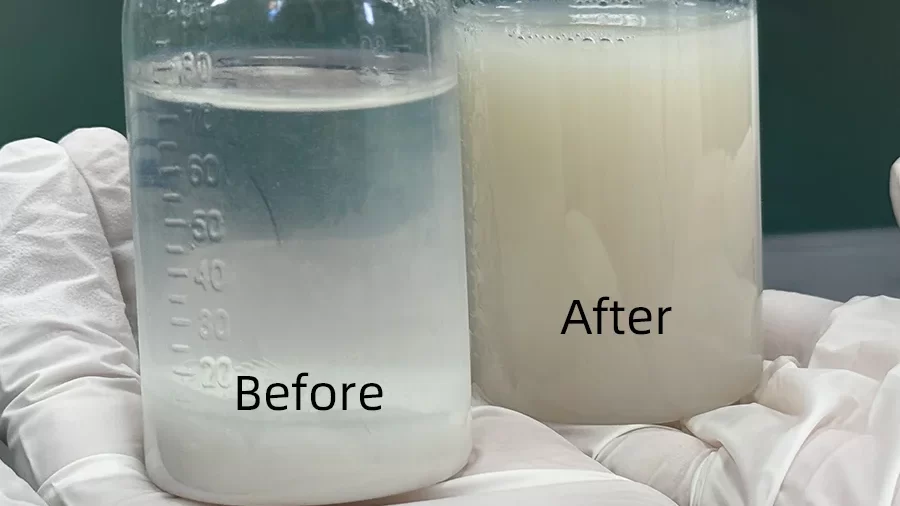
When an emulsion passes through a specialized homogenization zone, larger droplets are exposed to intense processing conditions and can be broken into smaller droplets.
A simplified process can be represented as:
Coarse Emulsion → High-Pressure Processing → Droplet Disruption → Fine Emulsion → Nanoemulsion
The final droplet size depends on several variables, including:
- Processing pressure
- Number of passes
- Formulation composition
- Oil-to-water ratio
- Surfactant system
- Initial droplet size
- Fluid viscosity
- Temperature
- Interaction-chamber design
Therefore, high-pressure homogenization should be treated as an adjustable process rather than a single fixed recipe.
Microfluidic Homogenizer vs. Conventional Homogenization
A microfluidic homogenizer takes high-pressure fluid processing into a more precisely engineered interaction environment.
Instead of relying solely on conventional valve structures, microfluidic systems use specialized microchannels or interaction chambers to control how fluid streams move and interact. Depending on the system design, the processing environment can generate multiple mechanisms for droplet and particle size reduction, including:
- High shear
- Turbulent flow
- Cavitation
- Fluid-stream collision
- Rapid pressure changes
- Controlled microchannel interaction
This can make microfluidic homogenization particularly attractive for applications where fine particle size, narrow size distribution, and repeatable processing are important.
For cosmetic R&D, this technology can be useful when developing advanced nanoemulsion systems and investigating the relationship between processing conditions and formulation performance.
Why Are Nanoemulsions Attractive for Cosmetic Formulations?
The growing interest in nanoemulsions is closely related to the increasing complexity of modern cosmetic formulations. Many cosmetic ingredients have challenging formulation characteristics. An active ingredient may have:
- Low water solubility
- Poor dispersion
- Limited compatibility with the formulation
- Sensitivity to oxidation
- Limited physical stability
- Difficulty achieving uniform distribution
Nanoemulsion technology provides another formulation platform for addressing some of these challenges.
Improved Dispersion of Lipophilic Ingredients
Many cosmetic ingredients have limited solubility in water.
By incorporating an oil phase into a finely dispersed emulsion, formulators can improve the distribution of selected lipophilic ingredients throughout an aqueous formulation. This can be relevant to serums, lotions, facial-care products, and other water-based cosmetic systems.
Fine and Uniform Droplet Structure
High-pressure homogenization can break larger droplets into much smaller structures. A more uniform droplet population can contribute to consistent appearance and physical behavior.
Improved Physical Stability
Droplet size is an important factor affecting emulsion stability.
Smaller droplets can reduce certain gravitational separation tendencies, although overall stability depends on the entire formulation system.
Surfactant selection, interfacial properties, viscosity, density differences, and storage conditions also play important roles.
Potential for Advanced Active-Ingredient Delivery
Nanoemulsions are being investigated as delivery platforms for various cosmetic actives.
Their small droplet size and increased interfacial area can influence how ingredients interact with the formulation and the skin surface.
However, it is important to avoid assuming that smaller droplets automatically result in greater skin penetration or absorption.
Actual delivery performance depends on the active ingredient, formulation composition, skin characteristics, and experimental conditions.
Does Smaller Droplet Size Always Mean Better Absorption?
This is one of the most important questions in advanced cosmetic formulation.
It is tempting to assume:
Smaller Droplets = Better Absorption
In reality, the relationship is much more complex.
The performance of a cosmetic delivery system depends on multiple variables, including:
- Active-ingredient properties
- Molecular size
- Lipophilicity
- Solubility
- Droplet size
- Interfacial composition
- Surfactant system
- Skin condition
- Formulation pH
- Application conditions
Therefore, the objective of homogenization should not simply be to achieve the smallest possible droplet size.
Instead, formulators should determine an appropriate droplet-size range and distribution for the specific formulation and application.
This is where controllable high-pressure processing can provide value during formulation development.
How to Choose a High Pressure Microfluidic Homogenizer for Cosmetics
When selecting a high pressure microfluidic homogenizer for cosmetics, maximum pressure should not be the only evaluation criterion.
A comprehensive assessment should consider the following factors:
Target Droplet Size
Define the target droplet-size range based on the formulation and desired performance.
Different cosmetic formulations may require different processing intensities, so the homogenizer should provide sufficient control to achieve the desired particle or droplet size.
Pressure Range and Process Control
The system should provide an appropriate pressure range with precise and repeatable process control.
For R&D and formulation development, adjustable processing conditions are particularly valuable because different formulations can respond differently to pressure, flow conditions, and processing intensity.
Microfluidic Interaction Chamber Design
The interaction chamber is a critical component of a high pressure microfluidic homogenizer.
Its geometry directly influences fluid flow, shear forces, cavitation, and particle or droplet breakup.
Specialized microchannels, including diamond interaction chambers, can provide controlled fluid interaction and help achieve more consistent homogenization results.
Material Compatibility
Cosmetic formulations may contain oils, surfactants, solvents, acids, botanical extracts, and other chemically active ingredients.
Contact materials should therefore be selected according to formulation chemistry, corrosion resistance, cleaning requirements, and applicable manufacturing standards.
Temperature Management
High-pressure processing can generate heat, which may affect temperature-sensitive ingredients and formulations.
Integrated cooling, temperature monitoring, and process-temperature control can therefore be important considerations when selecting equipment for cosmetic applications.
Scalability
Cosmetic product development often progresses from laboratory testing to pilot production and eventually to industrial manufacturing.
A high pressure microfluidic homogenization platform that supports consistent process parameters across different production scales can help simplify formulation development, process validation, and scale-up from R&D to commercial production.
Applications of High-Pressure Homogenization in Cosmetics
High-pressure homogenization can be considered for a wide range of cosmetic and personal-care formulations.
Facial Serums
Nanoemulsion processing can support the development of lightweight formulations containing selected oil-soluble active ingredients.
Creams and Lotions
Fine emulsification can help achieve smooth texture, uniform dispersion, and desirable physical stability.
Sunscreen Formulations
Depending on the active ingredients and formulation architecture, homogenization can assist in producing fine dispersions and emulsified systems.
Hair-Care Products
Conditioning oils, botanical ingredients, and other functional components may benefit from improved dispersion.
Essential-Oil Formulations
Microfluidic homogenization can help produce fine oil-in-water dispersions for selected essential-oil-based formulations.
Anti-Aging Formulations
Advanced delivery systems can be explored for formulations containing peptides, botanical extracts, vitamins, and other cosmetic actives.
Conclusion
Homogenization in the cosmetics industry is increasingly important as formulations require finer dispersion, better stability, and more precise control. While traditional emulsification remains suitable for many products, advanced formulations such as nanoemulsions may benefit from the controlled processing provided by microfluidic homogenizers.
The goal is not simply to achieve the smallest possible droplet size, but to balance droplet size, size distribution, stability, formulation chemistry, temperature, pressure, and throughput. High-pressure microfluidic homogenization provides a flexible technology platform for cosmetic manufacturers and R&D teams, supporting formulation development from laboratory research to scalable industrial production.
