

Table of Contents
Nanoparticle preparation is a critical process in advanced materials research, pharmaceutical development, nanotechnology, and industrial formulation. Whether developing drug delivery systems, nanoemulsions, liposomes, battery materials, or functional food ingredients, researchers need to control not only particle size but also particle size distribution to achieve consistent product performance.
One of the most widely used indicators for evaluating particle size distribution is the Polydispersity Index (PDI). PDI provides insight into the degree of variation in particle sizes within a sample and helps researchers assess the uniformity of nanoparticle formulations. A lower PDI generally indicates a narrower particle size distribution, while a higher PDI suggests greater size variability or a more heterogeneous sample.
Achieving a consistent PDI can be challenging when using conventional mixing, stirring, or dispersion techniques, particularly when processing materials with different physical and chemical properties. This is where high-pressure microfluidization offers significant potential. By forcing a material through specialized interaction chambers under controlled high pressure, this technology generates intense shear forces, turbulence, and particle collisions that promote efficient particle size reduction and dispersion.
For researchers and manufacturers seeking reliable nanoparticle preparation methods, understanding the relationship between PDI, processing parameters, and equipment design is essential. An appropriately configured microfluidizer can help improve particle size uniformity, enhance process reproducibility, and support the development of advanced nanomaterials.
What Is PDI in Nanoparticle Preparation?
The Polydispersity Index, commonly abbreviated as PDI, is a dimensionless parameter used to describe the breadth of particle size distribution in a sample. In nanoparticle characterization, PDI is frequently reported alongside the average hydrodynamic diameter measured by dynamic light scattering (DLS).
Unlike the average particle size, which represents a central size estimate, PDI provides additional information about how broadly particle sizes are distributed. Two nanoparticle samples may have similar average diameters but significantly different PDIs, indicating that one sample has a more uniform distribution than the other.
For example, a nanoparticle formulation with an average diameter of 100 nm and a relatively low PDI may exhibit a narrower size distribution than another formulation with the same average diameter but a higher PDI. This difference can influence formulation stability, optical properties, surface interactions, and other application-dependent performance characteristics.
However, PDI should not be interpreted in isolation. Its meaning depends on the measurement method, sample properties, particle concentration, and data analysis model. DLS measurements can also be strongly influenced by larger particles or aggregates in a sample. Therefore, PDI should be evaluated together with particle size, measurement conditions, and other relevant characterization results.
For researchers working on PDI and nanoparticle preparation, the objective is not simply to obtain the smallest possible particle size. It is to develop a particle population with the size distribution, stability, and functional properties required for the intended application.
How High-Pressure Microfluidization Works
High-pressure microfluidization is a high-energy processing technology used to reduce particle size, improve dispersion, and refine the structure of emulsions and suspensions. It is particularly useful for formulations that require controlled particle size distribution and repeatable processing conditions.
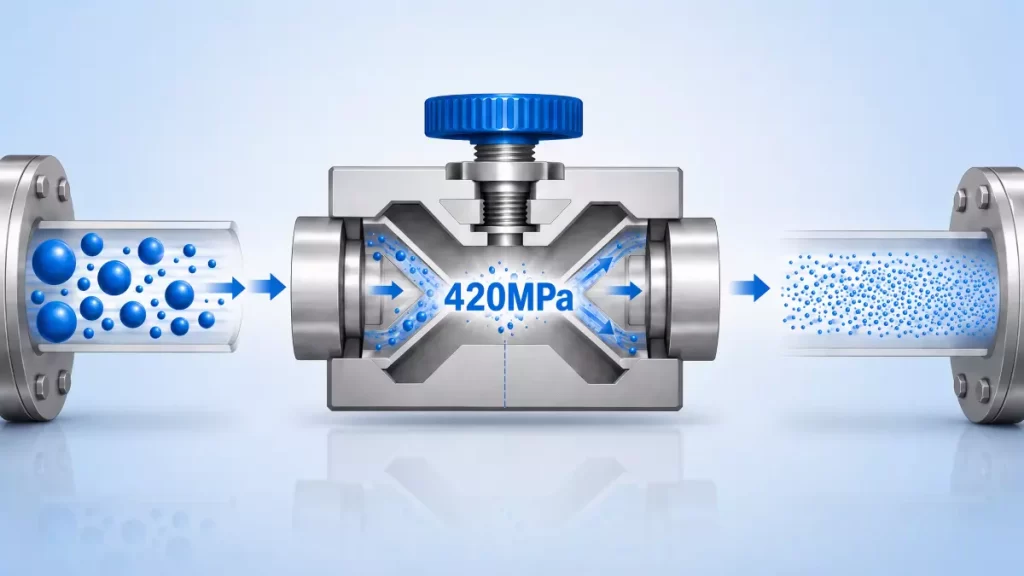
JUNJIE high-pressure microfluidizer utilizes advanced ultra-high-pressure microfluidization technology, with a maximum design pressure of up to 420 MPa. Under ultra-high pressure, materials pass through micron-scale channels, where the shear forces and cavitation effects generated by high-velocity impingement enable homogenization from the micron to the nanoscale. This process efficiently reduces solid particles or droplets to nanometer-sized dimensions.
The following describes the mechanism of action in nanoparticle preparation:
- Triple-Synergistic Particle Disruption
As materials pass through micron-scale channels under ultra-high pressure, they are accelerated, split into multiple streams, and forced to collide. This process simultaneously generates intense shear forces, high-frequency oscillations, and cavitation effects. These three mechanisms work synergistically to achieve efficient homogenization and reduce particles to the nanoscale.
- Precise Particle Size Control
By precisely adjusting pressure and the number of processing cycles, the particle size, morphology, and size distribution of the resulting product can be effectively controlled. This provides a critical material foundation for the development of high-performance catalysts, optoelectronic materials, and sensitive components.
- Uniform Dispersion and Structural Control
In nanocomposite manufacturing, microfluidizer homogenizers efficiently and uniformly disperse nanofillers, such as carbon nanotubes, graphene, and nanoceramics, within polymer or metal matrices. This process effectively prevents filler agglomeration and significantly improves interfacial bonding, thereby enhancing the overall electrical conductivity, thermal conductivity, and mechanical properties of composite materials.
How High-Pressure Microfluidization Can Improve PDI
More Uniform Particle Size Reduction
One of the principal advantages of high-pressure microfluidization is its ability to generate intense processing forces within a specialized interaction chamber. These forces can help break down larger particles and agglomerates, producing a more finely dispersed system.
When the initial formulation contains a broad distribution of particle sizes, optimized microfluidization may reduce some of the larger structures and narrow the resulting distribution. Depending on the material and formulation, this can contribute to a lower measured PDI.
The outcome is influenced by several factors, including the initial particle size distribution, material hardness, surface chemistry, viscosity, and susceptibility to aggregation. Not every formulation responds in the same way, so experimental validation is essential.
Improved Dispersion and Deagglomeration
Nanoparticles tend to aggregate when attractive interactions between particles exceed the stabilizing effects of surface charge, steric barriers, or other formulation mechanisms. Aggregation can increase the apparent particle size and broaden the measured distribution, leading to a higher PDI.
High-pressure microfluidization can help disrupt weakly bound agglomerates and improve the dispersion of particles within a liquid medium. This is especially valuable for suspensions containing poorly dispersed functional materials, pigment particles, or other solids that require consistent distribution.
However, breaking apart agglomerates does not necessarily guarantee long-term stability. If the formulation lacks sufficient stabilization, particles may aggregate again after processing. Appropriate surfactants, polymers, surface modifiers, or other formulation strategies may therefore be needed to maintain the desired particle size distribution.
Better Process Reproducibility
Reproducibility is essential in both laboratory research and industrial production. Researchers need to obtain comparable results across repeated experiments, while manufacturers must maintain consistent product quality between batches.
With controlled pressure delivery, engineered interaction chambers, and repeatable operating procedures, high-pressure microfluidization can provide a structured approach to nanoparticle processing. Parameters such as operating pressure, number of passes, flow rate, and processing temperature can be monitored and adjusted to establish a suitable process window.
Once the optimal conditions are identified, a validated protocol can help reduce variation between processing runs. This supports more consistent particle size measurements and PDI results, provided that the feed material, formulation, sampling procedures, and measurement conditions are also controlled.
Potential for Scalable Nanoparticle Processing
Moving from laboratory-scale experiments to pilot production or industrial manufacturing often presents challenges. A process that works well at a small scale may produce different results when throughput, temperature, or equipment geometry changes.
High-pressure microfluidization provides a processing platform that can support research, process development, and larger-scale production. By evaluating pressure requirements, flow characteristics, chamber configuration, and pass numbers, engineers can develop processing conditions suited to different production targets.
For nanomaterial manufacturers, this can help establish a more repeatable route from early-stage formulation development to practical production. Nevertheless, scale-up should be verified through application testing rather than assuming that identical nominal pressure will always produce identical results across different equipment configurations.
Key Parameters Affecting PDI During Microfluidization
Achieving a desirable PDI requires more than increasing operating pressure. Several interconnected variables influence how a formulation responds to high-pressure processing.
Operating pressure affects the intensity of the forces generated within the interaction chamber. Increasing pressure may improve particle size reduction in some formulations, but the relationship is not always linear. Excessive processing intensity can increase temperature, alter sensitive materials, or promote reaggregation under certain conditions.
Number of passes determines how many times the material passes through the processing chamber. Additional passes may further reduce particle size or improve dispersion, but improvements can eventually reach a plateau. More passes also increase processing time and may increase thermal exposure.
Processing temperature is particularly important for temperature-sensitive formulations, including certain pharmaceutical ingredients, liposomes, proteins, and other biological materials. Temperature control can help preserve formulation integrity and reduce the risk of undesirable changes during repeated processing.
Formulation composition also plays a major role. Surfactants, polymers, solvents, solid concentration, viscosity, and surface chemistry can all influence particle breakup, stabilization, and aggregation. Optimizing these factors alongside equipment settings is often necessary to achieve the desired PDI.
Finally, interaction chamber design and equipment precision influence flow behavior, processing intensity, and operational stability. Precision-engineered chambers and reliable pressure-control components can support consistent processing conditions, helping researchers establish repeatable protocols for nanoparticle preparation.
Applications of High-Pressure Microfluidization in Nanoparticle Preparation
Pharmaceutical and Drug Delivery Research
In pharmaceutical research, nanoparticle formulations are used to investigate drug solubility, delivery efficiency, controlled release, and other performance characteristics. Liposomes, nanoemulsions, and selected polymeric or lipid-based systems may benefit from processing methods that help refine particle size distribution.
High-pressure microfluidization can support the development of these formulations by reducing droplet or particle size and improving dispersion uniformity. A controlled PDI may be an important quality attribute, although acceptable values depend on the formulation, analytical method, and intended application.
Nanomaterials and Functional Materials
In advanced materials research, particle size distribution can influence surface area, optical behavior, catalytic performance, and interactions with other components. High-pressure microfluidization can help disperse selected nanomaterials and break down agglomerates, supporting the preparation of more uniform suspensions for further evaluation.
Applications may include functional coatings, conductive dispersions, specialty pigments, and other engineered materials. Material compatibility, chamber wear, and the potential introduction of contaminants should be considered when processing abrasive or chemically reactive materials.
New Energy and Battery Materials
Nanoparticle dispersion is important in the development of battery-related materials, conductive additives, and functional electrode formulations. Poor dispersion can lead to uneven material distribution and inconsistencies in downstream processing.
When compatible with the formulation, high-pressure microfluidization can help improve the dispersion of selected components and reduce agglomeration. Researchers can evaluate particle size, PDI where applicable, and other relevant material properties to determine whether processing improves the consistency of the final formulation.
The actual benefits depend on material composition and process requirements, and PDI alone is not sufficient to assess battery performance.
Food, Beverage, and Chemical Formulations
In food, beverage, and chemical applications, high-pressure microfluidization is used to process selected emulsions, suspensions, and functional ingredients. Smaller and more uniformly distributed droplets or particles may improve appearance, texture, physical stability, or other formulation characteristics.
For nanoemulsions and similar dispersed systems, monitoring particle size and PDI can help researchers compare formulations and optimize processing conditions. However, the desired particle size distribution depends on the intended product, ingredient compatibility, and applicable regulatory requirements.
How to Measure and Evaluate PDI After Microfluidization
Reliable PDI evaluation is essential for determining whether a processing method has achieved the intended results. Dynamic light scattering (DLS) is commonly used to characterize the hydrodynamic diameter and PDI of suitable nanoparticle dispersions.
To obtain meaningful results, samples should be prepared using consistent dilution procedures, solvent conditions, and measurement settings. Researchers should also consider sample concentration, viscosity, temperature, dust contamination, and the presence of larger aggregates, all of which may affect DLS measurements.
A practical optimization workflow begins by measuring the initial particle size and PDI, then processing the formulation under controlled conditions. The sample is subsequently characterized after each selected processing condition or pass number. Comparing the results helps identify whether processing has narrowed the distribution, reduced the apparent particle size, or introduced unwanted changes.
For complex or multimodal samples, DLS may not provide a complete picture of the particle population. Complementary techniques, such as electron microscopy, nanoparticle tracking analysis, or other appropriate particle characterization methods, may be needed to validate the findings.
The objective is to evaluate PDI alongside other quality attributes and identify a processing window that delivers the required particle characteristics without compromising formulation stability.
Choosing the Right High-Pressure Microfluidization Equipment
Selecting suitable equipment is an important step in achieving reliable nanoparticle preparation results. Researchers should evaluate the required processing pressure, sample volume, formulation viscosity, material compatibility, temperature sensitivity, and target particle size distribution before selecting a system.
The design and quality of core components can influence long-term reliability and process consistency. A high-pressure intensifier must deliver stable pressure, while the interaction chamber must provide suitable processing conditions for the target material. Precise manufacturing, effective sealing, and appropriate material selection are also important considerations.
For laboratories and industrial users, additional factors include ease of parameter adjustment, cleaning requirements, maintenance access, technical support, and the ability to reproduce validated processing protocols.
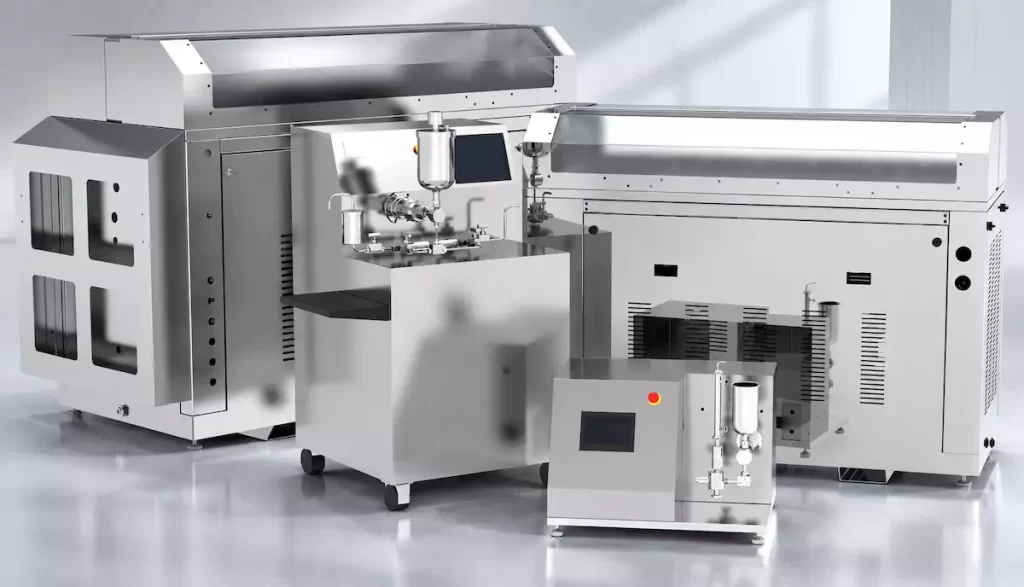
An equipment provider with in-house research and development, core-component manufacturing, and application-testing capabilities can help users evaluate processing feasibility and optimize operating conditions for specific materials. This is particularly valuable when standard equipment configurations do not fully meet the requirements of specialized nanomaterial or pharmaceutical research.
Conclusion: Improving Nanoparticle Quality Through Controlled Microfluidization
PDI is an important indicator of particle size distribution in nanoparticle preparation, helping researchers evaluate the uniformity of a formulation alongside its average particle size and other quality attributes. Although a lower PDI is often desirable, the appropriate target depends on the material, measurement method, and intended application.
High-pressure microfluidization offers an effective processing approach for reducing particle size, improving dispersion, and supporting repeatable nanoparticle preparation under optimized conditions. By controlling operating pressure, pass number, temperature, and formulation characteristics, researchers can investigate how processing influences particle size distribution and overall formulation performance.
From pharmaceutical research and advanced materials to new energy, food, and chemical applications, the combination of appropriate equipment design and systematic process optimization can help accelerate nanomaterial development.
For organizations seeking reliable high-pressure microfluidization equipment, working with a manufacturer that understands both precision engineering and application requirements can make a meaningful difference. Integrated equipment development, in-house core-component manufacturing, and application-specific technical support provide a strong foundation for developing reproducible processing protocols and advancing nanoparticle research from laboratory experimentation toward practical production.
