
Table of Contents
In nanomaterial research, advanced pharmaceutical manufacturing, and food processing, the ability to achieve fine, uniform dispersion directly affects final product quality. Traditional homogenization equipment may struggle to achieve nanoscale particle refinement or encounter challenges such as clogging and potential metal contamination.
JUNJIE addresses these challenges with its high-pressure microfluidics homogenizer, developed around ultra-high-pressure microfluidics technology. Designed for precise particle processing and uniform dispersion, it offers an alternative for manufacturers and research laboratories seeking improved processing performance and scalable solutions.
Working Principle: Achieving Nanoscale Refinement Through Multiple Physical Effects
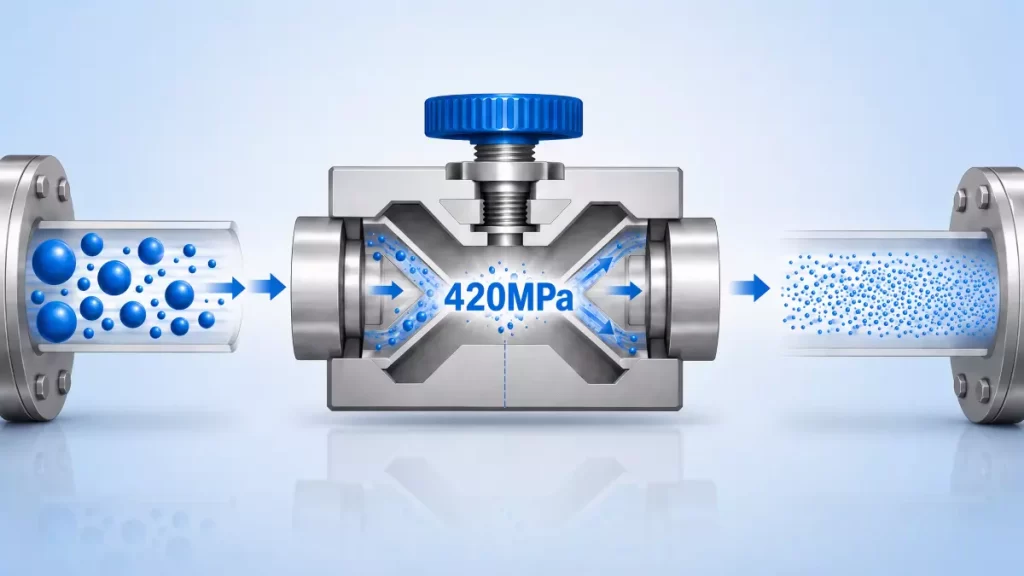
The core of JUNJIE’s high-pressure microfluidics homogenizer is its specialized ultra-high-pressure microfluidics technology, which differs from the operating principles of conventional high-pressure homogenizers.
The system uses ultra-high pressure of up to 420 MPa to drive materials through a specially designed diamond interaction chamber at extremely high velocity. Within the chamber, materials experience multiple physical effects, including intense shear, high-frequency disturbances, impact forces, and cavitation.
The combined effects help break down particles and aggregates, supporting nanoscale refinement and more uniform particle-size distribution. This can help address common processing challenges such as uneven dispersion and inconsistent active-ingredient distribution.
JUNJIE also incorporates high-hardness diamond components and specialized alloys into critical processing areas. These materials are designed to improve component durability and reduce the risk of metal contamination associated with wear in conventional processing systems.
This design is particularly relevant to pharmaceutical and nanomaterial applications where material purity and processing consistency are important considerations.
Key Advantages: Addressing Common Homogenization Challenges
Compared with conventional high-pressure homogenizers, JUNJIE’s high-pressure microfluidics homogenizer is designed to address practical challenges in maintenance, process adaptability, and production efficiency.
Easier Maintenance and Operation
High-solid-content or aggregation-prone materials can create clogging challenges in some homogenization systems. JUNJIE optimizes the flow path and uses a detachable interaction chamber to facilitate inspection and cleaning.
This design can simplify maintenance procedures and help reduce downtime. Actual clogging performance depends on material properties, particle characteristics, and operating conditions.
Flexible Solutions for Different Applications
From small-scale laboratory research to industrial production, JUNJIE offers equipment configurations for different processing requirements.
Benchtop systems are suitable for laboratory experiments, formulation development, and small-volume sample testing. Larger high-pressure microfluidics homogenizers support pilot-scale development and industrial processing.
Processing parameters and system configurations can also be customized according to material characteristics, throughput requirements, and specific process objectives.
Consistent Dispersion and Improved Process Efficiency
Uniform nanoscale dispersion can help improve product consistency and stability. In pharmaceutical applications, it can support more uniform distribution of active ingredients and the development of advanced delivery systems.
In nanomaterial processing, controlled particle-size distribution and dispersion can help improve the consistency of material properties. By reducing processing variability and quality-related losses, a properly optimized homogenization process may also contribute to better production efficiency.
Industry Applications: Supporting Advanced Processing Across Multiple Sectors
JUNJIE’s high-pressure microfluidics homogenizer serves a broad range of industry application in where particle refinement, dispersion, and processing consistency are essential.
Pharmaceutical and Biopharmaceutical Applications
The equipment can be evaluated for protein processing, lipid-based formulation development, liposome preparation, and other applications requiring controlled particle processing.
By refining particles and improving dispersion, homogenization can support formulation development and help optimize delivery-system performance. The final effects on bioavailability, stability, and product quality depend on the formulation and must be verified experimentally.
Nanomaterials and Advanced Materials
In nanomaterial research, ultra-high-pressure microfluidics technology can help disperse particles, break down aggregates, and support the preparation of nanoscale materials.
Potential applications include advanced functional materials, new-energy materials, and other research areas where particle-size control and dispersion quality influence material performance.
Food and Beverage Processing
The equipment can be used to evaluate homogenization processes for premium dairy products, functional beverages, plant-based formulations, and other food products.
Improved particle dispersion may help enhance texture, reduce sedimentation, and improve physical stability. Depending on the formulation and process conditions, homogenization may also support more consistent product quality and help maintain desired sensory characteristics.
Homogenization should not be considered a substitute for validated microbial inactivation or food preservation processes.
Other Research and Industrial Applications
Additional applications may include biotechnology, environmental testing, chemical processing, and laboratory research. In these fields, the ability to control particle dispersion and processing conditions can support experimental development and process optimization.
Product Portfolio: From Laboratory Research to Industrial Production
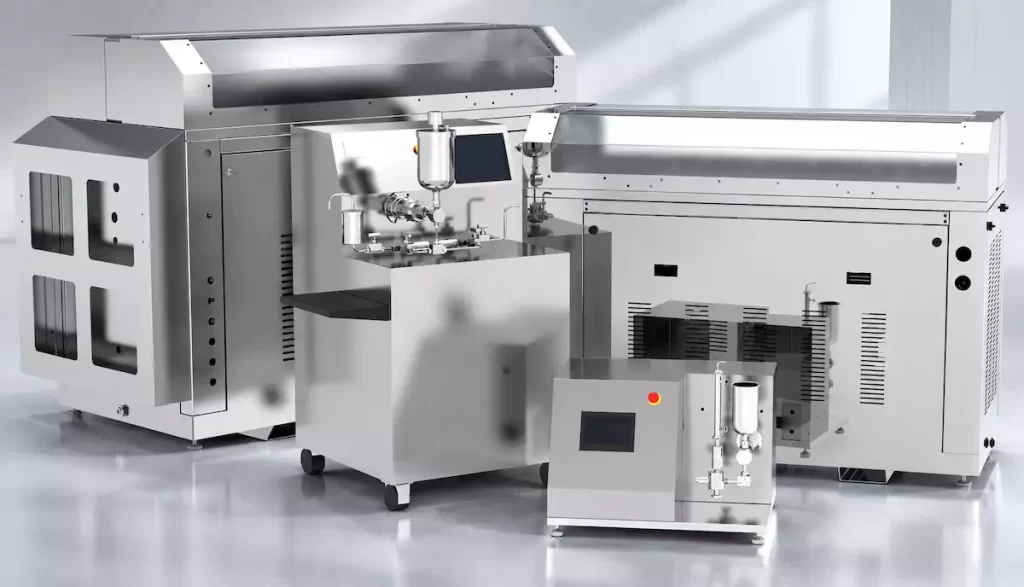
JUNJIE’s high-pressure microjet homogenizer product line covers the entire process from laboratory-scale to mass production and is divided into four main series:
- 10L lab scale high pressure homogenizer
- 250L high pressure pilot scale homogenizer
- 500Lindustrial high pressure microfluidics homogenizer
- Custom high-pressure homogenizer
The product range uses diamond interaction chamber technology to support nanoscale particle refinement and uniform dispersion, with selected systems operating at pressures of up to 420 MPa.
Laboratory Model: HPW-10
Application: Laboratory research, formulation development, and small-volume sample processing.
Key specifications:
- Nominal processing capacity: 10 L
- Minimum sample volume: approximately 20 mL
- Drive system: servo-electric cylinder
- Maximum working pressure: approximately 420 MPa
Key features:
The HPW-10 is designed for stable operation and precise pressure control. It features a high-resolution touchscreen, automatic data recording, and remote monitoring capabilities.
Its ability to handle small sample volumes makes it suitable for research involving valuable materials, preliminary formulation trials, and laboratory process development.
Pilot-Scale Model: HPW-250
Application: Bridging laboratory research and industrial process scale-up.
Key specifications:
- Nominal processing capacity: 250 L
- Hydraulic drive power: 37 kW
- Maximum working pressure: up to 420 MPa
Key features:
The HPW-250 provides the processing power required for pilot-scale development and can be configured for high-viscosity materials and particle aggregates, subject to formulation requirements.
Its integrated clean-in-place (CIP) and sterilize-in-place (SIP) capabilities support cleaning and sanitation workflows, helping improve operational efficiency and reduce contamination risks when properly validated.
Production Model: HPW-500
Application: Large-scale industrial production and continuous processing requirements.
Key specifications:
- Nominal processing capacity: 500 L
- Hydraulic drive power: 75 kW
- Maximum working pressure: up to 420 MPa
- Designed for extended industrial operation
Key features:
The HPW-500 is designed for demanding production environments where processing capacity and operational stability are priorities.
Its high-power hydraulic drive supports intensive processing requirements, while the integrated CIP/SIP system facilitates in-place cleaning and sanitation. These features can help reduce cleaning-related downtime and support consistent production workflows.
Actual throughput and continuous operating performance depend on material properties, process settings, and production conditions.
Customized Model: HPW-X
Application: Specialized materials, non-standard processing requirements, and customized production systems.
Core capabilities:
Built around ultra-high-pressure microfluidics technology, the HPW-X can be configured according to processing capacity, material characteristics, and specific process requirements.
Customization options may include the drive system, homogenization chamber structure, and control system.
Key features:
The HPW-X supports applications across pharmaceutical processing, food and beverage manufacturing, and advanced materials research. Its flexible configuration can accommodate different development stages, from laboratory testing to industrial production.
JUNJIE: Practical Homogenization Technology for Real-World Applications
JUNJIE specializes in ultra-high-pressure microfluidics technology, combining equipment development with practical application engineering.
With in-house research, manufacturing, and technical support capabilities, JUNJIE works with customers to evaluate processing requirements, select suitable equipment configurations, and develop customized homogenization solutions.
Whether a customer needs a laboratory microfluidic homogenizer for nanoscale research or an industrial high-pressure microfluidics homogenizer for large-scale production, JUNJIE provides equipment options designed around specific application requirements.
Its focus on practical performance, system customization, and ongoing technical support helps research institutions and manufacturers move from initial experiments toward scalable processing solutions.
Conclusion: Advancing Nanoscale Processing with JUNJIE
Achieving uniform nanoscale dispersion requires more than simply increasing operating pressure. Chamber design, physical processing effects, material compatibility, and process control all influence the final outcome.
JUNJIE’s high-pressure microfluidics homogenizer combines diamond interaction chamber technology with ultra-high-pressure microfluidics technology to support particle refinement, uniform dispersion, and process development across multiple industries.
From laboratory research and pilot-scale validation to industrial production, JUNJIE offers a range of equipment configurations to help customers explore suitable processing conditions and develop scalable solutions.
