

Table of Contents
The development of advanced biopharmaceuticals increasingly depends on precise particle engineering, formulation stability, and reproducible processing. From lipid nanoparticles (LNPs) for nucleic acid delivery to nanoscale drug carriers and protein-based formulations, manufacturers need reliable technologies that can achieve consistent particle characteristics while supporting efficient process development and scale-up.
A microfluidic device designed for high-pressure homogenization can play an important role in meeting these requirements. By combining controlled fluid flow, intense shear, turbulence, and rapid energy dissipation within specialized interaction chambers, microfluidic high-pressure homogenization helps reduce particle size, improve dispersion uniformity, and support the development of stable pharmaceutical formulations.
As biopharmaceutical manufacturing moves toward more sophisticated delivery systems and increasingly demanding quality requirements, microfluidic technology and high-pressure homogenization are becoming valuable tools for formulation research, process optimization, and production development.
This article explores how microfluidic homogenizers work, their applications in biopharmaceutical preparation, and the key factors to consider when selecting equipment for laboratory research and industrial manufacturing.
Why Particle Engineering Matters in Biopharmaceutical Manufacturing
Biopharmaceutical products often involve complex molecules, sensitive active ingredients, or sophisticated delivery systems. Their performance can depend on multiple formulation and process parameters, including particle size, size distribution, surface characteristics, aggregation behavior, and physical stability.
For nanoparticle-based formulations, these characteristics can influence drug encapsulation, colloidal stability, biological interactions, and batch-to-batch reproducibility.
Traditional processing methods may encounter limitations when manufacturers need to achieve a narrow particle size distribution, reduce aggregation, or establish a reproducible process across different production scales. Mechanical processing technologies that provide controllable and repeatable energy input can help address these challenges.
Key Processing Requirements
Precise particle size control
Many advanced drug delivery systems require particles within a defined size range. Consistent processing conditions help researchers optimize particle size and distribution according to formulation requirements.
Improved dispersion uniformity
Effective homogenization can break down larger particles or aggregates and improve the uniformity of dispersed systems, depending on the formulation and process conditions.
Formulation stability
Reducing oversized particles and improving dispersion quality may help address physical instability. However, stability must be evaluated for each formulation, as homogenization alone does not guarantee long-term stability.
Process reproducibility
Biopharmaceutical development requires well-defined operating parameters and consistent processing performance. Reproducible equipment operation helps researchers establish process windows and evaluate critical quality attributes.
Scalable process development
A laboratory process must eventually be translated into a suitable pilot or production process. Equipment that supports systematic parameter optimization and scale-up evaluation can make this transition more manageable.
These requirements make particle-processing equipment an important consideration throughout biopharmaceutical formulation development.
How Does a Microfluidic Device Work in High-Pressure Homogenization
A microfluidic device uses controlled fluid movement through small channels or specialized flow structures to manipulate fluids at defined scales. Depending on its design, it may facilitate mixing, emulsification, particle formation, or other fluid-processing operations.
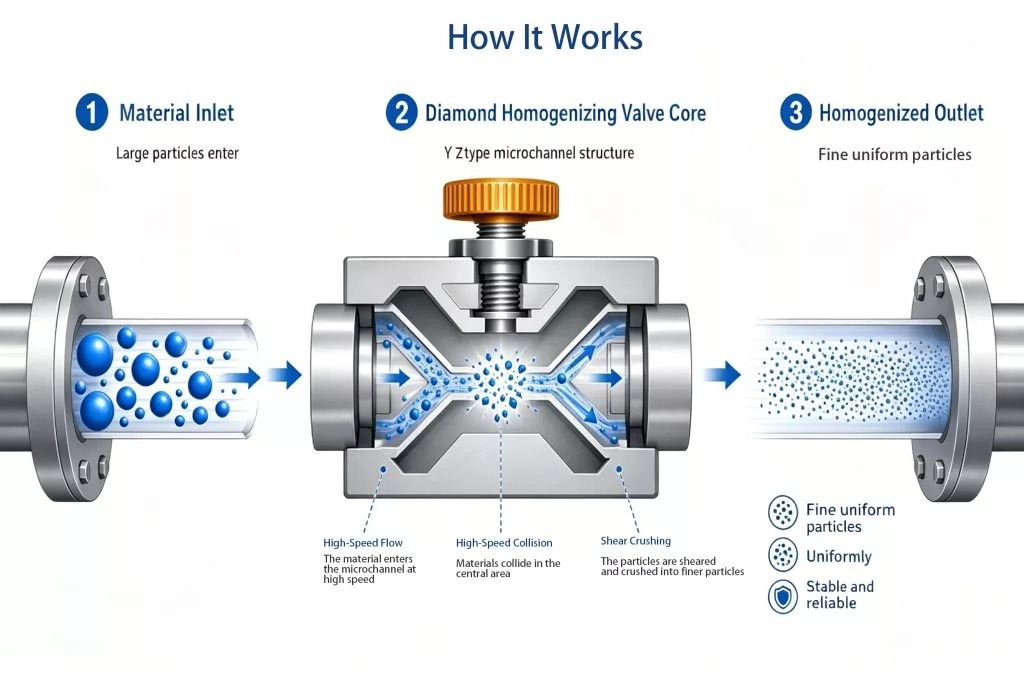
Microfluidic high-pressure homogenization applies high pressure to force a fluid or suspension through a specialized interaction chamber. Within this chamber, rapid acceleration, intense shear, turbulence, and other hydrodynamic effects can generate the energy needed to reduce particle size and improve dispersion.
Although microfluidic mixing devices and high-pressure homogenizers can both be used in nanoparticle processing, they are not identical technologies. Conventional microfluidic mixers commonly rely on controlled mixing within microchannels, while high-pressure homogenizers generate intense mechanical and hydrodynamic effects through a high-pressure processing chamber. Some advanced systems combine aspects of both approaches.
The High-Pressure Homogenization Process
Step 1: Pressurization
The feed material is delivered by a high-pressure pump or intensifier to establish the required processing pressure.
Step 2: Controlled Fluid Acceleration
The pressurized material passes through a specialized homogenization chamber, where the geometry of the flow path influences fluid velocity and local energy dissipation.
Step 3: Particle Size Reduction
Depending on the formulation, the resulting shear forces, turbulence, and related hydrodynamic effects can disrupt agglomerates, reduce droplet size, or break down larger dispersed structures.
Step 4: Improved Dispersion
The processed material is collected for evaluation. Researchers can measure particle size, polydispersity index (PDI), stability, and other relevant quality attributes to determine whether the processing conditions meet the formulation requirements.
Step 5: Parameter Optimization
Pressure, processing cycles, feed composition, temperature, and other process variables can be adjusted systematically to establish a suitable operating window.
The actual results depend on the material properties, formulation, chamber design, operating conditions, and thermal sensitivity of the product. Therefore, process validation should be based on experimental data rather than pressure settings alone.
Key Applications of Microfluidic Technology in Biopharmaceutical Preparation
Microfluidic technology and high-pressure homogenization support different stages of pharmaceutical formulation development. Their suitability depends on the product’s physical characteristics, required particle size, production volume, and processing sensitivity.
Lipid Nanoparticles for Nucleic Acid Delivery
Lipid nanoparticles are widely investigated as delivery systems for messenger RNA (mRNA), small interfering RNA (siRNA), and other nucleic acid therapeutics.
Their performance depends on several factors, including particle size, size distribution, lipid composition, encapsulation efficiency, and storage stability.
High-pressure homogenization can help refine the particle characteristics of suitable lipid-based formulations. It may be particularly useful when a formulation requires additional particle size reduction or dispersion optimization after an initial preparation step.
In some LNP manufacturing processes, rapid mixing of lipid and aqueous streams is used to initiate nanoparticle formation. Microfluidic mixing and high-pressure homogenization can therefore serve complementary roles rather than acting as interchangeable processes.
Potential benefits of a well-optimized process include:
- More consistent particle size and distribution.
- Improved dispersion quality.
- A controllable processing window for formulation development.
- Support for evaluating formulation performance across processing conditions.
The appropriate processing strategy must be established experimentally, especially for formulations containing sensitive nucleic acids or structurally complex lipid assemblies.
Liposomes and Advanced Drug Delivery Systems
Liposomes are vesicular carriers composed primarily of lipid bilayers. They are used in pharmaceutical research to encapsulate and deliver a range of active ingredients.
A key challenge in liposome preparation is controlling vesicle size and size distribution while preserving the integrity of the lipid membrane and the encapsulated compound.
High-pressure homogenization can reduce the size of suitable liposomal dispersions and improve their uniformity. Researchers must nevertheless evaluate the effects of pressure, processing cycles, and temperature on vesicle structure, encapsulation efficiency, and formulation stability.
This makes process optimization essential when developing liposomal formulations for specific drug delivery applications.
Nanoemulsions and Pharmaceutical Emulsions
Nanoemulsions are dispersions of two immiscible liquids, typically oil and water, stabilized by appropriate emulsifiers or surfactants.
They are investigated for applications such as poorly water-soluble drug delivery and selected topical or other pharmaceutical formulations.
High-pressure homogenization generates mechanical and hydrodynamic forces that can break larger droplets into smaller ones. The resulting droplet size depends on the formulation, interfacial properties, operating pressure, and number of processing passes.
Potential applications include:
- Oil-in-water pharmaceutical emulsions.
- Lipid-based drug delivery formulations.
- Selected topical and dermal delivery systems.
- Formulation research involving hydrophobic active ingredients.
A smaller droplet size does not automatically guarantee superior performance. Formulation composition, interfacial stability, active ingredient compatibility, and the intended route of administration must all be considered.
Protein and Peptide Formulation Research
Proteins and peptides can be sensitive to mechanical stress, temperature changes, and interactions with processing surfaces.
In selected formulation workflows, homogenization may be investigated to improve dispersion or manage particle formation. However, the processing conditions must be carefully controlled to avoid undesirable aggregation, unfolding, or loss of biological activity.
For these applications, researchers should evaluate product recovery, aggregation, structural integrity, and relevant biological activity alongside particle size measurements.
A suitable microfluidic device or high-pressure homogenizer should therefore be selected according to the specific material and the required quality attributes, rather than on particle size reduction capability alone.
Nanocrystals and Poorly Soluble Drug Compounds
Many pharmaceutical compounds have limited aqueous solubility, creating challenges for formulation development.
Nanocrystal technologies aim to reduce drug crystal size and increase the available surface area, potentially improving dissolution behavior under suitable conditions.
High-pressure homogenization is one established approach used in the preparation of pharmaceutical nanosuspensions. Repeated processing can reduce the size of drug particles, provided that the material properties and formulation are compatible with the process.
Important evaluation criteria include particle size distribution, crystal form, dissolution behavior, physical stability, and the potential for particle growth during storage.
These measurements help determine whether a homogenization process is suitable for the intended pharmaceutical application.
What to Look for in a Microfluidic Device for Biopharmaceutical Manufacturing
Selecting a microfluidic device or high-pressure homogenizer involves more than comparing maximum operating pressure or nominal processing capacity.
For biopharmaceutical manufacturing, equipment should support controlled processing, reliable operation, material compatibility, and a clear path from formulation research to production.
Pressure Control and Operating Stability
Pressure is a critical parameter in high-pressure homogenization because it influences the energy delivered to the processing chamber.
Stable pressure control helps researchers compare experiments and establish reproducible operating conditions. However, the appropriate pressure range must be determined according to the formulation, chamber design, and processing objective.
When evaluating equipment, consider the available pressure range, control accuracy, operating stability, and suitability for continuous or repeated-pass processing.
Interaction Chamber Design
The homogenization chamber is central to the equipment’s processing performance.
Its geometry influences fluid acceleration, flow distribution, energy dissipation, and the forces acting on particles or droplets. Chamber materials and surface characteristics are also important when processing sensitive or valuable pharmaceutical formulations.
A well-designed chamber should provide consistent processing performance while supporting maintenance, cleaning, and replacement requirements appropriate to the application.
Core Component Engineering
The performance of a high-pressure homogenizer depends on the coordinated operation of multiple components, including the pressure-generation system, homogenization chamber, seals, valves, and fluid-handling assemblies.
In-house development and manufacturing of critical components can provide closer control over component specifications, equipment integration, and manufacturing consistency.
For equipment buyers, it is worth assessing the manufacturer’s engineering capabilities, quality management practices, component traceability, and ability to support application-specific requirements.
Material Compatibility and Product Protection
Biopharmaceutical formulations can be sensitive to temperature, shear, contamination, and contact with equipment surfaces.
A suitable processing system should allow researchers to evaluate temperature changes during processing, material compatibility, product recovery, and the potential impact on product quality.
For pharmaceutical applications, cleaning procedures, contamination control, and compatibility with the intended manufacturing environment should be assessed during equipment selection.
Reproducibility and Process Documentation
Reliable formulation development requires consistent experimental conditions and documented results.
Equipment should support systematic adjustment of relevant process parameters and enable researchers to record operating conditions alongside formulation data.
Depending on the intended application, buyers may also need to evaluate instrumentation, data recording, process monitoring, and integration with existing laboratory or production systems.
These capabilities help establish a more robust basis for process development and technology transfer.
Scale-Up and Throughput Flexibility
Laboratory research and commercial production involve different processing volumes and operational requirements.
An equipment platform that supports laboratory evaluation, pilot-scale development, and larger-scale processing can help reduce discontinuities during technology transfer.
However, scale-up should not be assumed to depend on a simple increase in pressure or processing time. Flow conditions, chamber geometry, temperature, residence time, and formulation behavior may change with scale.
A systematic scale-up strategy should verify that the relevant product quality attributes remain within established specifications.
From Laboratory Research to Industrial Biopharmaceutical Manufacturing
Moving a formulation from laboratory development to manufacturing requires a repeatable process and a clear understanding of the relationship between operating parameters and product quality.
A structured development approach can help identify suitable conditions before committing to larger production volumes.
Stage 1: Feasibility Testing
Begin with a representative formulation and define the target particle size, size distribution, and other critical quality attributes.
Evaluate whether high-pressure homogenization is appropriate for the material and establish initial processing conditions.
Stage 2: Process Parameter Optimization
Investigate the effects of pressure, processing cycles, feed composition, temperature, and other relevant variables.
Use particle size analysis, PDI, stability testing, and application-specific measurements to identify a suitable operating window.
Stage 3: Repeatability Assessment
Repeat experiments under defined conditions to assess process variability.
For sensitive formulations, include measurements of encapsulation efficiency, product recovery, structural integrity, or biological activity as appropriate.
Stage 4: Pilot-Scale Verification
Evaluate the process at a larger scale and determine whether the required product characteristics can be maintained.
Pay particular attention to throughput, thermal effects, equipment performance, and changes in the processing environment.
Stage 5: Manufacturing Process Development
Establish operating procedures, acceptance criteria, maintenance requirements, and documentation appropriate to the intended manufacturing process.
For regulated pharmaceutical applications, equipment qualification, process validation, cleaning validation, and other applicable quality-system requirements must be addressed according to the product and manufacturing context.
A carefully planned transition from laboratory experiments to production helps manufacturers make decisions based on verified process performance rather than equipment specifications alone.
Conclusion: Choosing the Right Microfluidic Device for Your Application
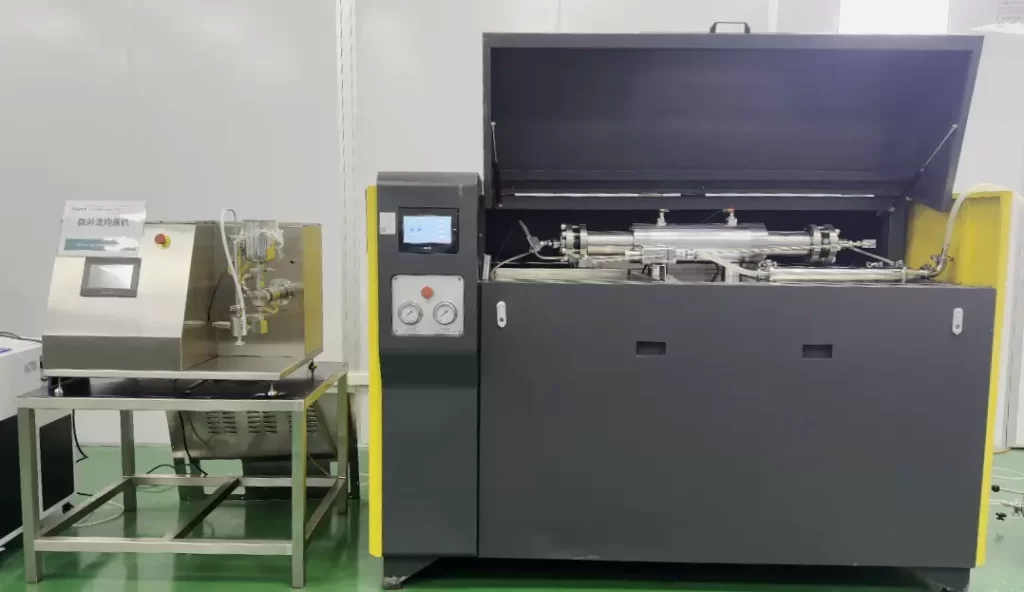
A suitable microfluidic device or high-pressure homogenizer can be an important part of biopharmaceutical formulation development, particularly when precise particle engineering, dispersion uniformity, and reproducible processing are required.
From lipid nanoparticles and liposomes to nanoemulsions and pharmaceutical nanosuspensions, the right processing strategy depends on the formulation, target particle characteristics, material sensitivity, and intended production scale.
Successful implementation requires more than selecting equipment with a high pressure rating. It involves understanding the processing mechanism, optimizing operating parameters, evaluating critical quality attributes, and establishing a reliable path from laboratory research to manufacturing.
For organizations developing advanced pharmaceutical formulations, working with an equipment manufacturer that combines core component engineering, application expertise, and integrated technical support can provide a stronger foundation for process development.
Frequently Asked Questions
1. What is a microfluidic device used for in biopharmaceutical manufacturing?
A microfluidic device can be used to control fluid movement, mixing, particle formation, and other processing operations in pharmaceutical research and manufacturing. Depending on its design, it may support lipid nanoparticle preparation, formulation development, or related nanoscale processing applications.
2. How does high-pressure homogenization help control nanoparticle size?
High-pressure homogenization forces a material through a specialized chamber, generating intense hydrodynamic forces that can reduce particle or droplet size and disrupt agglomerates. The final particle characteristics depend on formulation composition, operating pressure, chamber design, processing cycles, and other process conditions.
3. Are microfluidic mixing and high-pressure homogenization the same technology?
No. Microfluidic mixing typically relies on controlled fluid movement and mixing within microchannels or defined flow structures. High-pressure homogenization relies on pressurized flow through a specialized interaction chamber to generate forces that reduce particle size or improve dispersion. The technologies may complement each other in certain workflows.
4. Can high-pressure homogenization be used for lipid nanoparticles?
It can be used in selected lipid nanoparticle processing workflows, depending on the formulation and the intended processing objective. Researchers should evaluate particle size, PDI, encapsulation efficiency, stability, and any effects on formulation integrity before determining whether the process is suitable.
5. What factors should be considered when selecting a microfluidic device?
Important considerations include processing mechanism, pressure range, chamber design, material compatibility, temperature control, reproducibility, throughput, maintenance requirements, and scale-up capability. Application testing is essential to confirm that the selected system meets the target product quality requirements.
6. How can a laboratory homogenization process be scaled up?
Scale-up requires systematic evaluation of processing parameters, throughput, chamber performance, temperature, and formulation behavior. Researchers should verify product quality and process repeatability at each development stage rather than assuming that laboratory settings can be transferred directly to production.
7. Does high-pressure homogenization guarantee pharmaceutical sterility?
No. High-pressure homogenization is primarily a particle-processing technology and should not be assumed to provide a validated sterilization process. Sterility assurance depends on the product, manufacturing process, equipment design, and applicable pharmaceutical requirements.
