

Table of Contents
As research and manufacturing move toward increasingly complex materials, controlling particle size, dispersion, stability, and structural uniformity has become critical. From nanomaterials and lipid nanoparticles to advanced formulations, functional foods, and pharmaceutical systems, conventional mixing methods often struggle to deliver the consistency required for modern applications.
Microfluidic high pressure homogenization is emerging as a powerful processing technology for addressing these challenges. By forcing materials through a specialized interaction chamber under high pressure, the technology generates intense shear, turbulence, collision, and cavitation effects that can efficiently reduce particle size and improve dispersion.
For laboratories, research institutions, and industrial manufacturers, this provides a controllable route from material development to scalable production.
What Is Microfluidic High Pressure Homogenization?
Microfluidic high pressure homogenization is a high-energy fluid processing technology designed to process suspensions, emulsions, dispersions, and other complex material systems at the microscale.
During processing, a sample is pressurized and driven through a specially engineered interaction chamber. As the fluid passes through the chamber at high velocity, pressure energy is converted into localized mechanical forces. Depending on the interaction chamber design and process conditions, these forces can include:
- High shear forces
- Turbulence
- Particle-particle collision
- Cavitation
- Rapid pressure changes
- Extensional and impact forces
These mechanisms work together to break down agglomerates, reduce particle dimensions, improve dispersion, and promote greater uniformity throughout the processed material.
Unlike conventional stirring or mechanical mixing, the process does not simply move particles through a vessel. It creates controlled microscale interactions that can significantly influence the physical properties of the final product.
Why Microfluidic Homogenization Matters for Nanotechnology
Nanotechnology often depends on precise control over particles and structures at extremely small scales. However, producing nanoscale materials is only one part of the challenge. Maintaining uniform dispersion and preventing particles from re-agglomerating can be equally important.
For example, nanoparticles may have a strong tendency to aggregate because of surface energy and interparticle interactions. Poor dispersion can lead to inconsistent particle size, reduced functional performance, sedimentation, or unstable formulations.
Microfluidic high pressure homogenization provides a physical processing approach for improving these characteristics.
By applying controlled high-pressure forces repeatedly, a microfluidic homogenizer can help:
- Reduce particle size and agglomerates.
- Improve dispersion uniformity.
- Increase suspension stability.
- Produce more consistent emulsions.
- Facilitate repeatable laboratory experiments.
- Support process scale-up from R&D to production.
This makes high pressure homogenization particularly relevant to nanomaterial development, nanoemulsions, lipid nanoparticles, liposomes, and other advanced material systems.
How a Microfluidic Homogenizer Works
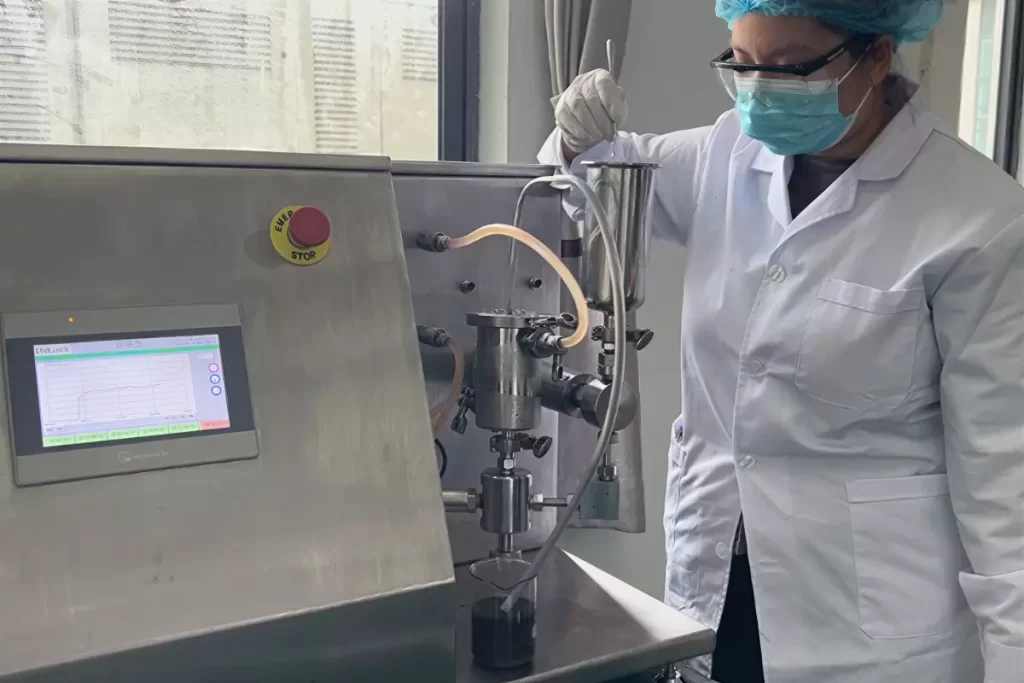
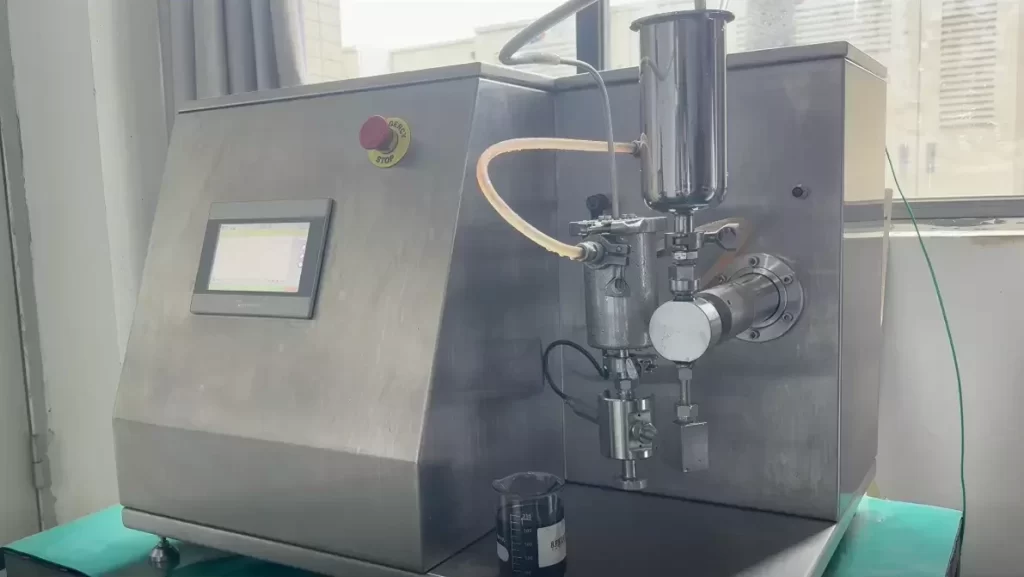
A microfluidic homogenizer typically consists of several core systems, including a high-pressure pumping or boosting system, pressure control components, pipelines, and an interaction chamber.
The interaction chamber is one of the most important components because it determines how the material experiences high-pressure mechanical forces.
A simplified process can be described as:
Feed Material → Pressurization → Microfluidic Interaction → Particle Disruption → Homogeneous Product
The material first enters the high-pressure system. A booster or intensifier increases the pressure to the required processing level. The pressurized stream then enters the interaction chamber, where rapid changes in flow velocity and pressure generate strong physical forces.
The processed material exits the chamber with improved particle dispersion and a more uniform structure.
Different interaction chamber geometries can generate different processing effects. Therefore, chamber design, pressure, number of passes, sample characteristics, and temperature control all need to be considered when developing a process.
Applications in Nanomaterial Processing
The growing demand for advanced materials has expanded the application of microfluidic homogenization beyond traditional food and pharmaceutical processing.
Nanoparticle Dispersion
Nanoparticles frequently need to be uniformly dispersed within liquids or other carrier systems. Agglomeration can negatively affect optical, electrical, catalytic, mechanical, or biological performance.
High pressure microfluidic processing can help break down agglomerates and improve the uniformity of nanoparticle suspensions.
Potential applications include:
- Ceramic nanoparticles
- Metal and metal oxide nanoparticles
- Carbon-based nanomaterials
- Functional powders
- Pigments and advanced coatings
- Battery-related material systems
The actual processing effect depends on material properties and formulation conditions, so process parameters should be established through experimental validation.
Liposomes and Lipid Nanoparticles
In pharmaceutical and biotechnology research, particle size and distribution can influence formulation stability, delivery performance, and biological behavior.
Microfluidic high pressure homogenization can be used as part of processing workflows for liposomes, lipid-based formulations, and other nanoscale delivery systems.
Controlled processing may help researchers investigate how pressure, processing cycles, formulation composition, and temperature influence particle characteristics.
This makes the technology valuable for both formulation development and process optimization.
Nanoemulsions
Nanoemulsions require efficient droplet size reduction and stable distribution of dispersed phases.
Compared with conventional high-speed mixing, microfluidic processing can provide much stronger and more controlled mechanical forces. This can support the development of fine emulsions for applications including pharmaceuticals, cosmetics, functional foods, and specialty chemicals.
Supporting New Materials and New Energy Research
Advanced materials for batteries, energy storage, electronics, and other emerging technologies often require precise dispersion and processing.
For example, researchers may need to disperse conductive materials, functional nanoparticles, ceramic particles, or other components into liquid systems.
The performance of these formulations can be affected by:
- Particle size
- Agglomeration
- Dispersion uniformity
- Solid concentration
- Viscosity
- Processing history
- Temperature
Microfluidic high pressure homogenization provides researchers with another controllable processing variable.
Rather than relying solely on chemical additives or prolonged mechanical mixing, researchers can investigate how controlled mechanical forces affect material structures and dispersion behavior.
This is particularly useful during early-stage material development, where researchers need to compare formulations and establish repeatable processing windows.
Advantages of Microfluidic High Pressure Homogenization
For advanced material processing, the technology offers several important advantages.
Precise Particle Size Control
Controlled processing conditions can help researchers reduce particle size and investigate the relationship between processing parameters and material characteristics.
Improved Dispersion
Strong microscale forces can break down agglomerates and improve the distribution of particles throughout a liquid system.
Repeatable Processing
Digital pressure monitoring, controlled operating conditions, and standardized processing procedures can improve experimental repeatability.
Flexible Applications
The technology can be applied to a broad range of formulations, including nanoparticles, emulsions, liposomes, plant-based materials, pharmaceuticals, and specialty chemicals.
Scalable Processing
Laboratory systems can be used to establish processing conditions before transferring the technology toward pilot and industrial equipment.
What Should Researchers Consider When Selecting a Microfluidic Homogenizer?
Selecting a homogenizer for nanotechnology research requires more than comparing maximum pressure.
Researchers should evaluate the entire processing system.
1. Processing Pressure
Different materials require different processing conditions. The equipment should provide sufficient pressure range and stable pressure control for the intended application.
2. Minimum Sample Volume
For universities and R&D laboratories, sample availability can be limited. A laboratory homogenizer capable of processing small sample volumes can significantly reduce material consumption during experimentation.
3. Interaction Chamber
The chamber determines how mechanical energy is applied to the sample. Different materials may require different chamber configurations.
4. Temperature Management
High-energy processing can generate heat. Temperature control is therefore important when working with heat-sensitive biological materials, pharmaceutical formulations, or other temperature-sensitive systems.
5. Data Monitoring
Pressure, temperature, processing cycles, and other operating parameters should be monitored and recorded whenever reproducibility is important.
6. Scale-Up Capability
A laboratory system should ideally provide a clear pathway toward pilot and production-scale equipment. This helps reduce the technical gap between research and commercialization.
7. Core Component Reliability
High-pressure boosters, valves, interaction chambers, seals, and material-contact components directly affect equipment stability and service life.
For long-term research and production applications, in-house engineering and manufacturing capabilities can provide an important advantage.
Building a More Integrated Approach to Advanced Material Processing
As nanotechnology continues to develop, material processing is becoming increasingly important. Researchers need technologies that can provide precise control while remaining flexible enough to accommodate different materials and experimental requirements.
Microfluidic high pressure homogenization addresses this need by combining high-pressure engineering with microscale fluid interactions.
For equipment manufacturers, this requires capabilities that extend from system design to the development and manufacturing of critical components.
A comprehensive platform may integrate independently developed high-pressure boosters, homogenization valves, diamond interaction chambers, control systems, and testing capabilities. This vertical integration can support faster equipment customization and more consistent system performance.
For researchers and manufacturers, the result is not simply a homogenizer, but a more complete material-processing platform.
JUNJIE Microfluidic High Pressure Homogenization: Enabling Precise Nanoscale Material Processing
JUNJIE’s microfluidic high pressure homogenization technology operates at pressures of up to 420 MPa. Powered by a diamond interaction chamber, it generates intense shear forces and cavitation effects to achieve precise 20–50 nm-scale dispersion and emulsification, addressing common challenges such as large particle sizes and inconsistent batch performance associated with conventional processing methods.
The all-diamond interaction chamber minimizes the risk of metal contamination, making the technology suitable for high-purity applications in industries such as semiconductor manufacturing and pharmaceuticals. A product portfolio based on unified pressure levels also supports linear process scale-up from laboratory research to mass production, helping significantly shorten the R&D-to-production cycle.
In applications including new energy battery materials, graphene exfoliation, and liposome drug preparation, JUNJIE technology enables uniform nanoscale dispersion, high retention of active ingredients, and consistent batch-to-batch performance, making it a powerful technology platform for advancing nanotechnology and advanced material processing.
Conclusion
Microfluidic high pressure homogenization is becoming an important technology for advanced material processing because it provides controlled mechanical forces for particle size reduction, dispersion, emulsification, and material structure optimization.
Its applications extend from nanotechnology and nanomaterial dispersion to pharmaceuticals, new energy materials, food, cosmetics, and specialty chemicals.
A high-performance microfluidic homogenizer should therefore be evaluated not only by its maximum pressure, but also by its interaction chamber technology, pressure stability, temperature management, sample-volume requirements, data monitoring, scalability, and core-component reliability.
As research moves toward increasingly sophisticated nanoscale materials, the ability to precisely control processing conditions will become even more important. Microfluidic high pressure homogenization provides a flexible bridge between laboratory discovery, process development, and scalable manufacturing.
