
Table of Contents
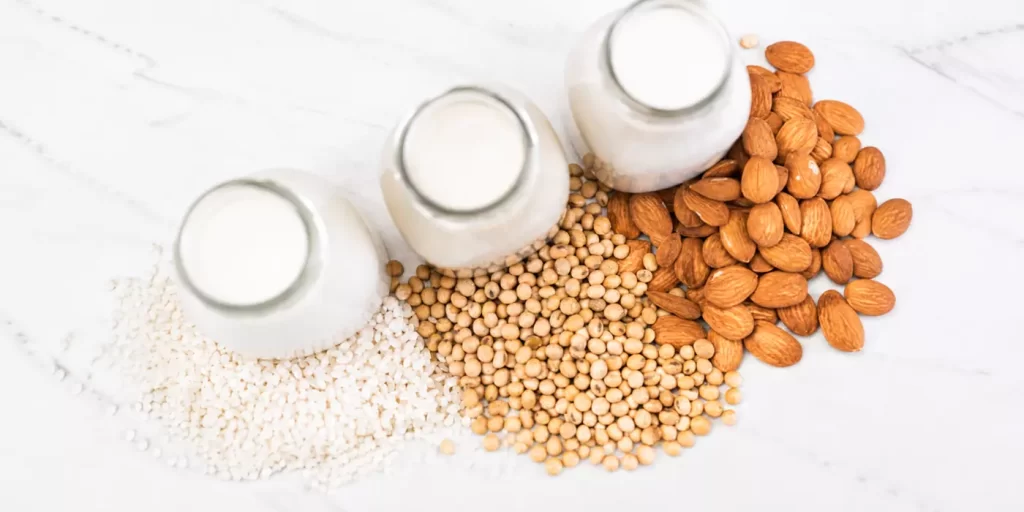
Plant-based protein beverages are becoming increasingly sophisticated as manufacturers respond to growing demand for dairy alternatives, high-protein nutrition products, functional drinks, and clean-label formulations. However, producing a beverage that remains smooth, stable, and consistent throughout its shelf life can be challenging.
Plant proteins such as pea, soy, oat, rice, and other botanical proteins often have relatively large particles, poor dispersibility, aggregation tendencies, and sedimentation issues. These characteristics can affect mouthfeel, appearance, nutritional consistency, and storage stability.
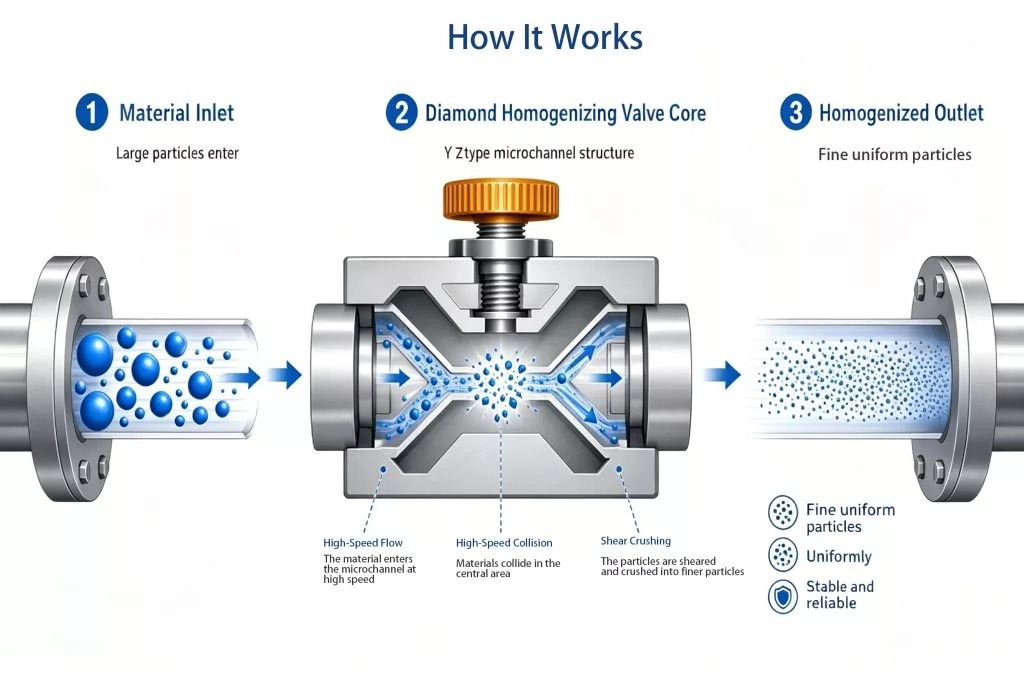
Microfluidization provides an advanced approach to controlling these properties. By forcing a formulation through a specialized interaction chamber under high pressure, a microfluidic homogenizer can generate intense shear, collision, and cavitation effects that reduce particle size and improve dispersion.
For manufacturers and research institutions developing plant-based protein beverages, microfluidization can provide a more controlled route toward improved particle distribution, suspension stability, texture, and formulation performance.
What Is Microfluidization?
Microfluidization is a high-pressure fluid processing technology designed to reduce particle size and improve the uniformity of dispersed systems.
Unlike conventional mechanical mixing, which primarily relies on bulk agitation, microfluidization accelerates a fluid through engineered microchannels or an interaction chamber. The resulting high-velocity flow generates controlled physical forces, including:
- High shear
- Particle-particle collision
- Turbulence
- Cavitation
- Rapid pressure changes
These mechanisms can break down protein aggregates and other suspended particles into smaller and more uniformly distributed structures.
A microfluidic homogenizer is therefore not simply a high-speed mixer. It is a precision processing system in which pressure, flow rate, interaction chamber design, temperature, and the number of processing passes can be controlled to achieve a target particle-size distribution.
For plant-based beverages, this distinction is important because the objective is not merely to mix protein powder with water. The goal is to create a stable and reproducible colloidal system with the desired physical and sensory properties.
Why Plant-Based Protein Beverages Are Difficult to Stabilize
Plant proteins behave differently from many conventional dairy-based ingredients. Their functional properties are affected by protein source, extraction method, particle size, pH, ionic strength, concentration, temperature, and interactions with other ingredients.
Common challenges include:
1. Particle Aggregation
Protein particles can aggregate during hydration and processing. Larger aggregates may produce a gritty or coarse mouthfeel and can contribute to sedimentation.
2. Poor Dispersion
Some plant proteins are difficult to disperse uniformly in water. Incomplete hydration can result in undissolved particles and inconsistent protein distribution.
3. Sedimentation
Large or dense particles can gradually settle during storage. This is particularly problematic for beverages that are expected to maintain a uniform appearance without constant shaking.
4. Grittiness and Poor Mouthfeel
Particle size has a significant influence on sensory perception. Large particles or aggregates may produce undesirable grittiness, whereas a more uniform dispersion can contribute to a smoother beverage texture.
5. Formulation Instability
Plant protein beverages often contain additional ingredients such as oils, carbohydrates, minerals, fibers, flavors, and functional compounds. Interactions among these components can make physical stability more difficult to control.
These challenges make particle-size management and dispersion quality important considerations during product development.
How Microfluidization Improves Plant-Based Protein Beverages
The main advantage of microfluidization is its ability to apply controlled high-energy processing to a fluid system.
When a plant-protein formulation passes through the interaction chamber of a microfluidic homogenizer, the flow conditions generate strong mechanical forces. These forces can disrupt larger aggregates and improve the uniformity of dispersed particles.
Particle Size Reduction
Reducing the size of protein aggregates can improve the physical stability of a beverage and help create a smoother sensory profile.
The actual particle size that can be achieved depends on the formulation, initial particle characteristics, pressure, interaction chamber, number of passes, and other process parameters. Therefore, particle-size reduction should be established experimentally rather than assumed from pressure alone.
Improved Protein Dispersion
Microfluidization can help distribute protein particles more uniformly throughout the liquid phase.
A more homogeneous dispersion can reduce localized aggregation and contribute to more consistent beverage quality from batch to batch.
Improved Suspension Stability
Smaller and more uniformly distributed particles generally have different settling behavior from larger aggregates. By reducing problematic particle populations, microfluidization can help improve suspension stability.
However, long-term stability also depends on formulation chemistry, density differences, viscosity, pH, ionic strength, and the presence of stabilizers or emulsifiers.
Smoother Texture
Particle-size control can directly affect the sensory characteristics of plant-based beverages.
Reducing large aggregates may help decrease undesirable particulate perception and produce a smoother mouthfeel.
Better Emulsion Performance
Many plant-based protein beverages contain vegetable oils or other hydrophobic ingredients. In these formulations, microfluidization can also contribute to droplet-size reduction and more uniform oil dispersion.
This makes microfluidization particularly useful when protein dispersion and emulsion stability need to be addressed within the same formulation.
Microfluidization Process for Plant-Based Protein Beverages
A typical development workflow can include several stages.
Step 1: Raw Material Preparation
Plant protein powder is dispersed into water or another aqueous phase.
The formulation may include additional ingredients such as:
- Plant oils
- Carbohydrates
- Minerals
- Dietary fibers
- Vitamins
- Flavor compounds
- Emulsifiers
- Stabilizers
The initial mixing stage should achieve sufficient hydration before high-pressure processing.
Step 2: Pre-Mixing and Hydration
The protein dispersion is pre-mixed to eliminate large dry agglomerates and allow the protein to hydrate.
Depending on the protein source and formulation, hydration time and temperature may need to be optimized.
Step 3: High-Pressure Microfluidization
The prepared dispersion is transferred to the microfluidic homogenizer.
Under high pressure, the fluid passes through the engineered interaction chamber. Intense shear, collision, turbulence, and cavitation forces act on the dispersed particles.
Step 4: Process Parameter Optimization
Key parameters can include:
- Processing pressure
- Flow rate
- Interaction chamber configuration
- Number of passes
- Product temperature
- Initial particle size
- Protein concentration
- Formulation composition
There is no single pressure setting that is optimal for every plant protein beverage. Process development should therefore combine equipment parameters with analytical testing.
Step 5: Cooling and Final Formulation
High-pressure processing can generate heat through mechanical energy dissipation. Temperature management may therefore be necessary, particularly for formulations containing heat-sensitive ingredients.
After processing, the beverage can proceed to final formulation, filling, packaging, and stability evaluation according to the product’s manufacturing process.
Key Parameters to Optimize
For industrial and research applications, pressure should not be considered the only important variable.
Processing Pressure
Higher pressure can increase the intensity of the processing effect, but more pressure does not automatically mean better beverage quality.
Excessive processing may be unnecessary or could alter the desired functional properties of the formulation.
Interaction Chamber
The interaction chamber is one of the most important components of a microfluidic homogenization system.
Different chamber geometries can generate different flow conditions and processing effects. For demanding applications, engineered interaction chambers can provide greater control over the processing environment.
Advanced systems may use diamond interaction chambers or other specialized geometries designed for high-pressure microfluidic processing.
Number of Passes
One pass may be sufficient for some formulations, while others may require multiple passes.
Additional passes should be evaluated based on particle-size reduction, stability, viscosity, temperature increase, and energy consumption.
Temperature
Temperature can influence protein functionality, viscosity, emulsion behavior, and the stability of heat-sensitive components.
Real-time temperature monitoring and cooling control can therefore be important during process development.
Particle Size Distribution
Average particle size alone does not provide a complete picture of beverage stability.
Researchers should consider particle-size distribution, aggregation behavior, PDI where appropriate, zeta potential, viscosity, and accelerated storage stability.
Microfluidization vs. Conventional Mixing
Conventional mixing is useful for initial dispersion and hydration, but it may not provide sufficient energy or control to effectively break down persistent protein aggregates.
Microfluidization offers a different processing mechanism.
| Processing Approach | Conventional Mixing | Microfluidization |
|---|---|---|
| Main mechanism | Bulk agitation | High-pressure microfluidic processing |
| Particle reduction | Limited | High potential |
| Aggregate disruption | Moderate | Strong |
| Flow environment | Relatively uncontrolled | Engineered interaction chamber |
| Nano-scale applications | Limited | Well suited |
| Process repeatability | Depends on mixing conditions | Pressure and chamber can be controlled |
| Scale-up | Tank-based | Equipment-based process scale-up |
For plant-based protein beverage development, conventional mixing and microfluidization do not necessarily replace one another. A practical process may use mixing for hydration followed by high-pressure microfluidization for particle-size and dispersion control.
Microfluidic Homogenizer for Different Plant Protein Sources
Different protein sources can behave differently during high-pressure processing.
Pea Protein
Pea protein is widely used in plant-based beverages but can present challenges related to particle aggregation, sedimentation, and mouthfeel.
Microfluidization can be investigated as a method for improving dispersion and reducing undesirable aggregates.
Soy Protein
Soy protein has established functionality in beverage applications. High-pressure processing can be evaluated to optimize particle distribution, texture, and emulsion performance.
Oat Protein
Oat-based formulations may contain proteins, starches, fibers, and other components. Processing conditions need to be optimized according to the complete formulation rather than protein alone.
Rice Protein
Rice protein can be challenging to disperse because of its relatively poor water solubility. Microfluidization may help improve dispersion characteristics when the formulation and processing parameters are appropriately designed.
Blended Plant Proteins
Many commercial beverages use combinations of pea, rice, soy, oat, or other plant proteins to achieve a desired amino-acid profile and sensory performance.
For blended formulations, process development becomes even more important because different components may respond differently to high-pressure treatment.
Conclusion
Microfluidization offers a powerful tool for improving the physical characteristics of plant-based protein beverages.
By applying controlled high-pressure processing through a specialized interaction chamber, a microfluidic homogenizer can help reduce particle size, disrupt aggregates, improve dispersion, and support more stable and consistent beverage formulations.
However, successful processing depends on more than pressure alone. Protein source, formulation composition, interaction chamber design, temperature, number of passes, particle-size distribution, and storage conditions all need to be considered.
For manufacturers and research institutions developing next-generation plant-based beverages, the most effective approach is to combine high-pressure microfluidic technology, formulation development, analytical characterization, and application-specific process optimization.
With in-house development and manufacturing of core components such as pressure boosters, homogenization valves, and diamond interaction chambers, an integrated microfluidic homogenization platform can provide a flexible foundation for laboratory research, pilot development, and industrial-scale production.
