
Table of Contents
JUNJIE recently completed a dedicated homogenization process validation for UV gel nail polish at its microfluidic laboratory. The testing focused on common formulation challenges in high-end gel nail products, including pigment agglomeration, uneven particle size, sedimentation, phase separation during storage, and visible particles or brush marks after application. Using microfluidic device, JUNJIE evaluated multiple pressure gradients, circulation cycles, and temperature-control parameters to develop a nano-scale dispersion and homogenization process specifically suited to UV gel systems. The results provide a practical process reference for cosmetics, color cosmetics, pigment dispersion, and UV-curable gel manufacturers seeking scalable and reproducible homogenization solutions.
What Is UV Gel Nail Polish?
UV gel nail polish, also known as gel polish or UV-curable nail gel, is a light-curable composite formulation widely used in professional nail salons and consumer beauty applications.
Unlike conventional solvent-based nail polish, UV gel systems typically contain a combination of acrylate or methacrylate-based resins, functional monomers, photoinitiators, organic or inorganic pigments, pearlescent powders, rheology modifiers, stabilizers, and other functional additives.
The formulation is cured through UV or LED light, initiating polymerization and crosslinking to form a durable coating.
UV gel nail products are valued for characteristics such as:
- High film hardness
- Glossy surface appearance
- Long-lasting color
- Wear and scratch resistance
- Fast curing
- Low odor compared with some conventional solvent-based systems
- A wide range of colors, effects, and finishes
As consumers demand smoother application, stronger color intensity, better transparency, and more consistent results between batches, the dispersion quality of pigments and other functional particles becomes an increasingly important formulation factor.
In simple terms, the dispersion quality of the pigment system can strongly influence the final appearance and processing performance of UV gel nail polish. More uniform particle dispersion can contribute to smoother application, more consistent color development, and improved formulation stability.
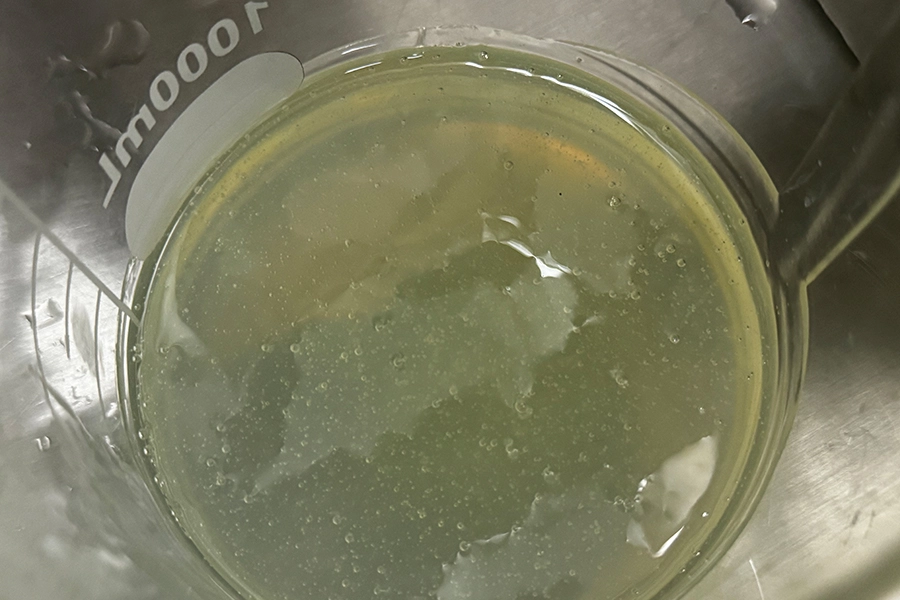
A Growing Global Market for UV Gel Nail Products
UV gel nail products are becoming an increasingly important segment of the global nail care industry. According to Fortune Business Insights, the global UV nail gel market was valued at USD 1.60 billion in 2025 and is projected to reach USD 2.80 billion by 2034, representing a CAGR of 6.66% from 2026 to 2034. Asia Pacific accounted for approximately 38.77% of the global market in 2025. [Source: Fortune Business Insights, “UV Nail Gel Market Size, Share & Industry Analysis, 2026–2034.”]
Another market study by Polaris Market Research estimates the global UV nail gel polish market at USD 5.97 billion in 2024, with a projected CAGR of 7.8% from 2025 to 2034. The study also identifies North America as the largest regional market in 2024. The differences between these estimates reflect different market definitions and segmentation methods, but both indicate sustained demand for UV-curable nail products. [Source: Polaris Market Research, “UV Nail Gel Polish Market Share, Size, Global Analysis Report, 2025–2034.”]
As the market becomes more competitive, manufacturers are placing greater emphasis on color consistency, surface finish, storage stability, application feel, and formulation reproducibility. This makes efficient pigment dispersion and precision homogenization increasingly important in UV gel nail polish manufacturing.
Common Challenges in Conventional UV Gel Nail Polish Processing
Many UV gel manufacturers still rely on conventional processes such as mechanical stirring, high-speed dispersion, bead milling, or conventional high-pressure homogenization.
These technologies can be effective for macroscopic mixing and dispersion, but achieving highly uniform particle distribution in complex, high-viscosity formulations can remain challenging.
1. Pigment Agglomeration
Organic pigments, inorganic pigments, pearlescent powders, and other fine particles can have high surface energy and strong interparticle interactions. Conventional mixing may not provide sufficient localized energy to completely break down agglomerates.
The result can be uneven pigment distribution and visible fine particles in the finished product.
2. Uneven Surface Appearance
Residual agglomerates or oversized particles can affect application smoothness. Depending on the formulation, this may contribute to brush marks, uneven coating, orange-peel-like surface effects, or reduced visual uniformity after curing.
For premium color formulations, particle dispersion can also influence perceived color intensity, transparency, and surface gloss.
3. Sedimentation and Phase Separation
When particle size distribution is broad and dispersion is insufficient, pigments and functional particles may gradually migrate or settle during storage.
This can lead to sedimentation, phase separation, color differences between the upper and lower portions of the container, or changes in formulation consistency.
4. Batch-to-Batch Variation
Conventional mechanical dispersion can be sensitive to equipment configuration, mixing conditions, material loading, and operating parameters.
As a result, achieving exactly the same dispersion state from batch to batch can be difficult, increasing the workload associated with quality control.
5. Difficult Scale-Up
A formulation that performs well during laboratory testing may behave differently during pilot or industrial production.
Changes in equipment geometry, processing volume, residence time, energy distribution, and heat generation can affect the final dispersion result, making direct process scale-up challenging.
Why Use a Microfluidic Device for UV Gel Nail Polish?
A high-pressure microfluidic device provides a different approach to particle dispersion and homogenization.
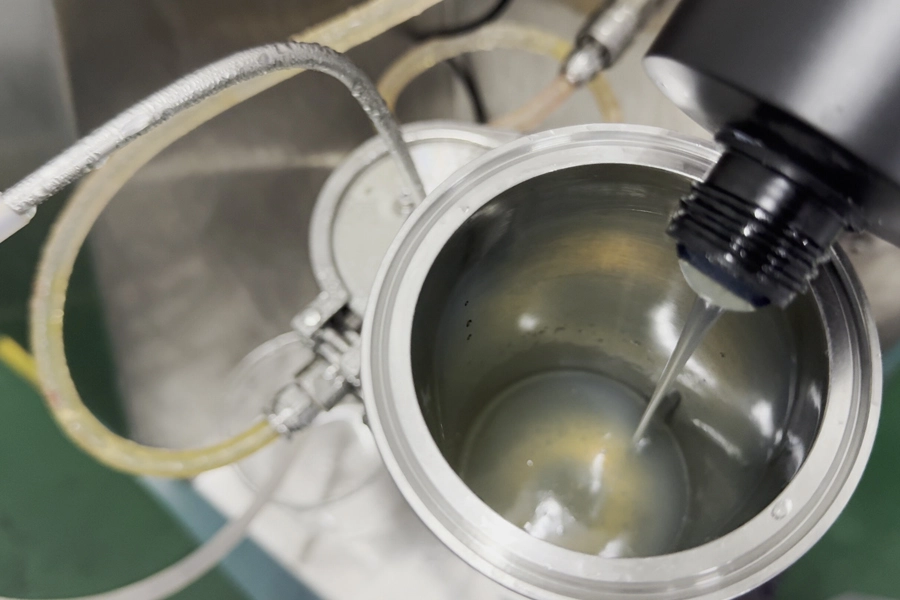
Instead of relying primarily on conventional mechanical agitation, microfluidization forces the material through precisely engineered interaction channels under controlled high pressure. The resulting high shear, turbulence, impact, and cavitation effects can generate intensive localized processing conditions.
JUNJIE’s high-pressure microfluidic homogenizers are designed around a self-developed diamond interaction chamber and intelligent pressure-control system. Depending on the formulation and process objective, the equipment can operate across a controlled pressure range of 20–420 MPa.
This approach can be particularly useful for formulations that require fine particle dispersion, narrow particle-size distributions, and highly reproducible processing conditions.
How Does Microfluidization Work?
During microfluidization, the formulation is pressurized and accelerated through a precisely designed microchannel or interaction chamber.
Within the interaction zone, several physical mechanisms can act simultaneously:
- High shear forces
- High-speed impingement
- Turbulence
- Cavitation
- Particle-particle interaction
- Rapid pressure and velocity changes
These mechanisms can help break down pigment agglomerates and improve the uniformity of particle distribution throughout the formulation.
Unlike random mechanical shear, the fixed geometry of the interaction chamber allows processing conditions to be more precisely defined and reproduced.
For UV gel nail polish, this can provide a controllable pathway for optimizing pigment dispersion without relying solely on prolonged conventional mixing.
Key Advantages of Microfluidic Systems for UV Gel Formulations
Nano-Scale Dispersion and Controlled Particle Distribution
A properly optimized microfluidic system can apply intense and repeatable processing forces to pigment-containing formulations.
For suitable materials, this can help reduce particle agglomeration and improve dispersion into the submicron or nano-scale range.
A more uniform particle distribution can contribute to a smoother formulation texture, more consistent color development, and improved visual quality after application.
Particle-size analysis should be used to verify the actual effect for each formulation rather than assuming that every UV gel system will achieve the same particle-size reduction.
Improved Resistance to Sedimentation
Uniform particle dispersion can improve the physical stability of a formulation by reducing large agglomerates and improving particle distribution throughout the continuous phase.
For UV gel nail polish, this may help reduce the tendency toward sedimentation, separation, and particle re-agglomeration during storage.
Actual storage stability, however, should be verified through formulation-specific accelerated and real-time stability testing.
Controlled Temperature Processing
UV-curable formulations can contain temperature-sensitive components such as photoinitiators, resins, and functional additives.
High-pressure microfluidic processing can be integrated with temperature monitoring and cooling strategies to manage heat generated during homogenization.
This makes temperature control an important part of process optimization, particularly for UV-sensitive formulations.
Highly Reproducible Processing Parameters
One of the important advantages of a microfluidic device is the ability to define processing parameters such as:
- Pressure
- Number of passes
- Flow rate
- Processing temperature
- Cooling conditions
- Material concentration
Once an optimized process window has been established, these parameters can be documented and reproduced more consistently between batches.
This provides manufacturers with a more structured approach to formulation development and quality control.
From Laboratory Development to Industrial Production
A major consideration for cosmetic manufacturers is whether a laboratory formulation can be transferred successfully to production.
JUNJIE’s microfluidic systems are designed to support a development pathway from laboratory testing to pilot-scale validation and industrial production.
By establishing the appropriate pressure, pass number, temperature, and formulation conditions during development, manufacturers can create a defined process window that can subsequently be evaluated for larger-scale production.
This approach can help reduce repeated trial-and-error during scale-up and support more systematic process development.
JUNJIE UV Gel Nail Polish Homogenization Test
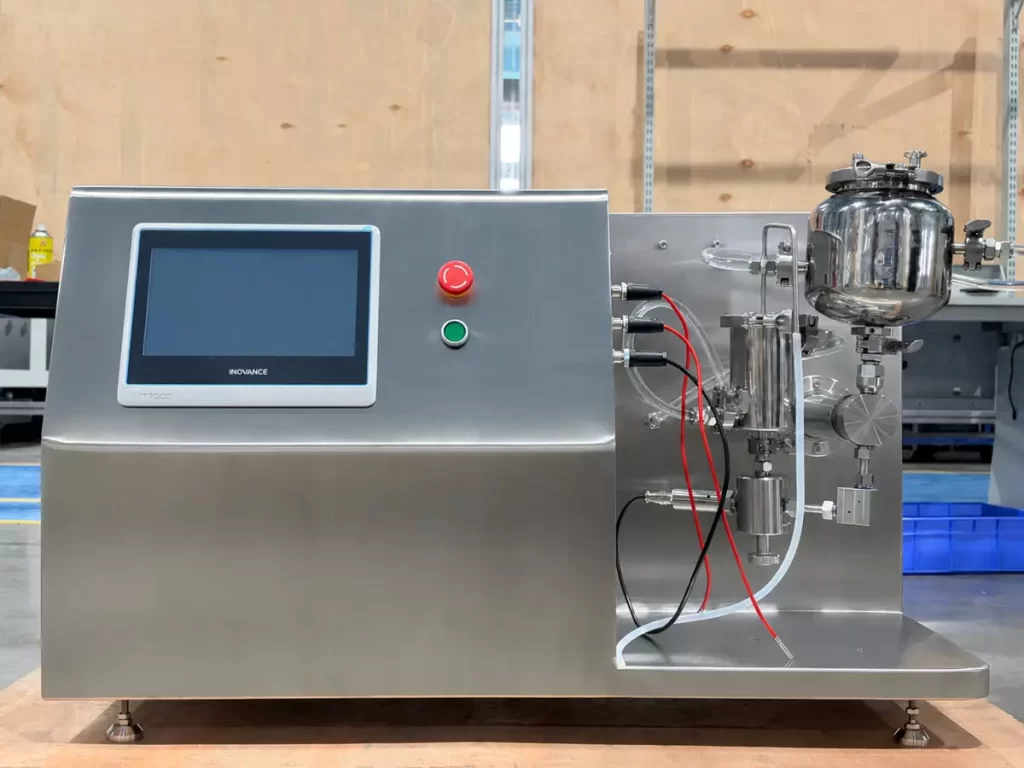
For the recent UV gel nail polish study, JUNJIE used the HPW-10 laboratory microfluidic homogenizer to evaluate several common gel nail polish formulations.
The experimental program compared different combinations of:
- Processing pressure
- Number of homogenization cycles
- Temperature-control conditions
- Formulation characteristics
- Dispersion performance
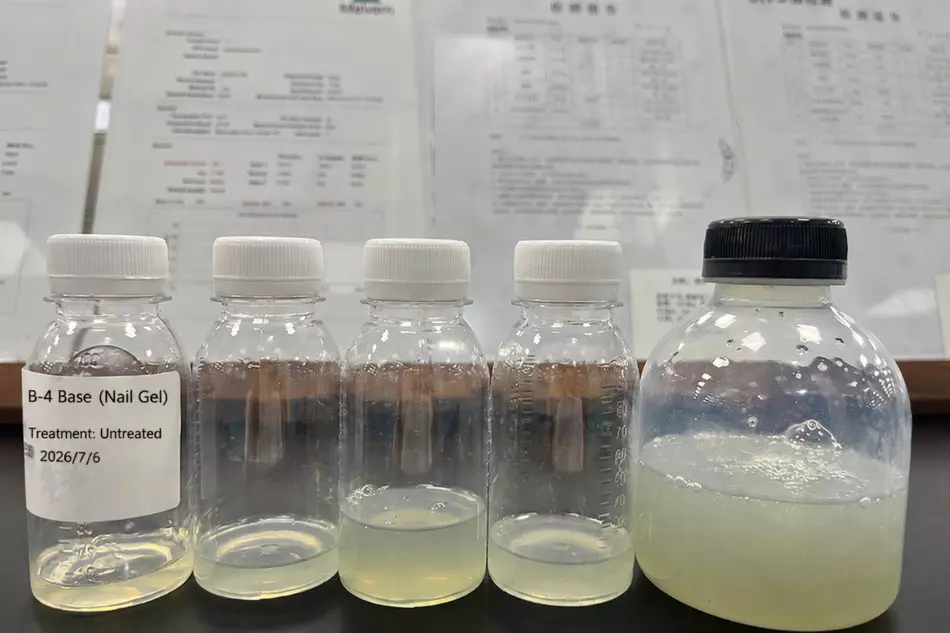
According to JUNJIE’s internal experimental observations, high-pressure microfluidic treatment significantly improved pigment dispersion compared with the untreated samples.
The processed samples showed more uniform pigment distribution and reduced visible agglomeration. JUNJIE also observed improvements in color saturation, visual transparency, and surface uniformity after application.
In a 72-hour static observation conducted during the test, the processed samples showed no obvious phase separation or sedimentation.
These results are internal laboratory observations rather than independent third-party certification, and actual performance can vary depending on pigment type, resin system, viscosity, solids content, photoinitiator system, and other formulation variables.
Suitable UV Gel Nail Polish Applications
The microfluidic homogenization process can be evaluated for a range of UV-curable nail gel formulations, including:
- Standard color gel polish
- Pearl gel polish
- Glitter gel
- Cat-eye gel
- Shimmer gel
- Pigmented UV gels
- Specialty effect gels
- Other pigment-containing cosmetic gel systems
Each formulation requires its own process-development window. Pressure, number of passes, temperature, and feed composition should be optimized according to the specific material characteristics.
JUNJIE Microfluidic Solutions for Cosmetics and Personal Care
JUNJIE provides high-pressure microfluidic homogenization equipment for applications across cosmetics, personal care, fine chemicals, pharmaceuticals, food and beverage, and advanced materials.
Its equipment portfolio includes laboratory, pilot-scale, production-scale, and customized microfluidic systems, allowing manufacturers and research organizations to evaluate formulations at different stages of development.
For cosmetic and personal-care applications, JUNJIE can support:
- UV gel nail polish
- Pigment dispersions
- Cosmetic colorants
- Skincare emulsions
- Functional cosmetic gels
- Active ingredient formulations
- Encapsulation systems
- Fine chemical dispersions
The technical service process can include laboratory sample testing, process parameter optimization, customized homogenization development, pilot validation, and scale-up support.
For manufacturers developing new UV gel products or upgrading existing production processes, microfluidization provides a controllable physical-processing route for improving particle dispersion and formulation uniformity.
With its self-developed high-pressure components and diamond interaction chamber technology, JUNJIE aims to help cosmetic manufacturers move from formulation experiments to reproducible production processes.
From formulation development to industrial scale-up, JUNJIE provides microfluidic homogenization solutions designed to help manufacturers achieve more controlled dispersion, consistent processing, and scalable production.
