
Table of Contents
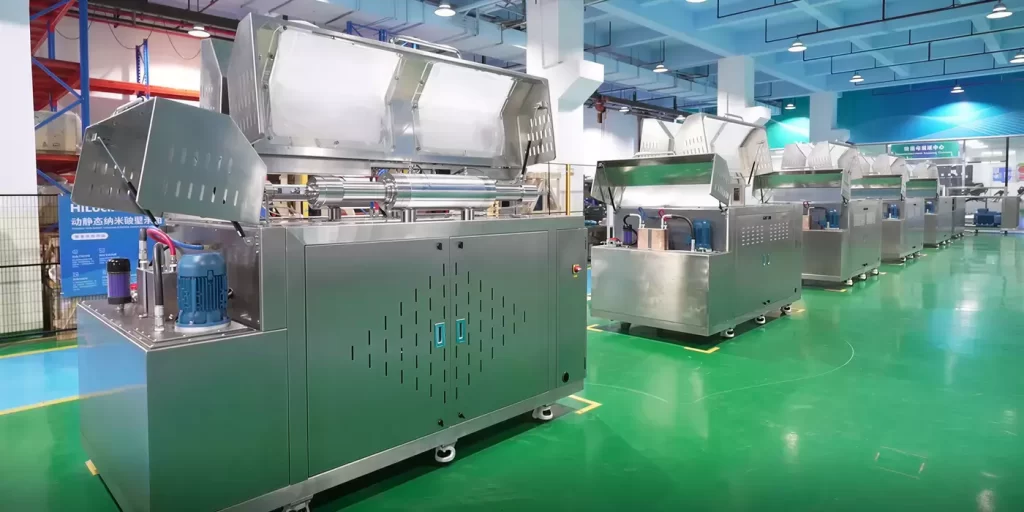
As nanotechnology continues to drive industrial innovation, the microfluidizer is becoming a key piece of equipment for overcoming process challenges in biopharmaceuticals, new energy, advanced materials, food and beverage, chemicals, and personal care.
With a 420 MPa ultra-high-pressure design, vertically integrated manufacturing capabilities, and comprehensive process development services, the JUNJIE microfluidizer provides solutions spanning laboratory research, pilot-scale validation, and industrial production. By combining advanced microfluidic technology with application-focused process development, JUNJIE helps manufacturers improve product consistency, dispersion, particle-size control, and overall process efficiency.
Advanced Technology: 420 MPa Ultra-High Pressure for Precision Homogenization
The core advantage of the JUNJIE microfluidizer lies in its 420 MPa (approximately 60,900 psi) design pressure. The high-pressure capability provides sufficient processing intensity for materials with high hardness, strong agglomeration, or demanding dispersion requirements.
Key Technology Highlights:
- Long-Stroke, Low-Speed Design: Reduces wear on sealing components, extends maintenance intervals, and helps minimize equipment downtime.
- Electromagnetic Directional Switching Assembly: Improves operational stability and enables consistent pressure output for more consistent particle-size distribution between batches.
- Bidirectional Pressurization Technology: Both directions of piston movement contribute to pressurization, increasing throughput and processing efficiency for continuous production.
- Diamond Interaction Chamber: A diamond-based interaction chamber provides high wear resistance and helps minimize metal contamination while supporting narrow particle-size distributions.
Together, these technologies form the foundation of JUNJIE’s microfluidic system, providing precise and repeatable high-pressure processing for demanding applications.
Complete Product Line: Seamless Scale-Up from Laboratory to Production
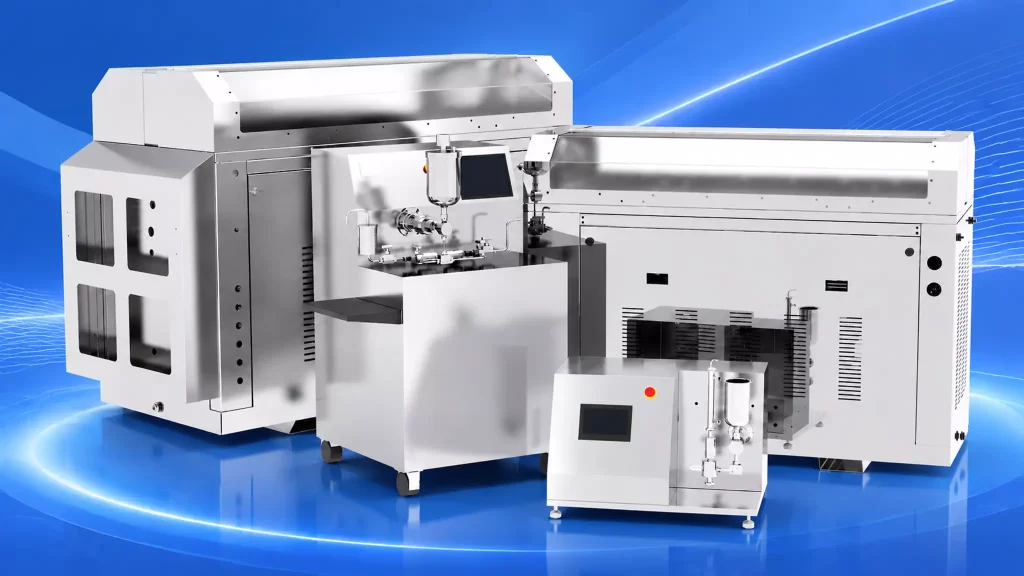
JUNJIE offers four microfluidic homogenization systems. All models feature a 420 MPa design pressure, supporting a consistent process development pathway from laboratory testing to pilot-scale validation and industrial production.
| Model | Design Pressure | Flow Rate | Power | Pressurization | Application |
|---|---|---|---|---|---|
| HPW-10 | 420 MPa | 0.2 L/min | 3.7 kW | Single-direction | Laboratory-scale, high-precision R&D |
| HPW-20 | 420 MPa | 0.33 L/min | 4 kW | Bidirectional | Laboratory-scale, customized applications |
| HPW-250 | 420 MPa | 4 L/min | 37 kW | Bidirectional | Pilot-scale process development |
| HPW-500 | 420 MPa | 8 L/min | 75 kW | Bidirectional | Industrial-scale continuous production |
Simplified Scale-Up
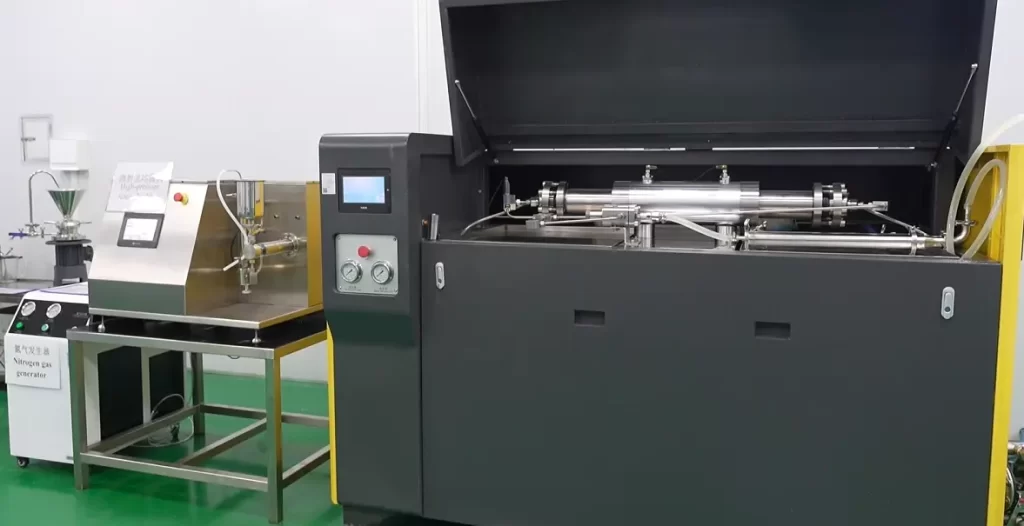
Process parameters validated on laboratory equipment can be transferred to pilot and production systems for scale-up validation. This consistent technical approach helps manufacturers reduce repeated process development and shorten the transition from R&D to commercial production.
Multi-Industry Applications: Addressing Specific Processing Challenges
1. Biopharmaceuticals: Cell Disruption and Liposome Processing
Challenge: Conventional mechanical grinding and ultrasonic disruption can result in incomplete cell disruption, active-ingredient loss, and inconsistent batch performance.
JUNJIE Solution:
- Cell disruption rates of 75–90% in specific tested applications
- D90 particle size reduced from 10,367.68 nm to 3,533.18 nm
- Active-ingredient extraction increased significantly in tested applications
- Product qualification rate increased by 15% in specific applications
- Overall energy consumption reduced by approximately 30%
- Suitable for particle-size control and active-ingredient retention in applications such as liposomes and mRNA-related formulations
Actual performance depends on the material properties, formulation, and processing parameters.
2. Chemical Engineering: Nano-Scale Dispersion and Batch Consistency
Challenge: High-speed mixing, bead milling, and ultrasonic dispersion may result in uneven dispersion, particle agglomeration, and broad particle-size distributions.
JUNJIE Solution:
- At 270 MPa and 20 processing cycles, D90 was reduced from 9,875 nm to 294.1 nm in a tested material
- PDI decreased from 0.423 to 0.156
- Processing efficiency increased by more than 65% compared with the tested conventional milling process
- Batch consistency reached 98.5% in the tested application
- Overall energy consumption decreased by approximately 40%
The actual results of microfluidic processing vary according to material characteristics and process conditions.
3. Advanced Materials: Customized Homogenization, Dispersion, and Stabilization
Challenge: Functional materials such as graphene, nano-ceramics, and metal slurries require highly controlled dispersion processes. Conventional methods may struggle to achieve consistent nanoscale performance.
JUNJIE Solution:
- Analyzes material characteristics including viscosity, particle size, and interfacial properties to develop customized processing parameters
- Supports seamless scale-up from laboratory testing to pilot and production systems
- Provides customized process proposals based on application requirements
- In a tested glass-powder application, average particle size decreased from 3 μm to 260 nm, with PDI maintained at 0.07–0.10
- Overall energy consumption reduced by approximately 32% in the tested application
4. Food & Beverage: Improved Texture and Product Stability
Challenge: Conventional extraction and dispersion methods can result in low extraction efficiency and loss of functional ingredients.
JUNJIE Solution:
- Lycopene extraction increased from 38% to 82% in a tested application
- Particle size reduced from 80 μm to 3 μm
- Active-ingredient loss was controlled below 8%
- Reduced reliance on large quantities of organic solvents
- Overall energy consumption decreased by approximately 30% in the tested process
For food and beverage applications, microfluidic technology can be used for particle-size reduction, emulsion stabilization, ingredient dispersion, and texture optimization.
5. New Energy: Electrode Slurry Homogenization for Battery Applications
Challenge: Conventional processing of solid-state battery materials may encounter filler agglomeration and limitations in ionic conductivity.
JUNJIE Solution:
- Particle size reduced from 74 μm to 360.57 nm
- PDI decreased from 0.41 to 0.27
- Ionic conductivity increased from 1.2 × 10⁻⁴ S/cm to 8.5 × 10⁻⁴ S/cm in the tested formulation
- Batch consistency exceeded 98.5%
- Overall energy consumption reduced by approximately 38%
A microfluidic system can provide controlled high-pressure processing for advanced battery materials, supporting more consistent dispersion and formulation development.
6. Beauty & Personal Care: Efficient Nano-Dispersion of Active Ingredients
Challenge: Active raw materials such as silk protein solutions can present challenges related to processing efficiency, particle-size control, and active-ingredient retention.
JUNJIE Solution:
- Average protein particle size reduced from 522 nm to 310 nm
- PDI decreased from 0.416 to 0.254
- Dispersion uniformity improved by approximately 38.9% in the tested application
- High active-ingredient retention
- Overall energy consumption reduced by approximately 25–30%
The JUNJIE microfluidizer can be integrated into formulation development workflows for nano-dispersion, homogenization, and active-ingredient processing.
Full-Cycle Process Support: From Sample Testing to Production
JUNJIE operates a dedicated Microfluidic Nanohomogenization Laboratory to provide application-focused process development services throughout the product lifecycle.
Sample Testing & Process Validation
Customers can submit material samples for testing. JUNJIE application engineers evaluate the material and recommend suitable processing parameters, followed by particle-size distribution analysis and test reports.
Scale-Up Data Transfer
Parameters validated on laboratory systems can be transferred to pilot-scale and production-scale equipment for further scale-up validation, helping reduce repeated process development.
Joint Process Development
For new materials and formulations, customers can work with JUNJIE application engineers to develop customized homogenization and dispersion processes based on specific application requirements.
Service Coverage
| Stage | Service |
|---|---|
| Pre-Sales | Free sample testing, equipment selection, and process evaluation |
| Delivery | Equipment installation, commissioning, material testing, and operator training |
| After-Sales | Preventive maintenance plans, spare parts support, technical consultation, and equipment upgrades |
Key Advantages Summary: JUNJIE Microfluidizer
| Dimension | JUNJIE Microfluidizer Advantages |
|---|---|
| Pressure Performance | 420 MPa ultra-high-pressure capability for demanding homogenization and dispersion applications |
| Particle-Size Control | Supports precise particle-size and PDI control in laboratory and production applications |
| Contamination Control | Diamond interaction chamber designed to provide high wear resistance and help minimize metal contamination |
| Process Scale-Up | Consistent technology pathway from laboratory development to pilot and industrial production |
| Core Components | In-house development and manufacturing of key components such as high-pressure pumps and interaction chambers |
| Process Support | Full-cycle technical support from sample testing and process development to equipment delivery and after-sales service |
Conclusion
As industries continue to pursue higher product quality, process efficiency, and nanoscale control, microfluidic technology is becoming an important approach for overcoming complex homogenization and dispersion challenges.
Built around 420 MPa ultra-high-pressure processing, vertically integrated manufacturing, and application-focused process development, the JUNJIE microfluidizer provides a scalable microfluidic system for biopharmaceuticals, new energy, advanced materials, food and beverage, chemicals, beauty, and personal care applications.
From laboratory R&D and sample testing to pilot validation and industrial production, JUNJIE supports customers throughout the process development cycle with high-pressure homogenization and microfluidic processing solutions.
