
Table of Contents
Mango juice is valued for its distinctive flavor, natural color, nutritional profile, and smooth mouthfeel. However, producing a stable and consistent mango juice or mango-based beverage at commercial scale can be technically challenging.
Natural mango pulp contains suspended fruit particles, fibers, pectin, pigments, and other components with different physical properties. Without effective particle-size control and homogenization, these components can gradually separate during storage, resulting in sedimentation, phase separation, inconsistent texture, or changes in appearance.
This is where microfluidic technology provides an advanced approach to mango juice processing.
A microfluidic homogenizer uses controlled high-pressure fluid dynamics to force a liquid through a specially designed interaction chamber. Within the chamber, intense shear, turbulence, impact, and cavitation-related effects can help reduce particle size and improve the dispersion of suspended components.
For mango juice manufacturers, this technology can provide a more controlled approach to particle size reduction, dispersion, homogenization, and physical stability.
Why Is Mango Juice Homogenization Challenging?
Mango is a complex fruit matrix rather than a simple liquid system.
Depending on the variety and processing method, mango juice and puree may contain:
- Fruit pulp
- Insoluble fibers
- Pectin
- Natural pigments
- Colloidal particles
- Flavor compounds
- Sugars and organic acids
- Other suspended or dispersed components
These components contribute to the characteristic appearance and mouthfeel of mango beverages, but they can also create processing challenges.
For example, relatively large or poorly dispersed particles can settle during storage. Differences in particle density and size can also contribute to phase separation.
Traditional mechanical mixing may distribute these components temporarily, but it does not necessarily provide sufficient particle-size reduction or long-term dispersion.
Therefore, an effective homogenization process needs to do more than simply mix the ingredients.
It needs to control the physical structure of the liquid system.
How Microfluidic Technology Works in Mango Juice Processing
Microfluidic technology applies high-pressure fluid dynamics to process liquids through a precisely engineered microchannel or interaction chamber.
In a typical high-pressure microfluidization process, mango juice is pressurized by a high-pressure intensifier and then accelerated through a specially designed interaction chamber.
As the fluid passes through the chamber, several physical effects can occur simultaneously:
1. High shear
The extremely high fluid velocity creates strong shear forces that can help break down larger particles and aggregates.
2. Turbulence
Rapid changes in fluid direction and velocity promote intensive mixing and dispersion throughout the liquid.
3. Impact
High-velocity fluid streams interact within the chamber, generating additional mechanical forces that contribute to particle disruption.
4. Cavitation-related effects
Under suitable processing conditions, localized pressure changes can contribute to cavitation-related physical effects, further assisting particle disruption and dispersion.
The combined effect can produce a significantly more uniform dispersion than conventional low-shear mixing.
Why Use a Microfluidic Homogenizer for Mango Juice?
A microfluidic homogenizer is particularly relevant when manufacturers need precise control over particle size and dispersion.
Rather than relying primarily on mechanical agitation, microfluidic homogenization uses controlled high pressure and engineered fluid channels to process the product.
This can provide several potential advantages for mango juice applications.
1. Particle Size Reduction
One of the main objectives of mango juice homogenization is to reduce and redistribute larger suspended particles.
A properly designed microfluidizer can subject mango juice to intense fluid forces inside the interaction chamber, helping break down larger particles and aggregates.
Smaller and more uniformly distributed particles can contribute to:
- Improved dispersion
- Reduced visible sedimentation
- More consistent texture
- Better product uniformity
- Improved physical stability
The actual particle-size reduction depends on the mango variety, pulp concentration, formulation, viscosity, initial particle-size distribution, pressure, number of passes, and interaction chamber configuration.
Therefore, processing conditions should be established through application testing rather than relying on a single universal pressure setting.
2. Improved Physical Stability
Physical stability is an important consideration for mango juice and mango-based beverages.
If suspended particles are too large or poorly dispersed, gravity can gradually cause them to settle during storage.
Microfluidic homogenization can help create a more uniform particle distribution.
This does not mean that homogenization alone guarantees complete stability. Mango juice formulations may also require optimization of:
- Solids content
- Pulp concentration
- Pectin structure
- Viscosity
- pH
- Formulation composition
- Processing temperature
- Storage conditions
Nevertheless, controlling particle size and dispersion can be an important part of developing a stable mango beverage system.
3. More Uniform Mouthfeel
Particle size has a direct relationship with the sensory characteristics of fruit beverages.
Large or irregular particles may produce a coarse or inconsistent mouthfeel, while a more uniform dispersion can contribute to a smoother drinking experience.
For mango juice, this is particularly relevant because consumers often expect mango beverages to have a characteristic rich and smooth texture.
A microfluidic homogenizer can therefore be used as part of a process-development strategy to optimize the balance between:
Particle Size → Suspension → Texture → Sensory Experience
The target should not necessarily be the smallest possible particle size.
Instead, the goal is to achieve the appropriate particle-size distribution for the specific mango product.
4. Consistent Product Quality
For industrial mango juice production, consistency is as important as individual batch performance.
Variations in raw materials can result in differences in:
- Pulp content
- Fiber concentration
- Particle size
- Viscosity
- Soluble solids
- Natural pigment concentration
A controlled high-pressure homogenization process can help manufacturers establish repeatable processing parameters.
This makes microfluidic technology particularly valuable during product development and scale-up.
Researchers can investigate the relationship between:
Pressure → Passes → Particle Size → Stability → Sensory Properties
before transferring the optimized process to larger-scale production.

Microfluidizer vs. Conventional Homogenization for Mango Juice
Different homogenization technologies generate different fluid-processing mechanisms.
Conventional high-pressure homogenizers typically force the product through a homogenizing valve. This can generate intense pressure drop, shear, turbulence, and related physical forces.
A microfluidizer, by contrast, typically uses an engineered interaction chamber where high-velocity streams interact within precisely designed microchannels.
This difference in chamber geometry can provide researchers and manufacturers with another method for controlling particle disruption and dispersion.
| Processing Aspect | Conventional Homogenization | Microfluidic Homogenization |
|---|---|---|
| Main mechanism | High-pressure valve | Engineered interaction chamber |
| Particle reduction | Yes | Yes |
| High shear | Yes | Yes |
| Turbulence | Yes | Yes |
| Controlled microchannel interaction | Limited | Core feature |
| Application flexibility | Broad | Broad |
| R&D optimization | Available | Highly suitable |
| Scale-up potential | Established | Application-dependent |
The choice between technologies should be based on the product formulation, target particle size, throughput, viscosity, processing pressure, and desired product characteristics.
Key Processing Parameters for Mango Juice
Using a microfluidic homogenizer effectively requires more than simply increasing pressure.
Several variables should be evaluated systematically.
Processing Pressure
Pressure determines the energy delivered to the fluid during the homogenization process.
Higher pressure can increase the intensity of particle disruption, but excessive processing may not always provide additional benefits.
The optimal pressure depends on the specific mango juice formulation and desired outcome.
Number of Passes
Multiple passes can further modify particle-size distribution.
However, more passes do not automatically mean better product quality.
Additional processing should be evaluated against:
- Particle-size reduction
- Stability
- Viscosity
- Temperature increase
- Energy consumption
- Sensory characteristics
Initial Particle Size
The starting particle-size distribution has a significant influence on homogenization results.
Mango puree containing large fiber particles may require a different processing strategy from a clarified mango beverage.
Solids and Pulp Content
Mango beverages with higher pulp concentrations generally have different flow behavior and processing requirements than low-pulp formulations.
Equipment configuration should therefore be selected according to the actual product.
Temperature
High-pressure processing can generate heat due to energy dissipation.
Temperature management is therefore important when processing mango juice, particularly when the product contains temperature-sensitive flavor, color, or nutritional components.
Microfluidic Homogenization for Different Mango Products
The technology can be applied to more than conventional mango juice.
Mango Juice
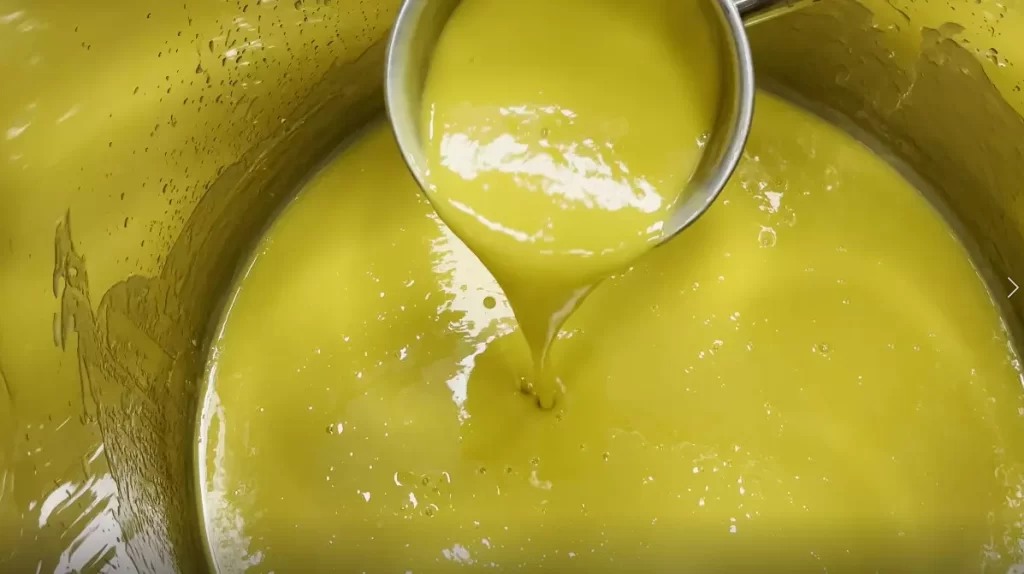
For mango juice, microfluidic homogenization can be used to improve particle dispersion and product uniformity.
Mango Nectar
Mango nectar generally contains a higher proportion of fruit solids than many juice products.
Particle-size control can therefore become especially important for suspension stability and mouthfeel.
Mango Puree
Mango puree has a significantly higher viscosity and solids concentration.
The equipment and process parameters need to be selected according to the puree’s rheological characteristics and particle distribution.
Mango-Based Functional Beverages
Mango can also be used as a base for functional beverages containing additional ingredients.
Microfluidic homogenization can help create a more uniform dispersion when multiple components need to be incorporated into the beverage matrix.
Microfluidic Technology for Mango Juice Product Development
One of the most valuable applications of microfluidic technology is not necessarily immediate mass production.
It can also serve as a powerful tool for R&D.
Food scientists can use a microfluidic homogenizer to investigate how different processing parameters influence mango juice characteristics.
For example, a development study could compare:
300 MPa → 350 MPa → 400 MPa → 420 MPa
and evaluate:
- Particle-size distribution
- Zeta potential
- Viscosity
- Sedimentation behavior
- Color
- Turbidity
- Storage stability
- Sensory properties
This experimental approach makes it possible to establish a processing window rather than selecting parameters based solely on theoretical assumptions.
For universities, research institutes, and food companies developing new mango-based products, this provides a pathway from laboratory research to pilot-scale validation and industrial production.
How to Select a Microfluidic Homogenizer for Mango Juice
Choosing a microfluidizer should involve more than comparing maximum pressure.
Important technical factors include:
Maximum Working Pressure
The equipment should provide an appropriate pressure range for the intended formulation and application.
Interaction Chamber Design
The chamber is one of the most important components of a microfluidic homogenization system.
Its geometry directly influences fluid velocity, collision behavior, shear, turbulence, and particle-processing performance.
High-Pressure Intensifier
The intensifier determines the system’s ability to generate and maintain stable high pressure.
For research and industrial applications, pressure stability and controllability can be as important as maximum pressure.
Product Compatibility
Materials in contact with the product should be compatible with food, pharmaceutical, or other application requirements.
Temperature Control
A temperature-control system can help manage the heat generated during high-pressure processing.
Scalability
For commercial development, the system should support a logical transition from laboratory experiments to pilot production and eventually industrial-scale processing.
Conclusion
Mango juice presents unique challenges because its natural pulp, fibers, pectin, and other components can influence particle distribution, stability, texture, and appearance.
Microfluidic technology provides an advanced high-pressure approach for addressing these challenges.
By combining controlled high pressure with an engineered interaction chamber, a microfluidic homogenizer can help reduce particle size, improve dispersion, and support the development of more uniform mango juice and mango-based beverages.
However, there is no universal processing parameter that works for every mango formulation. Pressure, number of passes, temperature, raw material characteristics, solids content, and interaction chamber configuration should be optimized according to the specific application.
For food manufacturers, universities, and research institutes, the most effective approach is therefore to combine high-pressure microfluidization with systematic application testing—from laboratory research and formulation development to pilot validation and industrial-scale production.
With the right equipment and process parameters, microfluidic homogenization can become an important technology for developing the next generation of high-quality mango beverages and other advanced liquid formulations.
