Table of Contents
Orange juice, fruit and vegetable juices, and plant-based beverages often develop more surface liquid, bottom sediment, pulp settling, or a thinner mouthfeel after several days of storage. For beverage manufacturers, these issues are more than just visual defects—they can also affect shelf-life stability and the overall consumer experience. Using a microfluidizer can help improve particle dispersion and suspension stability, making it a potential solution for reducing juice separation during storage.
Therefore, juice separation treatment should not be understood simply as “making particles smaller.” The factors that affect orange juice stability often include particle sedimentation, changes in the pectin system, pectin methylesterase (PME) activity, solids content, pasteurization conditions, and homogenization parameters.
In practical process optimization, manufacturers may consider high pressure homogenizers, ultra-high-pressure homogenizers, or microfluidizers to improve particle distribution and create a more uniform and stable beverage system. But what problems can microfluidization actually solve, and why is 14-day stability an important evaluation point?
Why Does Juice Separate?
Orange juice is a complex suspension containing not only water-soluble sugars and acids, but also pulp cell fragments, pectin, polysaccharides, dietary fiber, pigments, and fine insoluble particles.
Immediately after production, these particles may remain suspended in the juice. However, as storage time increases, larger particles, uneven particle distributions, coarse particles, or flocculated aggregates can gradually settle because of density differences. This can result in sediment at the bottom and a clearer liquid layer at the top.
This is one of the first things manufacturers should consider when addressing juice separation: it is not enough to look only at the average particle size. The proportion of large particles, particle size distribution, and changes in sedimentation during storage are also important.
If the juice appears uniform immediately after processing but develops visible separation on Day 3, Day 7, or Day 14, the underlying stability issue has not been fully addressed.
Key Causes: Sedimentation and PME Activity
Cause 1: Particle sedimentation
Larger particles generally settle faster. When the particle size distribution is broad, the coarse-particle tail becomes more significant, increasing the likelihood of visible sediment during storage.
Therefore, when using a high pressure homogenizer or microfluidizer to process orange juice, the goal should not simply be to reduce D50. Manufacturers should also pay attention to D90, the coarse-particle fraction, and overall particle distribution uniformity.
Cause 2: PME activity
PME, or pectin methylesterase, acts on the pectin structure in orange juice. Pectin can contribute to suspension stability, but if PME activity is not effectively controlled, changes in the pectin system may promote particle aggregation, flocculation, and sedimentation. This can eventually appear as separation, sediment, and a thinner mouthfeel.
Therefore, if orange juice separates after several days of storage, the problem may not simply be insufficient homogenization. PME activity, pasteurization conditions, pH, pectin characteristics, and storage conditions may all contribute.
This is why professional juice separation treatment needs to address both particle size reduction and overall system stability, rather than simply assuming that higher pressure always produces better results.
How Can a Microfluidizer Reduce Juice Separation?
A microfluidizer uses high-pressure processing combined with intense shear, impact, cavitation, and turbulence to further break down and disperse pulp particles, fibers, and colloidal components in juice.
For orange juice, fruit and vegetable juices, and plant-based beverages, microfluidization can potentially improve separation stability in three main ways.
1. Reduce Coarse Particles
Pulp particles, fiber aggregates, and certain colloidal agglomerates can be further refined under high-pressure processing. This can help reduce the risk of rapid sedimentation.
2. Improve Particle Distribution
Effective homogenization is not simply about reducing the average particle size. It is also about reducing coarse particles, narrowing the particle size distribution, and creating a more uniform suspension.
3. Improve Short-Term Storage Stability
When processing parameters are properly matched to the formulation, microfluidized orange juice may show improved stability during Day 0, Day 7, and Day 14 storage evaluations, with less sedimentation, a smaller clear-liquid layer, and a more consistent mouthfeel.
However, a microfluidizer is not a standalone replacement for formulation optimization, pasteurization, or enzyme control. For orange juice systems containing active PME, pasteurization temperature, holding time, pH, formulation, and storage conditions should still be evaluated together.
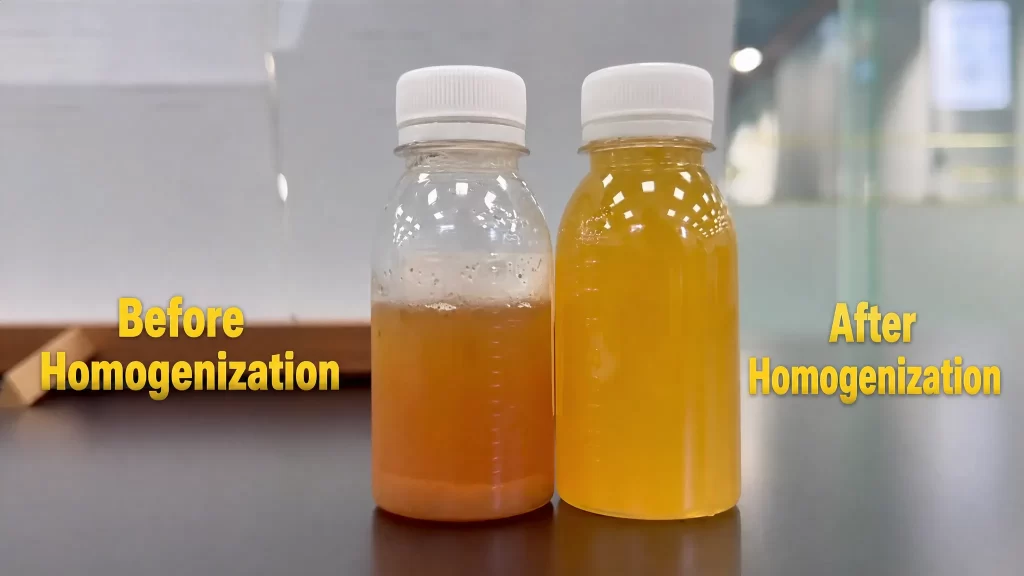
JUNJIE Microfluidizer: Sample Testing for Juice Stability
Juice separation in orange juice, fruit and vegetable juices, and plant-based beverages is often caused by multiple interacting factors. Particle sedimentation, PME activity, pectin characteristics, pasteurization conditions, and storage environment can all affect the final stability of a beverage.
For this reason, JUNJIE recommends conducting real-sample testing before selecting a high pressure homogenizer or microfluidizer.
As a source manufacturer of high-pressure microfluidic nano-homogenization equipment, JUNJIE has an in-house database of 1,000+ material and process cases and dedicated laboratory facilities. Based on the characteristics of each customer sample and the desired results, we can develop different pressure levels, cycle numbers, and temperature-control conditions.
The samples can then be evaluated before and after treatment based on particle size distribution, sedimentation height, turbidity changes, mouthfeel, and 14-day stability.
If your orange juice, fruit and vegetable juice, or plant-based beverage is experiencing visible separation, bottom sediment, excessive surface liquid, or inconsistent mouthfeel, contact JUNJIE for sample testing.
We use real experimental data to help determine whether microfluidization is suitable for your product and process, while providing process parameters for subsequent equipment selection and production scale-up.