
Table of Contents
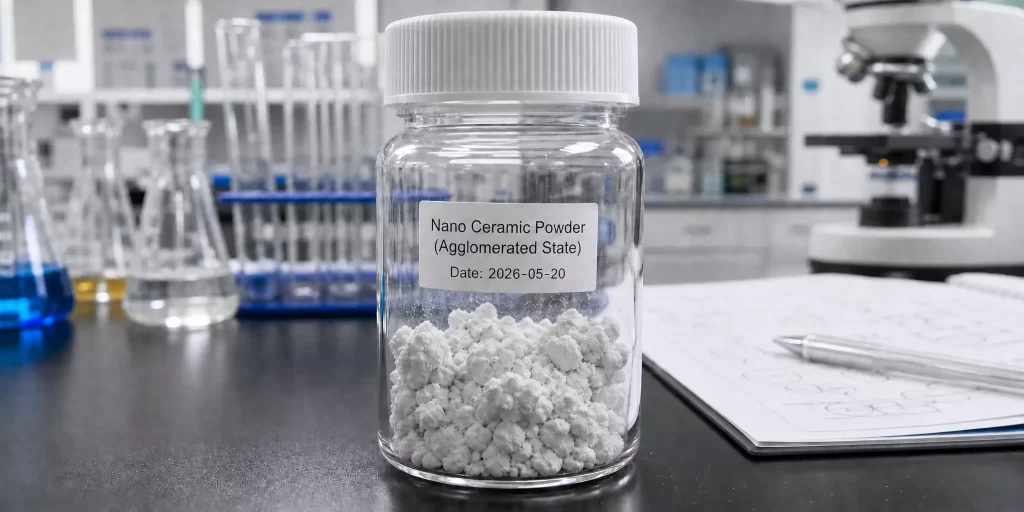
Large-scale forming of Nanoceramic Powder—including alumina, zirconia, aluminum nitride, MLCC electronic ceramics, and transparent ceramic powders—presents significant challenges for advanced ceramic manufacturers.
Conventional uniaxial pressing and cold isostatic pressing (CIP) can encounter limitations when processing fine and nanoscale ceramic powders. Uniaxial pressing may produce non-uniform stress distribution and density gradients within green bodies, increasing the risk of deformation, cracking, and internal porosity after sintering. Conventional cold isostatic pressing operates at room temperature and may not provide sufficient thermal conditions to optimize binder behavior and powder packing for certain formulations.
At the same time, large-sized ceramic components and high-volume production can increase machining requirements, material waste, and manufacturing costs.
JUNJIE’s self-developed WIP-525L warm isostatic presses is designed for high-density forming of ceramic powders at industrial scale. Based on more than two decades of ultra-high-pressure precision manufacturing experience, the system combines controlled pressure and temperature to support the processing of various industrial ceramic powders.
With customized automation options, the WIP-525L is designed to address common production challenges such as density gradients, internal porosity, sintering defects, and limited efficiency in large-volume ceramic manufacturing.
Warm Isostatic Pressing Technology for Ceramic Powder Densification
JUNJIE’s WIP-525L uses a fluid pressure medium to apply pressure uniformly from multiple directions while precisely controlling the processing temperature between 80–150°C.
Compared with conventional forming methods, this combination of pressure and temperature provides additional process flexibility for ceramic powder systems, particularly when binder behavior and powder packing need to be carefully controlled.
Uniform Pressure Distribution for More Consistent Green Body Density
The WIP-525L is equipped with multiple pressure boosters and designed for stable pressure control, with pressure fluctuation of up to ±10 MPa under specified operating conditions.
By applying pressure uniformly around the workpiece, warm isostatic pressing can reduce the density gradients and localized stress concentration that may occur during uniaxial pressing.
More uniform green-body density can contribute to more consistent sintering shrinkage and help reduce defects such as:
- Warpage
- Cracking
- Internal defects
- Uneven dimensional shrinkage
- Batch-to-batch variation
For advanced ceramics, more consistent green-body properties can provide a stronger foundation for subsequent sintering and precision machining.
Combined Temperature and Pressure for Improved Powder Compaction
One of the key characteristics of warm isostatic pressing technology is the ability to control pressure and temperature simultaneously.
Processing temperatures of 80–150°C can help modify the behavior of certain binder systems and improve powder packing under pressure. For appropriately formulated ceramic powders, this can support higher green density and reduce residual voids.
Improved densification can be particularly valuable for applications where final ceramic properties depend strongly on uniform density and low porosity, including:
- Transparent ceramics
- Precision electronic ceramics
- Structural ceramics
- Biomedical ceramics
- Wear-resistant ceramics
The actual densification performance depends on powder morphology, particle-size distribution, binder formulation, pressure, temperature, holding time, and subsequent sintering conditions. Process parameters should therefore be established through product-specific testing.
Large and Complex Ceramic Components
With a 525 L large-volume chamber, the WIP-525L provides substantial forming space for large ceramic green bodies and complex-shaped components.
Near-net-shape forming can help reduce the amount of material removed during subsequent CNC machining.
Potential benefits include:
- Reduced machining time
- Lower material waste
- Reduced post-processing requirements
- Improved utilization of expensive ceramic powders
- Greater flexibility for large-format components
This makes large-volume warm isostatic presses particularly relevant to ceramic manufacturers producing large or geometrically complex components.
Processing Options for Multiple Ceramic Powders
The WIP-525L can be evaluated for a range of ceramic powder systems, including:
- Alumina
- Zirconia
- Silicon carbide
- Aluminum nitride
- Magnesium aluminate spinel
- Transparent ceramic powders
- MLCC-related ceramic materials
- Refractory ceramic powders
These materials serve applications across electronics, medical technology, aerospace, energy, industrial equipment, and other advanced-materials industries.
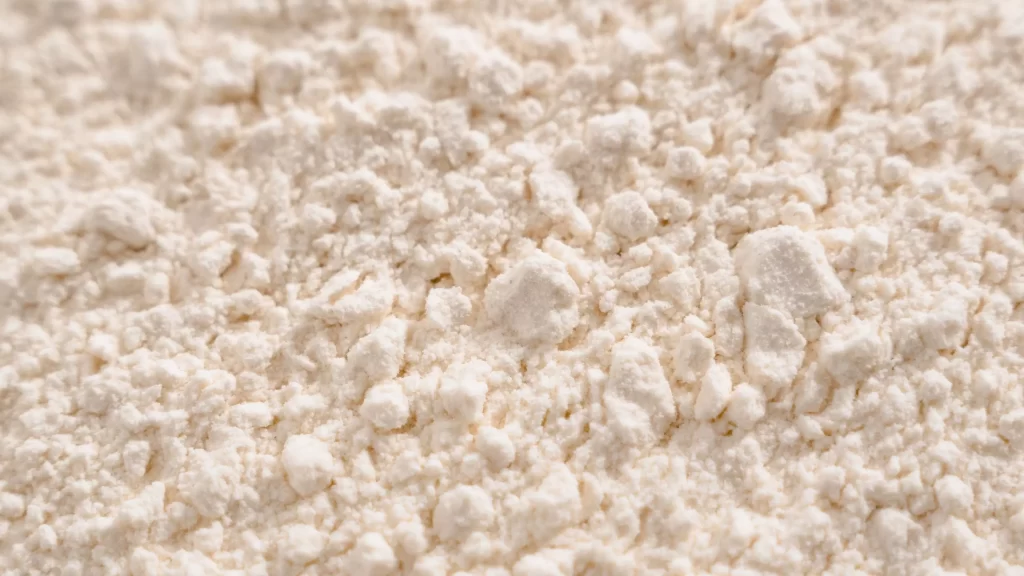
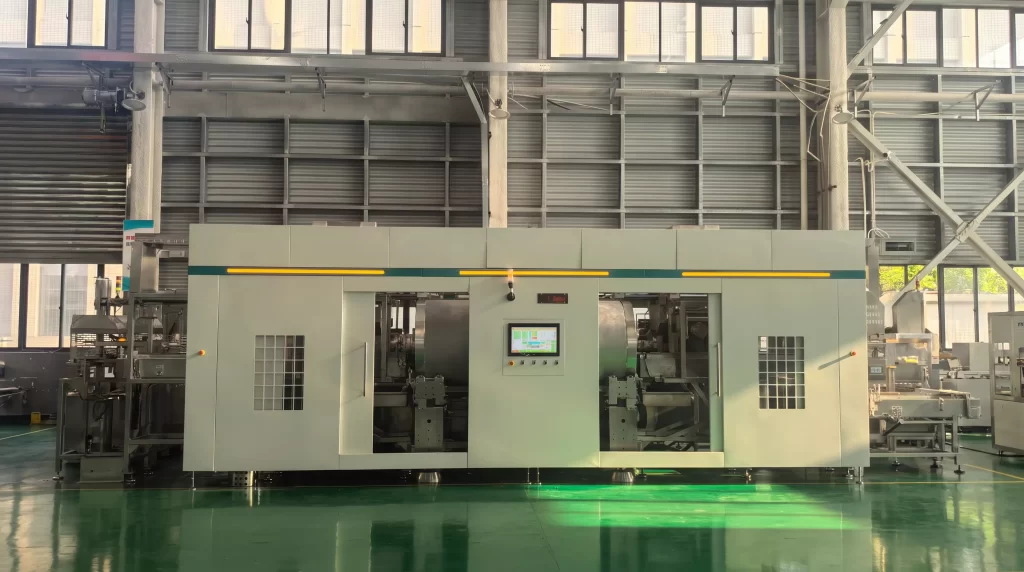
WIP-525L Warm Isostatic Press for Customized Ceramic Production
JUNJIE’s WIP product line focuses on the WIP-525L large horizontal warm isostatic pressing system, developed for medium- and large-scale ceramic powder production.
The system can be customized according to production requirements, with integrated engineering covering the high-pressure chamber, pressure-boosting system, temperature-control and circulation system, automation, and production-line integration.
525 L Chamber for High-Volume Production
The large chamber provides increased loading capacity for batch production.
Combined with automated loading and unloading systems, the WIP-525L can be integrated into continuous production workflows and is designed to support high-volume ceramic manufacturing.
For ceramic manufacturers targeting industrial-scale production, increased batch capacity can help improve throughput while reducing the processing cost per unit.
Clean Configuration for Ceramic Powder Processing
The material-contact chamber can be manufactured using 316L stainless steel with a seamless polished surface, helping minimize the risk of contamination from the processing environment.
An independent temperature-control and circulation system helps maintain consistent processing conditions, with chamber temperature variation controlled to within approximately ±1°C under specified operating conditions.
The horizontal configuration can also facilitate integration with factory production lines and material-handling systems.
Intelligent Pressure and Temperature Control
The WIP-525L supports programmable pressure and temperature profiles.
Processing pressure can be configured within 300–600 MPa, while temperature can be controlled within 80–150°C, depending on the material and process requirements.
The control system can support:
- Multi-stage pressure programming
- Temperature programming
- Production data storage
- Remote monitoring
- Process parameter tracking
- Quality-control data export
These capabilities can help ceramic manufacturers establish more consistent and traceable production processes.
Integration with Powder Pre-Treatment
For applications involving fine or nanoscale ceramic powders, powder preparation can be an important part of the overall manufacturing process.
JUNJIE can integrate its microfluidic high-pressure homogenization technology upstream of the WIP system to help improve powder dispersion and processing consistency.
This creates an integrated workflow:
Powder Dispersion → Powder Preparation → Warm Isostatic Pressing → Green Body Formation → Sintering → Precision Machining
By combining powder preparation with high-pressure forming, manufacturers can develop a more integrated ceramic processing line tailored to their specific material system.
Free Sample Testing for Ceramic Powder Densification
Developing a mass-production process for advanced ceramics can require significant testing and validation.
Third-party testing may also increase development time and create concerns about the confidentiality of proprietary powder formulations.
JUNJIE provides access to an in-house ultra-high-pressure application laboratory for ceramic material testing.
Customers can provide their ceramic powder samples, and engineers can evaluate suitable pressure and temperature conditions for the target material.
Testing may include:
- Green-body density
- Porosity
- Sintering shrinkage
- Forming quality
- Dimensional consistency
- Process parameter optimization
Based on the test results, JUNJIE engineers can develop preliminary process parameters suitable for scale-up to the WIP-525L system.
This approach allows manufacturers to evaluate forming and densification performance before investing in a full-scale production system.
For advanced ceramic applications such as transparent ceramics, electronic ceramics, and biomedical ceramics, laboratory validation can help identify potential processing challenges at an early stage.
Applications of Warm Isostatic Presses in Ceramic Manufacturing
Magnesium Aluminate Spinel Transparent Ceramics
Large-volume warm isostatic presses can be used to form large transparent ceramic green bodies.
By improving green-body density uniformity and reducing internal voids, the process can provide a more consistent starting structure for subsequent sintering.
For magnesium aluminate spinel and other transparent ceramic systems, this can be relevant to optical components and other applications where low porosity and optical quality are critical.
MLCC and Electronic Ceramic Materials
Electronic ceramic materials require highly controlled density and dimensional consistency.
Warm isostatic pressing can be evaluated as part of the forming process for selected electronic ceramic materials, helping manufacturers achieve more uniform green bodies before subsequent processing and sintering.
Potential applications include ceramic components used in:
- Automotive electronics
- Consumer electronics
- High-frequency electronics
- Advanced capacitor systems
Actual suitability depends on the specific material formulation and manufacturing process.
Zirconia Biomedical Ceramics
Zirconia is widely used in advanced biomedical and dental ceramic applications because of its mechanical properties and chemical stability.
Warm isostatic pressing can support high-density green-body formation for selected zirconia formulations.
Improved density uniformity and controlled porosity can contribute to more consistent sintering behavior and final component properties.
Potential applications include:
- Dental ceramics
- Biomedical components
- Precision ceramic parts
- Wear-resistant components
Silicon Carbide Wear-Resistant and Refractory Components
Silicon carbide ceramics are widely used where high hardness, wear resistance, thermal stability, and chemical resistance are required.
The large chamber of the WIP-525L can accommodate large or elongated ceramic green bodies, reducing the need for multiple forming sections in suitable applications.
Improved forming uniformity can help reduce dimensional changes during sintering and support more efficient production of large ceramic components.
Why Choose JUNJIE Warm Isostatic Pressing Technology?
For advanced ceramic manufacturers, selecting a warm isostatic pressing system is not simply a matter of choosing a pressure rating or chamber volume.
The overall solution should consider:
- Powder characteristics
- Binder system
- Target green density
- Final sintered density
- Component geometry
- Production volume
- Temperature requirements
- Pressure profile
- Sintering process
- Automation requirements
- Quality-control requirements
JUNJIE combines equipment engineering, ultra-high-pressure technology, powder-processing expertise, and application testing to develop customized solutions for advanced-material manufacturers.
The WIP-525L can be configured around specific production requirements, while laboratory testing provides an opportunity to evaluate material behavior before industrial-scale deployment.
From Powder Preparation to High-Density Ceramic Manufacturing
For advanced ceramic manufacturers, high-density forming is only one stage of the production process.
A more integrated approach can connect powder preparation, dispersion, forming, sintering, and precision machining.
A potential production workflow is:
Nanoceramic Powder → Powder Dispersion → Binder/Formulation Preparation → Warm Isostatic Pressing → High-Density Green Body → Sintering → Precision Machining → Final Inspection
This integrated approach can help manufacturers improve process consistency and reduce unnecessary material and machining losses.
For nanoscale ceramic powders, controlling powder dispersion before forming can be particularly important because agglomeration can influence powder packing, green density, sintering behavior, and final properties.
Combining powder-processing technology with warm isostatic pressing technology therefore provides manufacturers with an opportunity to optimize the process from the powder stage through to final ceramic production.
Conclusion
Large-scale production of advanced ceramic components requires more than simply applying higher pressure. Manufacturers must control powder dispersion, packing behavior, green-body density, temperature, pressure, sintering shrinkage, and final dimensional accuracy throughout the production process.
Warm isostatic presses provide a controlled approach to applying pressure uniformly around ceramic powder compacts while simultaneously controlling processing temperature. For suitable formulations, this can help improve green-body density uniformity, reduce internal voids, and provide more consistent conditions for subsequent sintering.
JUNJIE’s WIP–525L combines a 525 L large-volume chamber, 300–600 MPa pressure capability, 80–150°C temperature control, programmable process management, and customized automation options for industrial ceramic production.
For manufacturers working with Nanoceramic Powder, transparent ceramics, electronic ceramics, zirconia, alumina, silicon carbide, aluminum nitride, and other advanced ceramic materials, product-specific testing remains essential for determining the appropriate process parameters.
Through laboratory validation, customized equipment engineering, production-line integration, and technical support, JUNJIE provides a pathway from material testing to industrial-scale warm isostatic pressing.
