
Table of Contents
As industries move toward smaller particle sizes, more stable formulations, and increasingly sophisticated material systems, conventional mixing and homogenization technologies are often reaching their practical limits.
This is where high pressure microfluidization is gaining attention.
By forcing materials through precisely engineered microchannels and interaction chambers at extremely high pressure, microfluidization can generate intense shear, impact, turbulence, and cavitation effects. These mechanisms enable the processing of emulsions, suspensions, nanoparticles, liposomes, active ingredients, and other complex material systems at the micro- and nanoscale.
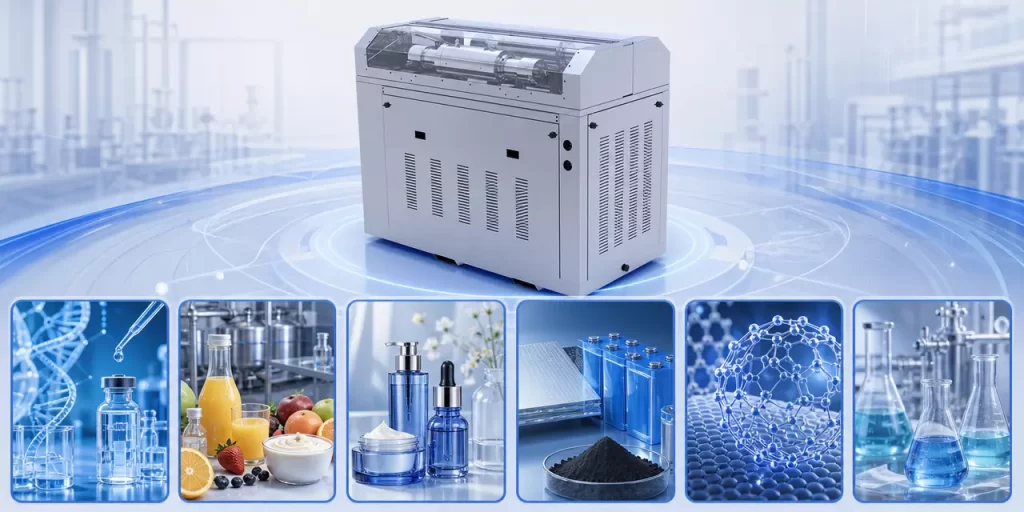
Today, microfluidic homogenizers are being used across research institutions, advanced materials, new energy, biopharmaceuticals, food, cosmetics, and chemical processing. As laboratory research increasingly moves toward pilot and industrial production, the role of the industrial microfluidizer is also becoming more important.
This article explores how high pressure microfluidization is driving innovation across multiple industries and why advanced high-pressure homogenization systems are becoming an important processing technology for next-generation materials and formulations.
How Does a Microfluidic Homogenizer Work?
Unlike the coarse processing of traditional agitation and shearing, the ultra-high-pressure microjet homogenizer uses ultra-high pressure (up to 400 MPa) as its core driving force. After pressurizing the material, it is propelled at high speed into extremely fine, specially designed diamond-lined microchannels with alternating cavities. Within these channels, the material forms supersonic jets. The strong shear forces generated by high-speed flow, the impact forces from head-on jet collisions, and the shock forces from the instantaneous formation and collapse of bubbles—these three forces work in concert to efficiently refine the material to the nanoscale and disperse it with extreme uniformity, achieving results far surpassing those of traditional equipment.
Whether dealing with high-viscosity colloids, slurries containing solids, or heat-sensitive materials, the system adapts efficiently to provide core homogenization solutions characterized by “precise refinement, uniform dispersion, and batch-to-batch consistency” for high-end fields such as biopharmaceuticals (liposome/nanomedicine preparation), food (plant-based emulsions/nano-fish oil), cosmetics (nano-creams), and new materials (graphene dispersion).
Why High Pressure Microfluidization Matters for Advanced Materials
One of the most important advantages of high pressure microfluidization is its ability to address particle size, dispersion uniformity, emulsion stability, and formulation consistency within a controlled processing environment.
For advanced materials, simply mixing two components together is often not enough.
A formulation may require:
- nanoscale particle dispersion
- narrow particle-size distribution
- stable emulsification
- reduced agglomeration
- improved suspension uniformity
- controlled surface interactions
- repeatable processing results
These requirements appear across seemingly unrelated industries.
For example, a pharmaceutical formulation may require uniform nanoparticles, while a battery slurry may require stable dispersion of functional particles. A cosmetic formulation may require a fine and stable emulsion, while a food product may require improved texture and physical stability.
The underlying processing challenge can therefore be surprisingly similar: how to achieve controlled and repeatable microscale or nanoscale dispersion.
Applications of High Pressure Microfluidization Across Industries
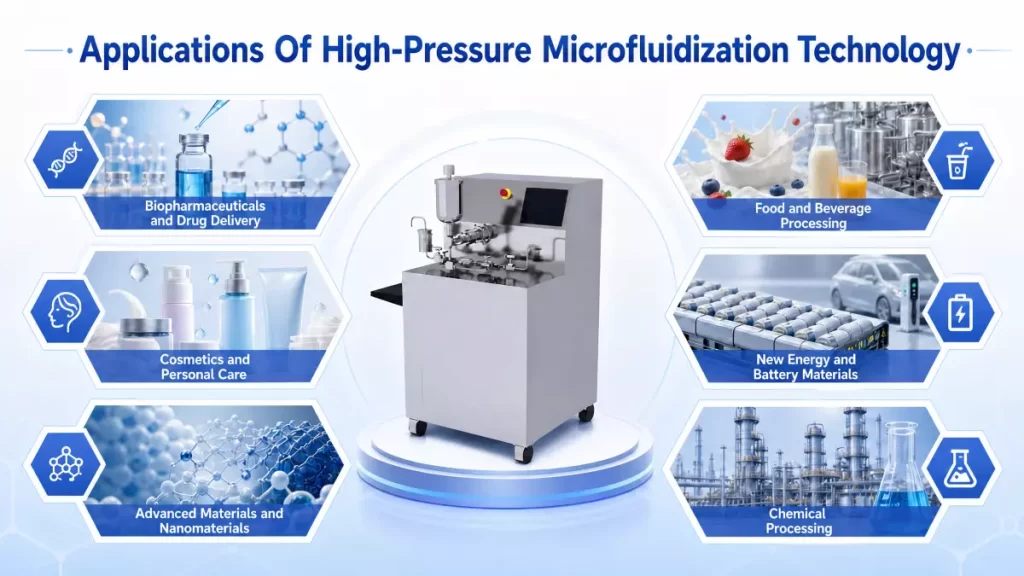
The applications of high-pressure microfluidization technology span biopharmaceuticals, food and beverages, cosmetics, new energy, advanced materials, and chemical processing, among others. By enabling precise control of particle size, dispersion, and emulsion properties, it helps researchers and manufacturers address diverse material-processing challenges from laboratory research to industrial production.
1. Biopharmaceuticals and Drug Delivery
Biopharmaceutical processing is one of the most technically demanding applications for microfluidization.
Modern drug delivery systems increasingly involve nanoscale structures, including liposomes, lipid nanoparticles, nanoemulsions, and other advanced delivery platforms.
A microfluidic homogenizer can provide controlled high-energy processing for applications such as:
- liposome preparation
- lipid nanoparticle processing
- nanoemulsion production
- nanoparticle dispersion
- active ingredient encapsulation
- drug delivery formulations
Particle size and distribution can directly affect formulation behavior, stability, and delivery performance.
For this reason, researchers and manufacturers often need processing equipment capable of providing precise pressure control and repeatable operating conditions.
For laboratory research, flexibility and process observation may be priorities. For production, throughput, reliability, cleaning, and process consistency become increasingly important.
2. Food and Beverage Processing
The food and beverage industry is another major application area for high pressure homogenization and microfluidization.
Many food products are complex multiphase systems containing oils, water, proteins, carbohydrates, natural particles, and functional ingredients.
Microfluidization can be used for applications including:
- fruit juice processing
- functional beverages
- plant-based beverages
- protein drinks
- food emulsions
- nanoemulsions
- nutritional formulations
- ingredient dispersion
For example, fruit-based beverages can contain suspended particles that influence mouthfeel, appearance, and physical stability.
High pressure microfluidization can help create finer and more uniform dispersions, depending on the formulation and process parameters.
In plant-based beverages, the technology can also be explored for improving the distribution of oil droplets and suspended components.
The objective is not simply to apply higher pressure, but to establish the appropriate combination of pressure, formulation, temperature, flow rate, and processing passes for the target product.
3. Cosmetics and Personal Care
Modern cosmetic formulations increasingly rely on sophisticated emulsions and delivery systems.
Serums, creams, lotions, sunscreens, active-ingredient formulations, and nanoemulsion-based products can benefit from controlled particle and droplet-size reduction.
A microfluidic homogenizer can be used in applications such as:
- cosmetic nanoemulsions
- skincare formulations
- active ingredient dispersion
- cream and lotion emulsification
- sunscreen formulations
- functional cosmetic ingredients
For cosmetic manufacturers, particle and droplet size can influence product appearance, texture, stability, and sensory characteristics.
High pressure microfluidization provides a way to engineer these characteristics through controlled physical processing rather than relying exclusively on conventional mechanical mixing.
4. New Energy and Battery Materials
The rapid development of new energy technologies is creating new challenges in material dispersion and slurry processing.
Battery materials often contain multiple functional components that need to be distributed uniformly throughout a formulation.
Potential applications of high pressure microfluidization include:
- conductive material dispersion
- nanoparticle processing
- battery slurry treatment
- advanced functional materials
- carbon material dispersion
- graphene processing
- energy-material formulation development
For example, carbon-based conductive materials can form agglomerates during processing. Achieving a stable and uniform dispersion can be critical for subsequent material processing.
High-pressure microfluidic processing provides researchers with another approach for controlling dispersion and reducing agglomeration.
For emerging battery materials, the ability to move from laboratory-scale experiments toward scalable production is particularly important.
This is where equipment architecture becomes critical.
A system intended for material research may prioritize flexibility across different formulations, while an industrial microfluidizer must additionally address continuous operation, throughput, durability, process control, maintenance, and integration into production lines.
5. Advanced Materials and Nanomaterials
Nanomaterials are highly sensitive to processing conditions.
Agglomeration can occur because of strong interparticle forces, surface interactions, or unfavorable formulation conditions.
High pressure microfluidization can be investigated for:
- graphene dispersion
- carbon nanotube dispersion
- nanoparticle dispersion
- ceramic nanoparticle processing
- functional material dispersion
- advanced composite materials
- pigment and particle processing
In some applications, high-pressure processing can help break apart agglomerates and improve the uniformity of the resulting dispersion.
For research teams working with emerging materials, an important advantage is process flexibility.
The same platform can potentially be evaluated at different pressure levels and processing conditions to determine the relationship between operating parameters and final material properties.
6. Chemical Processing
Chemical manufacturers increasingly require more precise control over particle size, dispersion, and emulsion characteristics.
Applications can include:
- chemical emulsions
- pigment dispersion
- catalyst dispersion
- nanoparticle processing
- specialty chemicals
- functional coatings
- advanced formulation systems
Compared with conventional batch mixing, microfluidic processing can provide a more controlled environment for high-energy fluid interactions.
This can be especially relevant when product performance depends strongly on particle-size distribution or dispersion uniformity.
From Laboratory Research to Industrial Production
One of the most important trends in advanced material processing is the transition from proof of concept to scalable production.
A material that performs well at laboratory scale may behave differently when production volume increases.
Scaling up a microfluidization process requires consideration of:
- processing pressure
- flow rate
- throughput
- number of passes
- temperature control
- formulation viscosity
- material concentration
- interaction-chamber geometry
- equipment wear
- cleaning requirements
- process monitoring
This is why an industrial microfluidizer should not simply be considered a larger laboratory homogenizer.
Industrial systems need to be engineered as complete processing platforms.
The pressure system, homogenization components, cooling system, control system, material-contact parts, and safety architecture all need to work together.
Why Core Component Design Matters
For high-pressure microfluidization equipment, the performance of the core components directly influences processing capability.
Two components are particularly important:
High-Pressure Intensifier
The intensifier converts mechanical energy into extremely high fluid pressure.
Stable pressure generation is essential for achieving repeatable processing conditions.
For advanced applications, a system may need to operate across a broad pressure range rather than being optimized for only one fixed operating point.
Microfluidic Interaction Chamber
The interaction chamber determines how pressure energy is converted into microscale fluid interactions.
Its geometry, material, durability, and internal flow structure can influence:
- shear conditions
- turbulence
- impact effects
- cavitation behavior
- pressure loss
- particle-size reduction
- processing consistency
For this reason, interaction-chamber engineering is one of the key technologies behind high-performance microfluidic homogenization.
From Equipment Supplier to Process Solution Provider
The future of high pressure microfluidization is not simply about building machines capable of reaching higher pressure.
It is about developing application-specific processing systems.
A research institution may need a flexible platform for exploring new materials.
A pharmaceutical company may require highly controlled processing for advanced formulations.
A battery-material manufacturer may focus on dispersion consistency and production scalability.
A food manufacturer may prioritize continuous throughput, temperature management, cleaning, and stable product quality.
These are different requirements, even when the underlying technology is similar.
Therefore, modern microfluidization equipment needs to combine high-pressure technology, microfluidic engineering, process control, application expertise, and scalable system design.
JUNJIE: High-Pressure Microfluidic Homogenization Solutions
JUNJIE focuses on the development and manufacturing of high-pressure microfluidic homogenization equipment and provides system solutions for research institutions and industrial applications.
The company’s technology covers applications in advanced materials, new energy, biopharmaceuticals, food and beverage, cosmetics, and chemical processing, with a focus on nanoscale dispersion and material processing.
JUNJIE develops and manufactures key components including the high-pressure intensifier and homogenization valve / diamond interaction chamber, enabling greater control over the core technologies behind the microfluidic homogenization process.
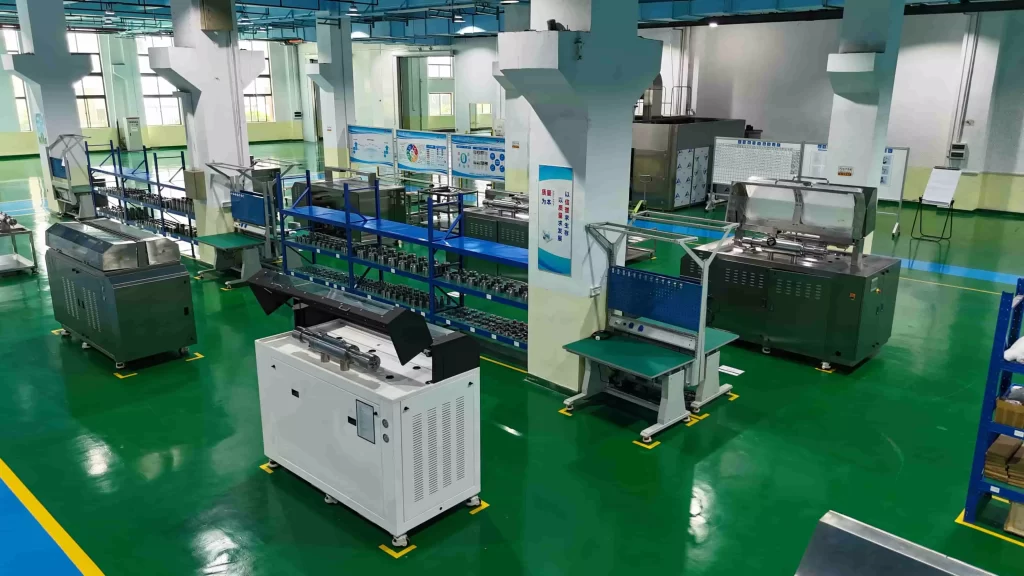
With integrated capabilities spanning R&D, manufacturing, sales, and technical service, JUNJIE can support customers from early-stage laboratory research through pilot development and industrial-scale processing.
The company’s high-pressure microfluidic homogenization platform can be adapted to different material characteristics, processing requirements, and production objectives.
Conclusion
From biopharmaceuticals and cosmetics to food, new energy, nanomaterials, and chemical processing, high pressure microfluidization is enabling researchers and manufacturers to address increasingly demanding dispersion and homogenization challenges.
The combination of controlled microscale flow, high-pressure energy, advanced interaction-chamber design, and precise process control makes the microfluidic homogenizer a versatile platform for nanoscale material processing.
As laboratory discoveries move toward commercialization, the role of the industrial microfluidizer will become increasingly important—not simply as a high-pressure machine, but as part of a complete, scalable, and application-specific processing system.
For organizations developing advanced materials and formulations, selecting the right microfluidization technology therefore requires looking beyond maximum pressure and considering the entire processing system, from core components and interaction-chamber technology to temperature control, scalability, and technical support.
