
Table of Contents
In advanced fine chemical industries such as nanomaterial processing, biopharmaceuticals, semiconductor polishing slurries, and new energy materials, particle agglomeration, structural damage, broad particle size distribution, and poor batch consistency remain major challenges in both research and large-scale production.
Traditional processing methods—including bead milling, ultrasonication, high-speed shear mixing, and conventional high-pressure homogenization—can present problems such as excessive deagglomeration, structural damage, metal contamination, and residual large particles. These issues may reduce final product performance, lower production yield, and shorten product stability.
JUNJIE addresses these challenges through self-developed diamond microchannel technology. Its advanced microfluidizer systems use microfluidization technology and precisely controlled fluid forces to achieve efficient and controlled deagglomeration while helping preserve the original structure of sensitive materials. This advanced approach provides an effective solution for high-end nanomaterial processing and dispersion.
The Challenge: Deagglomeration Without Damaging the Material
Many advanced materials present a difficult processing challenge. Insufficient pressure, shear intensity, or processing time may leave hard and soft agglomerates untreated, resulting in large particles that can cause wafer scratches, slurry sedimentation, emulsion instability, or reduced product performance.
Increasing processing intensity, however, may create another problem: excessive energy can damage the original crystal structure of powders, graphene sheets, carbon nanotubes, or biologically active molecules.
For materials such as cerium oxide CMP slurries, CNT conductive slurries, LNPs, liposomes, and graphene, conventional processes may struggle to balance effective dispersion with structural preservation. The fundamental limitation is the lack of a controlled and uniform fluid-processing mechanism capable of separating particle agglomerates while protecting the original material structure.
Diamond Microfluidic Technology for Precise Deagglomeration
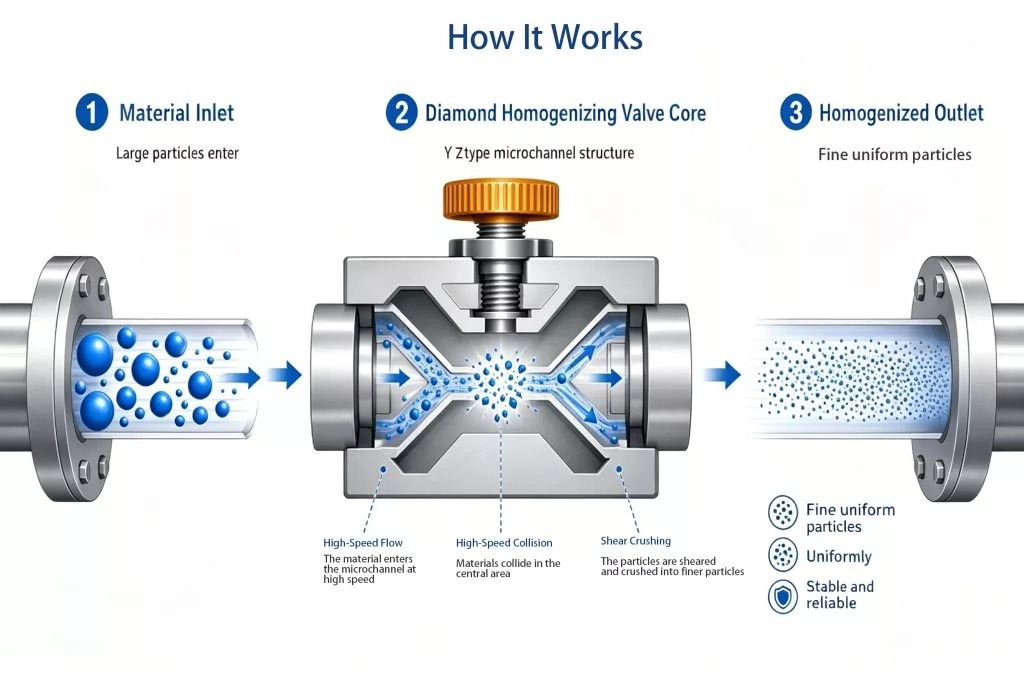
JUNJIE microfluidizers are equipped with self-developed diamond interaction chambers featuring precision-engineered microchannels. Through controlled microfluidization, materials pass through fixed diamond microchannels under optimized pressure conditions.
The system can support intelligent pressure adaptation in the 20–30K psi range, with a maximum design pressure of up to 420 MPa. As materials flow through the microchannels at high velocity, multiple fluid effects—including controlled shear, high-velocity impingement, cavitation, and uniform turbulent disturbance—work together to disperse agglomerates.
Unlike the less controlled forces generated by conventional homogenization equipment, JUNJIE’s microfluidic technology concentrates and distributes processing energy more consistently. This helps break down particle agglomerates, CNT entanglements, and powder clusters while minimizing unnecessary damage to primary particles, sheet structures, and sensitive biological materials.
The diamond microchannel also provides excellent hardness, wear resistance, and chemical stability. Its highly wear-resistant design helps reduce chamber wear and contamination risks, making it suitable for applications requiring high material purity.
Key Advantages of JUNJIE Microfluidization
Precise and Controlled Deagglomeration
JUNJIE microfluidization is designed to efficiently disperse both soft and hard agglomerates while helping preserve the original properties and structure of the processed material.
Improved Particle Size Uniformity
Fixed microchannel geometry combined with controlled pressure enables more consistent processing conditions. This helps narrow particle size distribution and reduce the presence of large particle agglomerates.
High-Purity Processing
Diamond interaction chambers offer excellent wear resistance and chemical stability, helping reduce contamination associated with component wear. This is particularly important for high-purity semiconductor slurries, pharmaceutical formulations, and advanced cosmetic materials.
Scalable Processing from R&D to Production
JUNJIE provides microfluidizer systems ranging from the HPW-10 laboratory model and HPW-250 pilot-scale system to the HPW-500 production-scale system and customized HPW-X solutions.
By maintaining consistent microfluidic technology principles across different system capacities, key process parameters developed during laboratory testing can support a smoother transition toward pilot and large-scale production.
Applications Across Advanced Industries
Microfluidization provides a versatile approach to improving the dispersion, deagglomeration, and processing consistency of advanced materials. As a microfluidic application, JUNJIE microfluidizer technology supports precise particle and formulation control across a wide range of industries, including semiconductor slurries, new-energy materials, biopharmaceuticals, cosmetics, and food chemicals.
Semiconductor and Advanced Materials
For materials such as cerium oxide, boron nitride, and nanoceramics, microfluidization can help disperse hard agglomerates and reduce large-particle risks while supporting the preparation of stable CMP polishing slurries and functional nanomaterial dispersions.
New Energy
For CNT and graphene conductive slurries, a microfluidizer can help address particle entanglement and agglomeration while supporting improved dispersion uniformity and stability.
Biopharmaceuticals
JUNJIE microfluidic technology is suitable for applications including mRNA vaccines, lipid nanoparticles (LNPs), and liposomes, where controlled processing and particle size consistency are important.
Cosmetics and Food Chemicals
Microfluidization can also support nano-encapsulation, emulsion processing, and stable material dispersion for cosmetic, personal care, and food-related applications.
From Equipment to Process Support
JUNJIE focuses on high-pressure microfluidic nano-homogenization technology and maintains in-house development and manufacturing capabilities for key components, including diamond microchannels, core pressurization components, and complete equipment systems.
With modular process design capabilities, JUNJIE can support material testing, process parameter optimization, equipment customization, and production-line solutions according to different material properties, viscosities, and processing requirements.
How to Select a Microfluidizer for Nano Powder Dispersion
Selecting a microfluidizer should involve more than comparing maximum pressure ratings. The following factors should be evaluated.
Target Particle Size
What particle size and distribution are required for the final formulation?
Initial Agglomeration
Does the feed material consist primarily of nanoscale particles, or does it contain micron-scale aggregates?
Material Hardness
Hard and abrasive powders can place higher demands on interaction-chamber materials and wear resistance.
Solid Concentration
Higher solid loading can significantly influence viscosity and processing behavior.
Processing Volume
Determine whether the application requires laboratory-scale, pilot-scale, or continuous production processing.
Temperature Sensitivity
Evaluate whether the formulation requires active cooling or temperature monitoring.
Interaction Chamber
The interaction chamber is a critical component of the system. Its geometry and material should be matched to the characteristics of the formulation.
Contamination Requirements
Semiconductor and pharmaceutical applications may require particularly stringent control over potential metallic or particulate contamination.
Scale-Up Requirements
Consider whether the laboratory equipment provides a practical pathway toward pilot and production systems.
Process Monitoring
Pressure, temperature, flow rate, and processing passes should be monitored and controlled to support repeatable process development.
Why Core Component Design Matters
For advanced nanomaterial processing, equipment performance depends on more than the high-pressure pump.
A professional microfluidic homogenization platform may integrate:
- High-pressure intensifier
- Homogenization valve or interaction chamber
- High-pressure piping
- Pressure monitoring
- Temperature management
- Feed system
- Process control
- Safety systems
- Cleaning and maintenance functions
JUNJIE integrates the development and manufacturing of key components, including high-pressure intensifiers, homogenization valves, and diamond interaction chambers.
This vertically integrated capability enables the system configuration to be adapted to different material characteristics and processing requirements.
For challenging nano powder applications, equipment selection should therefore be considered as part of an overall material processing and process-development strategy, rather than simply a machine purchase.
Building a Stable Nano Powder Dispersion Process
The objective of nano powder processing is not simply to make particles “as small as possible.”
The real target is a dispersion that is:
- Uniform
- Stable
- Reproducible
- Structurally appropriate
- Scalable
- Suitable for the final application
A systematic process-development strategy can start with nano powder pre-mixing, followed by microfluidization, particle size testing, parameter optimization, stability evaluation, and ultimately scale-up to pilot or production levels.
By optimizing pressure, concentration, temperature, interaction-chamber configuration, and processing passes, manufacturers can establish a more reliable process window.
This is particularly important for high-value applications involving semiconductor materials, battery materials, electronic materials, advanced ceramics, pharmaceuticals, and functional nanocomposites.
Conclusion
The goal of advanced nanomaterial processing is not simply to make particles smaller. More importantly, it is to achieve uniform particle size, controlled dispersion, structural preservation, and reliable batch consistency.
Through precision-engineered diamond microchannels, advanced microfluidization, and ultra-high-pressure processing capabilities, JUNJIE microfluidizers provide a controlled approach to particle deagglomeration and nanoscale material processing.
From biopharmaceuticals and semiconductor materials to new energy, advanced materials, cosmetics, and fine chemicals, JUNJIE microfluidic technology supports the development of more uniform, stable, and scalable material processing solutions.
If your nanomaterial formulation experiences agglomeration, broad particle size distribution, or insufficient dispersion stability, process testing can help determine appropriate operating pressure, interaction chamber configuration, and processing passes before equipment customization.