
Table of Contents
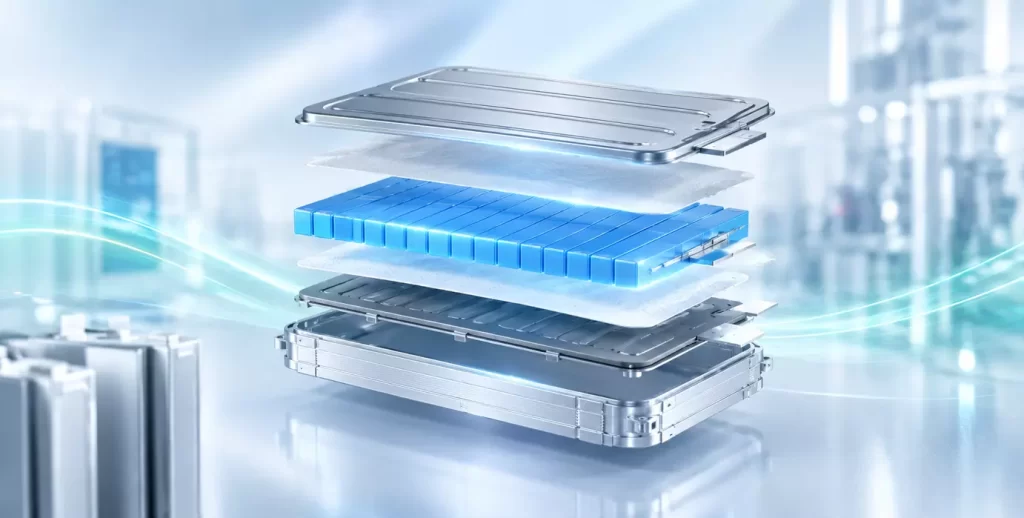
The development of solid-state batteries is accelerating as automakers, battery manufacturers, and energy companies seek higher energy density, improved safety, and longer service life. Unlike conventional lithium-ion batteries with liquid or gel electrolytes, solid-state batteries use solid electrolytes, offering potential for higher-energy-density designs and high-capacity electrode materials. However, commercializing these advantages remains a major manufacturing challenge, particularly in densification.
Solid-state battery materials and layers require sufficient density and intimate contact to minimize pores, voids, and interfacial defects. Warm Isostatic Pressing (WIP) can help address this challenge by applying uniform high pressure from multiple directions under controlled temperatures, improving component density and structural uniformity. This provides a more consistent foundation for higher energy density, improved electrochemical performance, and longer battery life.
What Is Warm Isostatic Pressing?
Warm Isostatic Pressing, commonly abbreviated as WIP, is a pressure-assisted manufacturing technology that applies isostatic pressure to a material while maintaining a controlled elevated temperature.
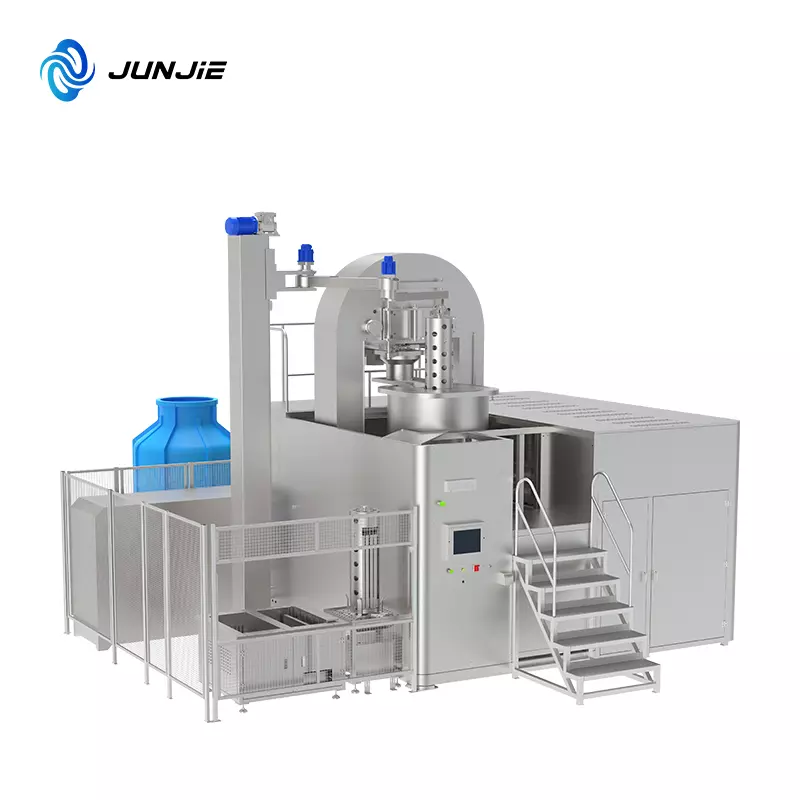
Unlike conventional uniaxial pressing, which applies force primarily along one or more specific directions, isostatic pressing applies pressure more uniformly around the workpiece. JUNJIE Warm Isostatic Pressing (WIP) equipment uses a fluid medium to transmit pressure, delivering uniform 360° omnidirectional pressure to encapsulated cells. Combined with precise temperature control at 80–150°C and a pressure range of 400–600 MPa, it ensures consistent force across every part of the cell, eliminating pressure blind spots associated with unidirectional pressing. This makes WIP particularly attractive for materials and structures where uniform densification is critical.
The combination of pressure + temperature + controlled processing time can promote more uniform compaction and reduce internal voids. For advanced battery manufacturing, this is especially relevant because microscopic structural defects can have a significant impact on electrochemical performance.
Why Densification Matters in Solid-State Batteries
One of the major challenges in solid-state battery manufacturing is achieving good contact between different material layers.
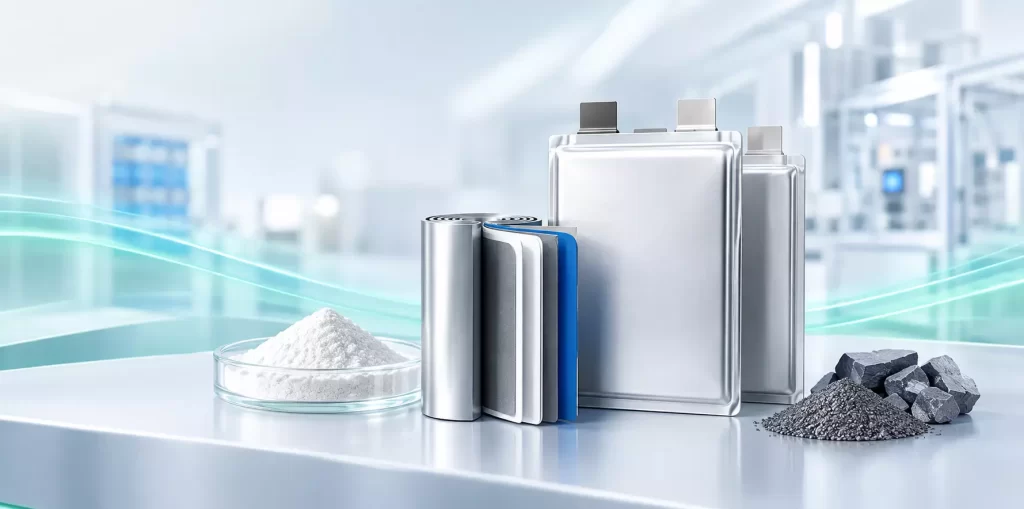
A typical solid-state battery may contain:
- Cathode materials
- Solid electrolyte
- Anode or anode-free structures
- Current collectors
- Composite electrode layers
- Interfacial layers
These components need to work together as a highly integrated structure.
However, differences in particle size, material properties, mechanical behavior, and processing conditions can result in:
- Residual pores
- Microcracks
- Poor particle contact
- Interfacial gaps
- Non-uniform density
- Localized mechanical stress
These defects can increase ion transport resistance and create non-uniform electrochemical behavior.
WIP can help address these challenges through uniform pressure application.
Because pressure is transmitted more evenly throughout the processing volume, WIP can help compress materials and structures more uniformly than conventional directional pressing approaches.
This can contribute to:
Higher density → Better particle contact → More uniform ion transport → Improved electrochemical performance
However, the actual result depends on the battery chemistry, material formulation, temperature, pressure, holding time, and overall manufacturing process.
How WIP Can Support Higher Energy Density
Energy density is one of the most important performance indicators for electric vehicle and portable energy-storage batteries.
Higher energy density means that more energy can potentially be stored within the same battery mass or volume.
For electric vehicles, this can translate into potential advantages such as:
- Longer driving range
- Reduced battery weight
- More compact battery packs
- Greater vehicle design flexibility
But achieving higher energy density requires more than simply increasing the amount of active material.
The internal structure of the battery must also be optimized.
Poor densification can leave unnecessary voids and reduce the effective utilization of the electrode and electrolyte materials.
By improving structural density and interfacial contact, Warm Isostatic Pressing can support the development of more compact and uniform battery architectures.
WIP does not independently determine a battery’s energy density. Instead, it is a manufacturing technology that can help battery developers optimize the physical structure required to achieve their targeted performance.
How WIP Can Contribute to Longer Battery Life
Energy density is only one part of battery performance.
For electric vehicles and energy-storage systems, cycle life is equally important.
A battery that offers high energy density but rapidly loses capacity during repeated charging and discharging may not provide sufficient commercial value.
Battery degradation can be influenced by many factors, including:
- Electrode degradation
- Electrolyte instability
- Interface reactions
- Mechanical stress
- Crack formation
- Uneven current distribution
- Volume changes during cycling
The quality of interfaces inside a solid-state battery is particularly important.
Poor contact between the solid electrolyte and electrode can create areas of high resistance. During repeated cycling, these areas may contribute to localized stress and degradation.
By improving the uniformity and density of battery structures, WIP can help create more stable interfaces and reduce certain types of structural defects.
This provides a potential pathway toward:
More uniform interfaces → More consistent ion transport → Reduced localized stress → Better cycling stability
Again, WIP is not a standalone solution for battery degradation. Long cycle life requires optimization of materials, interfaces, cell design, manufacturing parameters, and battery management systems.
Why Isostatic Pressure Can Be Advantageous
Traditional pressing technologies typically apply mechanical force from specific directions.
This can create differences in density throughout the material, particularly when processing complex geometries or multilayer structures.
WIP takes a different approach.
Conventional directional pressing
Pressure is mainly applied along a defined axis.
Potential challenges include:
- Density gradients
- Uneven compaction
- Shape deformation
- Difficulties with complex structures
Warm Isostatic Pressing
Pressure is applied more uniformly around the workpiece.
Potential advantages include:
- More uniform densification
- Improved dimensional consistency
- Better contact between particles
- Reduced internal voids
- Greater processing flexibility
For advanced solid-state battery structures, uniformity can be just as important as the absolute pressure level.
WIP vs. Conventional Hot Isostatic Pressing
WIP should not be confused with Hot Isostatic Pressing (HIP).
Both technologies use isostatic pressure, but their processing temperature ranges and applications can differ significantly.
| Feature | WIP | HIP |
|---|---|---|
| Temperature | Moderate/elevated temperature | High temperature |
| Pressure | High isostatic pressure | High isostatic pressure |
| Main objective | Compaction and densification | High-temperature densification |
| Typical applications | Electronics, ceramics, battery materials | Aerospace, metals, advanced ceramics |
| Material sensitivity | Suitable for temperature-sensitive materials | Better suited to materials requiring high-temperature processing |
For solid-state batteries, the processing temperature must be carefully controlled because battery materials and interfaces can be sensitive to thermal conditions.
WIP provides an approach for combining controlled temperature with high-pressure densification without necessarily relying on the extreme temperatures associated with conventional HIP processes.
The Role of WIP in the Future of Solid-State Batteries
Solid-state batteries have attracted significant attention because they offer the potential to overcome some limitations of conventional liquid-electrolyte battery technologies.
However, commercialization depends on more than material breakthroughs.
The industry also needs scalable and reliable manufacturing technologies.
This includes:
- Material synthesis
- Electrode preparation
- Layer formation
- Interface engineering
- Cell assembly
- Densification
- Quality inspection
- Formation and testing
WIP can become an important part of this manufacturing ecosystem by addressing the densification and structural uniformity of advanced battery components.
As battery designs become more sophisticated, the ability to precisely control pressure and temperature during manufacturing may become increasingly important.
JUNJIE Warm Isostatic Pressing: Proprietary Core Technology and Unique Process Solutions
With years of expertise in precision ultra-high-pressure manufacturing, JUNJIE has developed proprietary core technologies and specialized process solutions for Warm Isostatic Pressing (WIP). Our comprehensive range of WIP systems is designed to support the three major solid-state electrolyte systems—sulfide, oxide, and polymer-based electrolytes—covering the full production pathway from laboratory-scale R&D and pilot validation to GWh-scale mass production.
Advanced Parameters for Precise Solid-State Battery Processing
- Pressure Range: 400–600 MPa, with pressure fluctuations controlled within ±5 MPa. Dedicated pressure profiles for sulfide- and oxide-based electrolytes can be customized according to specific process requirements.
- Temperature Control: Precise constant-temperature control from 80–150°C, with temperature fluctuations within ±5°C, helping minimize unwanted high-temperature side reactions.
- Chamber Configuration: Vertical WIP systems are suitable for R&D and prototype development, while horizontal models can be integrated with automated production lines and robotic loading/unloading systems, enabling seamless integration into large-scale manufacturing lines.
Three Key Advantages for Real-World Manufacturing Challenges
Full-System Compatibility with Flexible Process Control: Pressure and temperature parameters can be programmed independently to accommodate different electrolyte forming requirements. One WIP system can support the development and iteration of multiple solid-state battery technology routes, helping reduce equipment investment costs.
Authoritative Certifications for Stable and Reliable High-Pressure Operation: Our systems are certified to ASME and ISO 9001 standards. The sealed pressure chamber undergoes rigorous fatigue testing to ensure reliable operation under demanding high-pressure conditions, while helping reduce maintenance requirements and shorten delivery cycles.
One-Stop Implementation Support Beyond Equipment Supply: A dedicated process engineering team provides production-line planning and evaluation, pressure-temperature profile optimization, installation, commissioning, and maintenance support. By providing integrated technical assistance throughout the implementation process, JUNJIE helps battery manufacturers reduce trial-and-error costs and accelerate the seamless transition from laboratory development to mass production.
Conclusion: WIP as an Enabler of Next-Generation Battery Performance
The future of solid-state batteries depends not only on innovative materials but also on advanced manufacturing technologies that can turn laboratory breakthroughs into reliable commercial products. Warm Isostatic Pressing (WIP) provides a powerful approach to improving the density and uniformity of advanced battery materials and structures through controlled temperature and uniform high-pressure processing, supporting better material and interface contact, fewer internal voids, more consistent cell structures, improved energy density and cycling stability, and scalable manufacturing.
JUNJIE specializes in Warm Isostatic Pressing (WIP), with proprietary technology, mature process solutions, and proven mass-production experience. Serving leading battery companies and research institutions, JUNJIE provides WIP equipment from lab-scale development to GWh-scale production, enabling cost-effective and scalable solid-state battery manufacturing. Ultimately, longer driving range and battery life result from the combined optimization of materials, cell architecture, interfaces, manufacturing processes, and battery management. As solid-state batteries move toward higher energy density and more complex architectures, WIP can serve as an important manufacturing enabler for next-generation energy storage.es WIP equipment from lab-scale development to GWh-scale production, enabling cost-effective and scalable solid-state battery manufacturing.
