
For companies developing advanced materials, pharmaceuticals, food, and specialty chemicals, achieving a successful laboratory result is only the beginning. The real challenge comes when the process moves to pilot production and mass manufacturing.
At production scale, higher throughput, continuous operation, pressure fluctuations, temperature rise, equipment wear, and batch-to-batch variation can make laboratory results difficult to reproduce. Particle size and dispersion performance may change, while repeated process adjustments increase development time and production costs.
The key question is:How can laboratory-scale nano-processing results be reproduced consistently and efficiently in mass production?
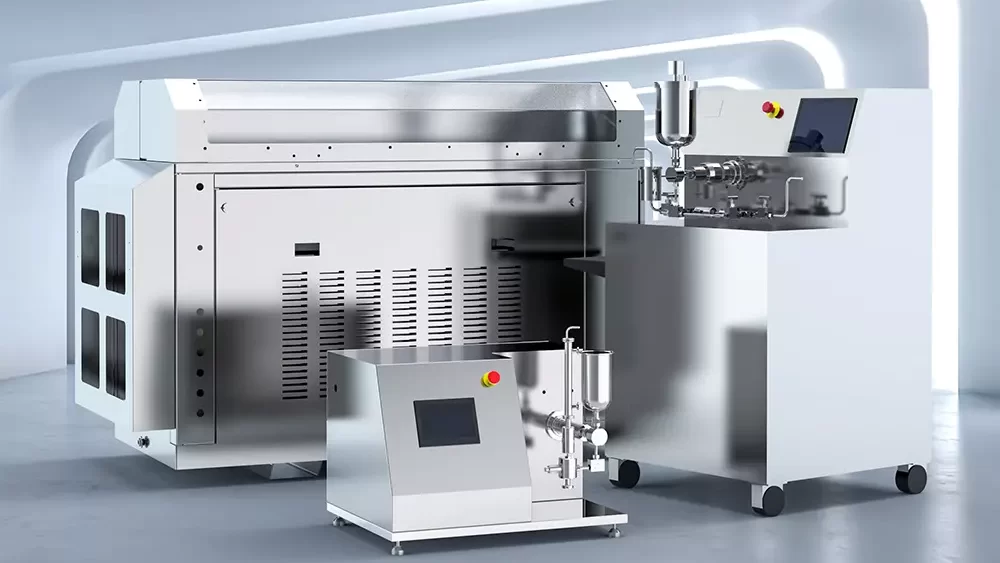
JUNJIE’s high-pressure microfluidizer addresses this scale-up challenge by combining high-pressure microfluidic technology, precision interaction structures, and independently developed core components—helping bridge the gap from laboratory R&D to pilot validation and mass production.
JUNJIE offers a comprehensive range of high-pressure microfluidizers designed to meet diverse requirements from laboratory R&D to industrial-scale mass production. Our product portfolio features scalable processing capabilities, advanced technology, and customized solutions.
By integrating high-pressure microfluidic technology, precision interaction structures, and independently developed core components, JUNJIE helps overcome scale-up challenges and enables a seamless transition from laboratory research and pilot validation to large-scale production.
Why Scale-Up Is Difficult in Nano-Scale Material Processing
Traditional laboratory equipment can be highly effective for formulation screening and proof-of-concept experiments. However, laboratory success does not automatically translate into industrial reproducibility.
The reason is that nano-scale processing is highly sensitive to process conditions.
When equipment changes, several parameters may change simultaneously:
Pressure → Flow Dynamics → Shear → Cavitation → Collision → Particle Breakup → Dispersion Quality
A small difference in pressure stability or processing geometry can influence the final particle-size distribution and dispersion performance.
For example, a formulation developed at laboratory scale may demonstrate excellent dispersion after several passes. When transferred to another machine for pilot production, however, the same number of passes may no longer generate the same result.
This creates a common problem:
Laboratory Formula ≠ Pilot Process ≠ Mass Production Result
The problem is not necessarily the formulation itself. It may be the processing platform.
This is why an industrial-grade high-pressure microfluidizer should not simply be considered a larger laboratory homogenizer.
It should be designed as a scalable processing system.
Microfluidic Technology: Turning High Pressure Into Controlled Processing
The core of a modern microfluidic homogenizer lies in the interaction between pressure, flow geometry, and material properties.
In a typical high-pressure microfluidic process, the feed material is pressurized and driven through a precisely engineered interaction region.
The process can be understood as four fundamental stages:
High-Pressure Acceleration
The feed material is pressurized to a very high level, converting pressure energy into high-velocity fluid flow.
Microchannel Interaction
The material enters engineered microchannels or a specialized interaction chamber.
The controlled geometry creates intense and localized physical forces.
Particle or Droplet Disruption
High shear, collision, turbulence, and cavitation contribute to the breakup of particles or droplets.
Homogeneous Nano-Scale Dispersion
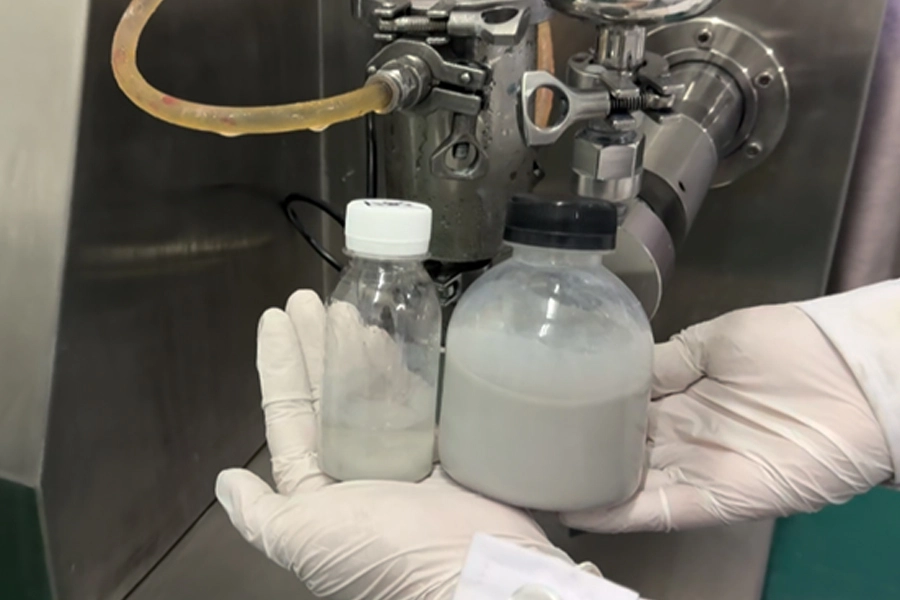
The processed material exits the interaction zone with improved particle or droplet uniformity.
This process architecture gives microfluidic technology an important advantage for applications where conventional mechanical mixing cannot provide sufficient particle-size control.
The Real Challenge: From Lab Parameters to Production Parameters
One of the most important considerations when selecting a microfluidic homogenizer is whether laboratory parameters can be meaningfully transferred to larger equipment.
A successful scale-up strategy should not depend solely on increasing machine size.
Instead, manufacturers need to preserve the critical processing conditions that determine the final product.
These may include:
| Laboratory Development | Scale-Up Requirement |
|---|---|
| Processing pressure | Stable pressure under continuous operation |
| Interaction geometry | Consistent processing environment |
| Number of passes | Defined and reproducible processing cycles |
| Feed rate | Controlled production throughput |
| Temperature | Effective thermal management |
| Particle size | Consistent particle-size distribution |
| Dispersion stability | Batch-to-batch reproducibility |
| Material compatibility | Reliable long-term operation |
This is where an industrial high-pressure microfluidizer makes a fundamental difference.
The goal is not to simply process a larger quantity of material.
The goal is to reproduce the processing mechanism at a larger production scale.
Why This Matters for New Materials and New Energy
Advanced materials frequently require precise dispersion and particle-size control.
Applications can include:
- Battery materials
- Solid-state battery materials
- Conductive materials
- Ceramic powders
- Carbon-based materials
- Nanomaterials
- Functional coatings
- Electronic materials
For these materials, agglomeration can negatively affect downstream performance.
A high-pressure microfluidic homogenizer can provide controlled physical processing designed to break down agglomerates and improve material uniformity.
For new-energy manufacturers, the value is therefore not simply “smaller particles.”
It is the potential to achieve a more controlled material-processing environment that can support downstream manufacturing consistency.
JUNJIE High-Pressure Microfluidizer: One-Stop Solutions from Lab to Mass Production
Full-Range Product Portfolio: Seamless Coverage from Laboratory to Mass Production
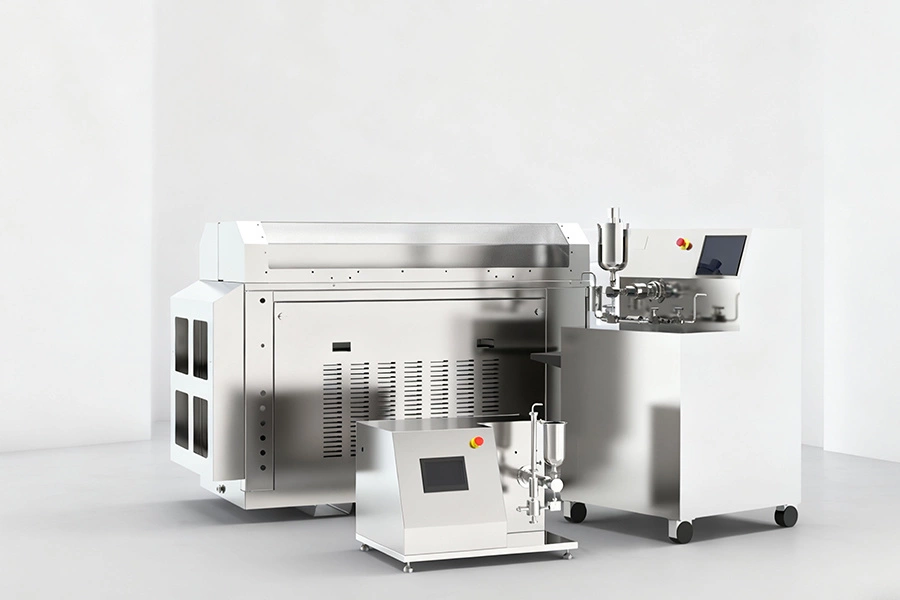
JUNJIE offers a complete product portfolio ranging from laboratory-scale to industrial-scale systems, ensuring that R&D, pilot production, and mass production can all operate on the same technology platform for a smooth and consistent process transition.
| Model | Positioning | Key Parameters | Core Value |
|---|---|---|---|
| HPW-10 | Laboratory Scale | 10 L processing capacity, servo electric-cylinder drive, supports sample volumes as low as 20 mL | Designed for laboratory R&D, ideal for process validation and parameter optimization with small batches and precious samples |
| HPW-250 | Pilot Scale | 250 L processing capacity, 37 kW hydraulic drive, integrated CIP/SIP backflushing system | Bridges laboratory R&D and mass production, enabling validation of process scale-up feasibility |
| HPW-500 | Industrial Production | 500 L processing capacity, 75 kW hydraulic drive, capable of 24-hour continuous operation | Designed for large-scale industrial production, delivering high throughput and reliable process stability |
| HPW-X | Customized | Pressure, flow rate, materials, and functional modules can be customized | Provides tailored solutions for specialized processes and demanding operating conditions |
Core Technology Advantages: Ensuring Process Stability and Product Quality
All models share the same core technology platform, enabling key process parameters to be transferred consistently from laboratory development to mass production.
- Ultra-High-Pressure Technology: Maximum pressure up to 420 MPa. Diamond interaction chamber technology generates intense shear, collision, and cavitation effects for nano-scale particle size reduction and uniform dispersion.
- Precise Particle Size Control: Fixed-geometry microchannel designs provide consistent particle-size results across batches with a narrow particle-size distribution.
- Sanitary-Grade Materials: All product-contact components are made from GMP- and FDA-recognized materials, including 316L and 17-4PH stainless steel, tungsten carbide, and zirconia, helping ensure hygienic and contamination-free processing.
- Modular Design: Optional features such as intelligent overload protection, online sampling interfaces, and GMP/GLP-compliant data recording can be integrated to meet the regulatory requirements of different industries.
Wide Range of Applications
JUNJIE systems are widely applicable across six major industries, supporting the entire process from laboratory research to industrial-scale production:
- Biopharmaceuticals: Particle-size control and activity preservation for liposomes and mRNA vaccines
- Chemical Engineering: Efficient dispersion and mass transfer for polymerization and catalyst preparation
- Materials Science: Nano-scale processing of graphene dispersions and ceramic powders
- Food & Beverage: Improved texture and stability of plant-based emulsions and nano-emulsified fish oil
- New Energy: Homogenization and dispersion of battery electrode slurries
- Beauty & Personal Care: Active-ingredient encapsulation and system stabilization in nano-emulsions and creams
Services & Support: Lowering the Barrier to Technology Implementation
JUNJIE provides one-stop services ranging from production-line design to after-sales operation and maintenance, helping customers accelerate the transition from laboratory development to mass production.
- Customized Solutions: Tailored to specific industries, applications, and requirements, delivering solutions designed for precise application fit and rapid deployment.
- Testing Services: Particle-size verification and material compatibility testing to validate process feasibility before scale-up.
- Technical Support: Comprehensive support covering preliminary planning, long-term process tracking, and technical troubleshooting to ensure reliable equipment operation.
- Documentation & Resources: Product catalogs, selection guides, product videos, and other technical resources to help customers select the most suitable model.
Conclusion
Taking nano-scale material processing from the laboratory to mass production is not simply a matter of increasing processing capacity. Pressure stability, throughput, temperature control, core component wear, and batch-to-batch consistency can all make laboratory results difficult to reproduce reliably on an industrial production line.
Successful process scale-up requires a unified technology platform, stable processing conditions, reliable core components, and equipment capable of adapting to different stages of production.
JUNJIE High-Pressure Microfluidizer provide full-scale coverage from laboratory R&D to industrial mass production through a complete product portfolio, including the HPW-10 laboratory model, HPW-250 pilot-scale model, HPW-500 production model, and HPW-X customized model. Built on a unified core technology platform featuring up to 420 MPa ultra-high pressure and diamond interaction chambers, the systems support scalable process development. Combined with one-stop technical services, JUNJIE helps lower the barriers to implementation and enables a smooth and efficient transition from R&D to mass production.
Serving industries including new energy, nanomaterials, biopharmaceuticals, food & beverage, and specialty chemicals, JUNJIE provides scalable and customizable high-pressure microfluidic solutions that help transform laboratory breakthroughs into stable and reliable industrial production processes.