
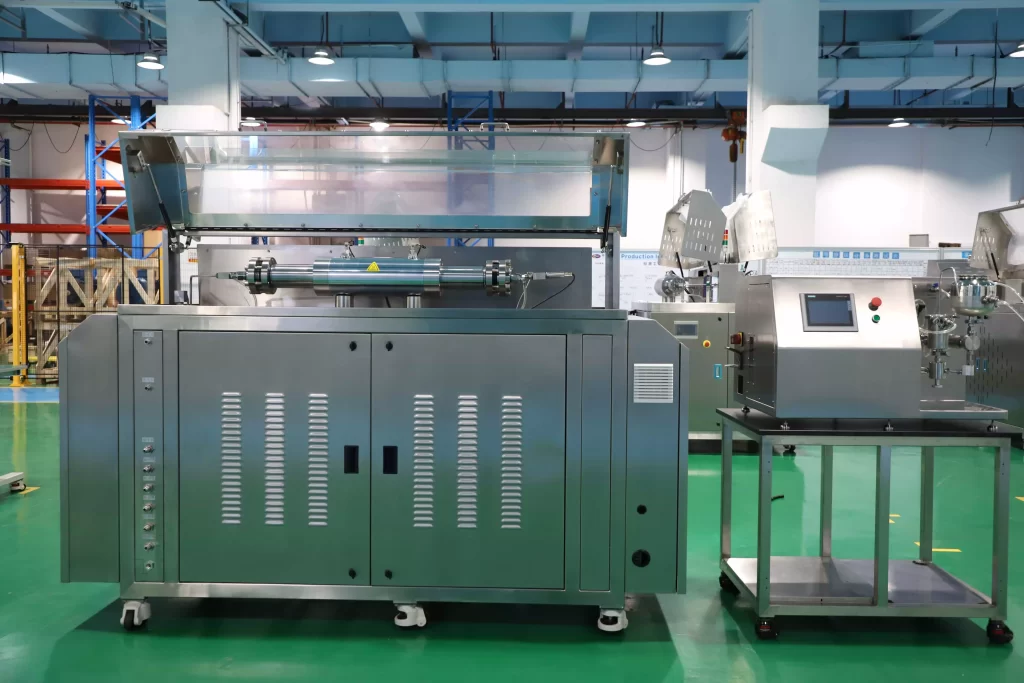
When manufacturers need to reduce particle size, improve dispersion, or create stable emulsions and suspensions, homogenization is often a critical processing step. However, not all homogenization technologies deliver the same results. The choice between a microfluidizer and a conventional homogenizer can significantly affect particle size, dispersion uniformity, product stability, processing efficiency, and scalability.
A conventional homogenizer has been widely used across the food, pharmaceutical, chemical, biotechnology, and materials industries for decades. It is effective for many standard emulsification and dispersion applications. However, as industries increasingly demand nanoscale materials, highly uniform particle distributions, and reproducible processing, microfluidic technology has emerged as a more advanced approach.
So, which technology is better: a microfluidizer or a conventional homogenizer?
The answer depends on the material, target particle size, formulation requirements, production scale, and desired level of process control. For applications requiring high-pressure processing, nanoscale dispersion, narrow particle-size distributions, and repeatable results, microfluidic technology can provide significant advantages.
What Is a Conventional Homogenizer?
A conventional homogenizer uses mechanical forces to break down particles or droplets and improve the uniformity of a formulation. Depending on the equipment design, the process may involve high-speed rotation, rotor-stator shear, pressure-driven valves, or other mechanical mechanisms.
A conventional homogenizer is commonly used for:
- Emulsifying oil and water phases
- Dispersing powders into liquids
- Reducing particle or droplet size
- Producing suspensions
- Mixing ingredients with different physical properties
- Improving formulation uniformity
Conventional homogenization can be highly effective when the required particle size is in the micron range or when extremely narrow particle-size distributions are not essential.
However, conventional systems can encounter limitations when processing advanced materials that require nanoscale particle reduction and highly controlled dispersion.
What Is a Microfluidizer?
A microfluidizer is a high-pressure processing system that uses microfluidic technology to process materials through specially engineered interaction channels or chambers.
Instead of relying primarily on conventional mechanical mixing, the material is accelerated under extremely high pressure and forced through engineered microchannels. Within the interaction region, the fluid experiences intense shear, impact, turbulence, cavitation, and other physical forces.
These combined mechanisms can rapidly break down particles and droplets and promote highly uniform dispersion.
Modern microfluidic homogenization systems are particularly suitable for applications where conventional mixing or homogenization cannot consistently achieve the desired particle size or dispersion quality.
Typical applications include:
- Nanoparticle dispersion
- Nanoemulsions
- Liposomes
- Solid-state battery materials
- Advanced ceramic materials
- Pharmaceutical formulations
- Biotechnology products
- Functional food ingredients
- Pigment and ink dispersion
- Carbon materials
- Graphene and other advanced materials
- High-performance chemical formulations
Microfluidizer vs. Conventional Homogenizer: Key Differences
The fundamental difference between these technologies is how mechanical energy is transferred into the material.
A conventional homogenizer generally relies on mechanical shear, rotor-stator action, or pressure-driven homogenization. A microfluidizer uses carefully engineered microchannels and high-pressure fluid dynamics to create highly intense and controlled processing conditions.
| Performance Factor | Microfluidizer | Conventional Homogenizer |
|---|---|---|
| Particle-size reduction | Excellent for micron-to-nanoscale processing | Generally effective for micron-scale processing |
| Dispersion uniformity | Very high | Moderate to high, depending on design |
| Particle-size distribution | Narrower and more controllable | Can be broader |
| Processing mechanism | High-pressure microfluidic interaction | Mechanical shear / conventional homogenization |
| Reproducibility | High with controlled pressure and processing parameters | Depends strongly on equipment and formulation |
| Nanoemulsion processing | Highly suitable | Application dependent |
| Nanomaterial dispersion | Highly suitable | May require additional processing |
| Scale-up | Designed for controlled process scaling | Widely scalable |
| Advanced-material applications | Excellent | More limited in demanding applications |
| Process control | High | Moderate to high |
The most important consideration is not simply whether one technology produces smaller particles, but how consistently and efficiently it can achieve the required material characteristics.
Core Advantages of Microfluidizer
Smaller Particle Size and Narrower Size Distribution
- Due to the highly concentrated and uniform shear forces, microfluidizer homogenizers are particularly well suited for producing monodisperse nanoemulsions and liposomes, with PDI (Polydispersity Index) controllable below 0.12.
- For applications requiring extremely high uniformity, such as liposomal drug delivery and mRNA vaccines, microfluidization is the preferred choice.
Highly Efficient Cell Disruption
Microfluidizer homogenizers are highly effective for disrupting difficult-to-lyse cells such as bacteria and yeast, offering significantly higher disruption efficiency than conventional high-pressure homogenizers.
Extremely Low Contamination Risk
The interaction chamber is typically made of industrial-grade diamond or ceramic materials, providing exceptional wear resistance. In addition, the absence of dynamic seals minimizes the risk of metal contamination, which is critical for sensitive applications such as pharmaceutical and biopharmaceutical production.
Excellent Process Scalability
Process parameters established on laboratory-scale equipment can be directly scaled proportionally to industrial production systems. Excellent linear scalability helps reduce the risks associated with transitioning from R&D to commercial-scale manufacturing.
Advantages of Conventional Homogenizer
Lower Cost
The initial investment cost is significantly lower than that of microfluidizer homogenizers, making them suitable for applications with limited budgets or less stringent particle-size requirements.
Relatively Simple Maintenance
Conventional high-pressure homogenizers feature more mature designs, with replacement parts readily available and maintenance costs generally easier to control.
Broad ApplicabilityFor less demanding applications, such as conventional emulsion preparation and preliminary dispersion, traditional high-pressure homogenizers can adequately meet process requirements.
Microfluidizer vs. Conventional Homogenizer: Application Comparison
| Application | Recommended Equipment | Reason |
|---|---|---|
| Liposome / Nanodrug Preparation | Microfluidizer | Requires an extremely narrow particle-size distribution and high repeatability, with very low contamination risk. |
| mRNA Vaccines / Gene Therapy | Microfluidizer | Provides highly efficient cell disruption and supports GMP-compliant processing requirements. |
| High-End Cosmetics (Nano Serums) | Microfluidizer | Nano-sized particles can enhance transdermal absorption and improve product texture and sensory performance. |
| Graphene Dispersion / Nanomaterials | Microfluidizer | Requires extremely high energy input to achieve nanoscale exfoliation and dispersion. |
| Conventional Dairy Products / Juices | Conventional Homogenizer | Cost-sensitive applications with less stringent particle-size requirements can be adequately handled by conventional equipment. |
| Chemical Coatings / Pigment Dispersion | Conventional Homogenizer | Particle-size distribution requirements are generally less stringent, making cost-effectiveness a priority. |
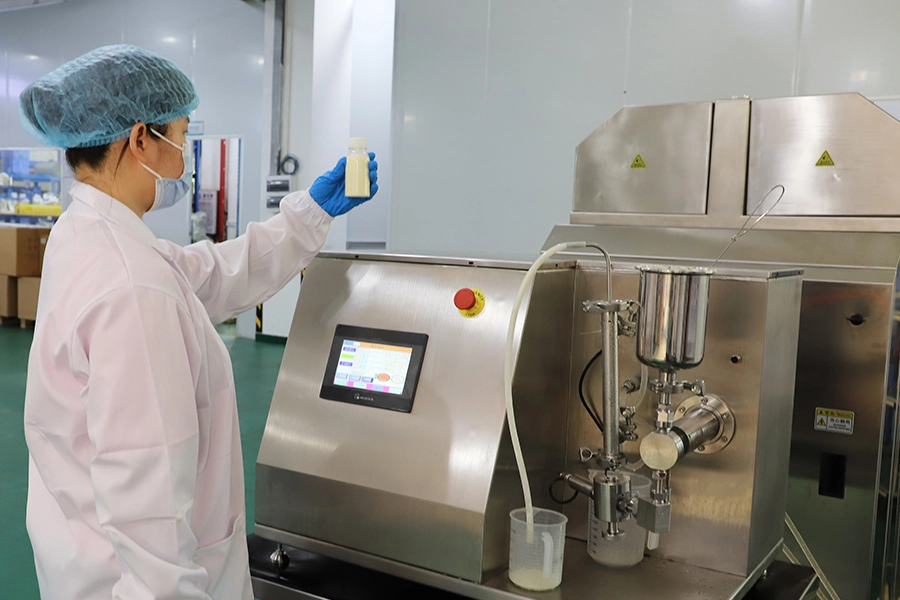
Microfluidizer vs. Conventional Homogenizer: Which One Should You Choose?
There is no universal answer. The better technology depends on your process requirements.
Choose a Conventional Homogenizer When:
A conventional homogenizer may be appropriate when:
- Micron-scale particle reduction is sufficient
- The formulation is relatively easy to process
- Standard emulsification is the primary objective
- Extremely narrow particle-size distribution is not required
- The application does not require advanced nanoscale processing
- Processing cost and simplicity are major priorities
For many established industrial applications, conventional homogenization remains a reliable and economical solution.
Choose a Microfluidizer When:
A microfluidizer is generally more attractive when:
- Nanoscale particle reduction is required
- Narrow particle-size distribution is important
- High dispersion uniformity is required
- The material contains difficult-to-disperse particles
- Nanoemulsions or liposomes are being developed
- Advanced materials require controlled dispersion
- High process reproducibility is essential
- The formulation requires intensive high-pressure processing
- R&D results need to be transferred to pilot or industrial production
In other words, if your objective goes beyond basic mixing and emulsification and involves precision material processing, microfluidic technology deserves serious consideration.
Why Microfluidic Technology Is Becoming Increasingly Important
The evolution of material science is changing homogenization requirements.
Traditional industrial applications often focused on achieving sufficient mixing and micron-scale homogenization. Today’s advanced industries increasingly require control at the nanoscale.
This shift can be seen across several sectors:
New Energy: Battery materials and energy-storage formulations require increasingly precise particle dispersion and interface control.
New Materials: Nanomaterials, advanced ceramics, carbon materials, and functional powders require highly uniform dispersion.
Biopharmaceuticals: Drug delivery systems and biologically active formulations increasingly depend on controlled particle and droplet sizes.
Food Technology: Nanoemulsions and functional ingredients require more sophisticated dispersion technologies.
As these requirements increase, the role of microfluidic technology in high-pressure homogenization is likely to become increasingly important.
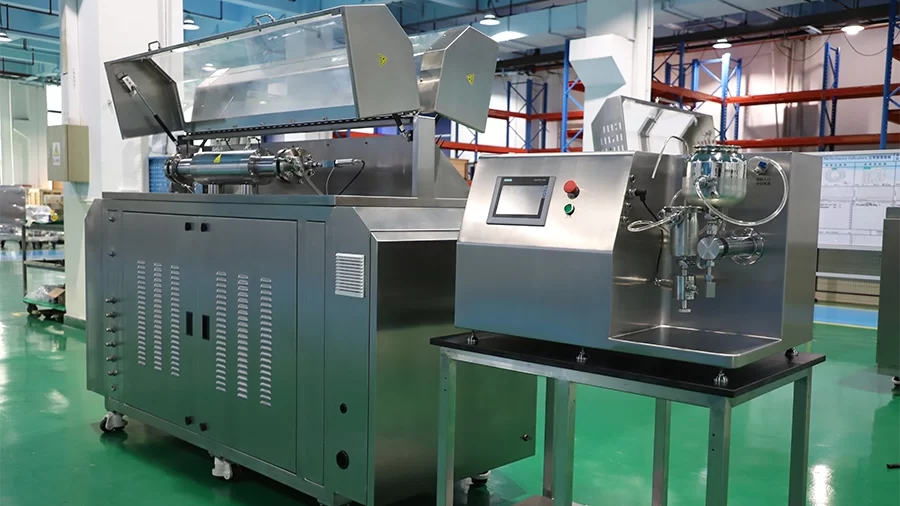
JUNJIE Microfluidizer: Lab-to-Production Scale-Up
For advanced nanoscale processing, equipment performance, process control, and scalability all play a critical role. JUNJIE combines ultra-high pressure technology, in-house core components, and full-cycle technical support to deliver a more reliable and scalable microfluidic homogenization solution—from lab research to industrial production.
Ultra-High Pressure and In-House Core Component Manufacturing
JUNJIE microfluidizers are designed for pressures of up to 420 MPa, with stepless adjustment across the full range. This allows flexible processing for applications such as graphene exfoliation, nanomaterial dispersion, liposome preparation, and nanoemulsification.
The system adopts a long-stroke, low-speed intensifier design, reducing mechanical stress and improving long-term operational stability.
Two core processing configurations are available:
- Diamond interaction chamber: Metal-free design for high-purity applications such as pharmaceuticals and semiconductors.
- Homogenizing valve: Cost-effective option suitable for higher-viscosity materials.
Unlike many manufacturers, JUNJIE independently develops and produces its key components, including the intensifier and homogenization system. This ensures better quality control, faster spare-parts supply, and greater customization flexibility.
Unified Pressure Range for Direct Process Scale-Up
Scaling from laboratory to industrial production is often challenging when equipment pressure conditions are inconsistent. JUNJIE solves this by standardizing a 420 MPa maximum design pressure across all platforms, including HPW-10, HPW-250, and HPW-500 series.
This unified pressure system ensures that once a process is optimized in the lab, it can be transferred more directly to pilot and production scales, reducing redevelopment time and process uncertainty.
All systems are equipped with Siemens PLC and touchscreen control, supporting recipe storage, real-time monitoring, and data export. Optional CIP/SIP systems and GMP-compliant data recording are also available for regulated industries.
Application Laboratory and Full-Cycle Technical Support
Because different materials respond differently to high-pressure processing, real testing is essential before equipment selection.
JUNJIE operates a dedicated microfluidic nanohomogenization laboratory, where customers can conduct sample validation and process optimization before purchase.
Support includes:
- Sample testing and process validation
- Parameter optimization (pressure, cycles, etc.)
- Particle size analysis
- Equipment selection guidance
- Process development support
- Scale-up assistance from lab to production
Beyond pre-sales testing, JUNJIE provides full lifecycle support, including installation, training, maintenance, and spare parts service.
With experience across semiconductors, new energy, pharmaceuticals, and advanced materials, JUNJIE helps customers solve both equipment and process challenges in real applications.
From Microfluidic Technology to a Complete Processing Solution
In advanced applications, value is not defined only by pressure or particle size reduction, but also by process stability, scalability, and long-term support.
JUNJIE integrates 420 MPa ultra-high-pressure technology, in-house core components, standardized platforms, intelligent control, application testing, and full-cycle service into one complete solution.
This enables a smoother transition from laboratory research to industrial production, making JUNJIE a reliable partner for high-performance nanoscale dispersion and high-pressure processing.
Conclusion
The comparison between a microfluidizer and conventional homogenizer ultimately comes down to application requirements.
Conventional homogenization remains an effective technology for many standard processes. However, as industries move toward nanoscale materials, advanced formulations, and increasingly demanding dispersion specifications, conventional equipment may not always provide sufficient control.
A microfluidizer based on advanced microfluidic technology can provide highly intensive and controlled processing, making it particularly suitable for nanoscale dispersion, nanoemulsification, advanced materials, pharmaceutical formulations, biotechnology, food ingredients, and new-energy applications.
For organizations developing next-generation materials and formulations, the most effective approach is to evaluate the two technologies based on actual processing data—including particle size, particle-size distribution, dispersion stability, throughput, energy consumption, and batch-to-batch consistency.
The right homogenization technology is not simply the one with the highest pressure. It is the technology that can consistently deliver the required material characteristics at the required production scale.
For demanding nanoscale processing applications, microfluidic high-pressure homogenization provides a powerful pathway from laboratory research to pilot development and industrial-scale production.