

Cream cheese is widely loved by consumers for its delicate, smooth texture and rich, creamy flavor. In cream cheese production, every processing step plays an important role, and different types of cheese require specialized equipment for processing. In fact, producing cream cheese involves multiple complex steps that require precise operation, strict hygiene standards, and professional expertise.
Achieving the desired quality of cream cheese—free from grittiness, stable without separation, and smooth and creamy in texture—relies heavily on the core technology of high-pressure homogenization. This article explores the key role of high pressure homogenizer in cream cheese production, with a focus on the features of the JUNJIE High Pressure Homogenizer.
Core Challenges in Cream Cheese Production
Cream cheese is a high-protein, high-fat dairy product that faces several challenges during production:
| Challenge | Specific Manifestation |
|---|---|
| Fat Separation | Uneven milk fat globule size, leading to fat rising and layering during storage |
| Poor Mouthfeel | Incomplete emulsification of protein and fat, resulting in a grainy texture |
| Poor Stability | Water separation (syneresis) and texture hardening during shelf life |
| Batch Inconsistency | Traditional processes struggle to maintain uniform quality across batches |
The root cause of these issues lies in the failure to achieve nano-level uniform dispersion and stable emulsification of the material. The high-pressure homogenizer is the core equipment designed to solve this problem.

Working Principle and Advantages of the High Pressure Homogenizer
The JUNJIE High Pressure Homogenizer uses ultra-high pressure of up to 420 MPa to pressurize the product and rapidly force it through extremely fine diamond interaction chamber microchannels, generating supersonic jets within the channels. Through the combined effects of intense shear forces, jet impact, and instantaneous cavitation, the homogenization process achieves:
- Fat Globule Reduction: Reduces milk fat globule size from the micron range to the nanoscale, below 100 nm.
- Uniform Protein Dispersion: Promotes thorough interaction between casein, whey proteins, and fat globules.
- Stable Emulsification: Creates a uniform and stable oil-in-water (O/W) emulsion structure.
Key Roles of the JUNJIE High Pressure Homogenizer in Cream Cheese Production
Ultra-Fine Particle Size Reduction for a Silky-Smooth Texture
The JUNJIE system uses a diamond interaction chamber with fixed internal microchannels to ensure stable and consistent particle size results from batch to batch. By precisely controlling the pressure at 30,000–60,000 psi, the fat globules in cream cheese can be uniformly reduced to the nanoscale, effectively eliminating grittiness and creating an exceptionally smooth, melt-in-the-mouth texture.
Efficient Emulsification to Prevent Phase Separation and Whey Separation
During homogenization, the intense shear forces and cavitation effects generated by ultra-high pressure promote thorough interaction between proteins and fats, forming a stable emulsification network. This effectively helps prevent issues such as fat separation and whey release during storage and transportation, significantly improving product stability and extending shelf life.
Precise Temperature Control to Preserve Active Components and Flavor
Proteins and flavor compounds in cream cheese are sensitive to temperature. The JUNJIE system is equipped with a sanitary temperature-control system that effectively regulates product temperature during homogenization, helping prevent protein denaturation and flavor loss caused by excessive heat while maintaining product quality.
Batch-to-Batch Consistency for Reliable Product Quality
The JUNJIE system features a high-definition touchscreen control system that supports program settings, data recording, and remote monitoring. By precisely controlling parameters such as pressure, flow rate, and temperature, it ensures highly consistent homogenization results across batches and addresses the batch-to-batch instability often associated with traditional processing methods.
Hygienic Design to Meet Food Safety Standards
All product-contact components of the JUNJIE system are made from GMP- and FDA-compliant 316L stainless steel and 17-4PH stainless steel. The system also supports CIP/SIP in-line cleaning, enabling rapid cleaning and sterilization without disassembly. This hygienic design meets the stringent sanitation requirements of the dairy industry.
Full-Process Solutions from Lab to Production
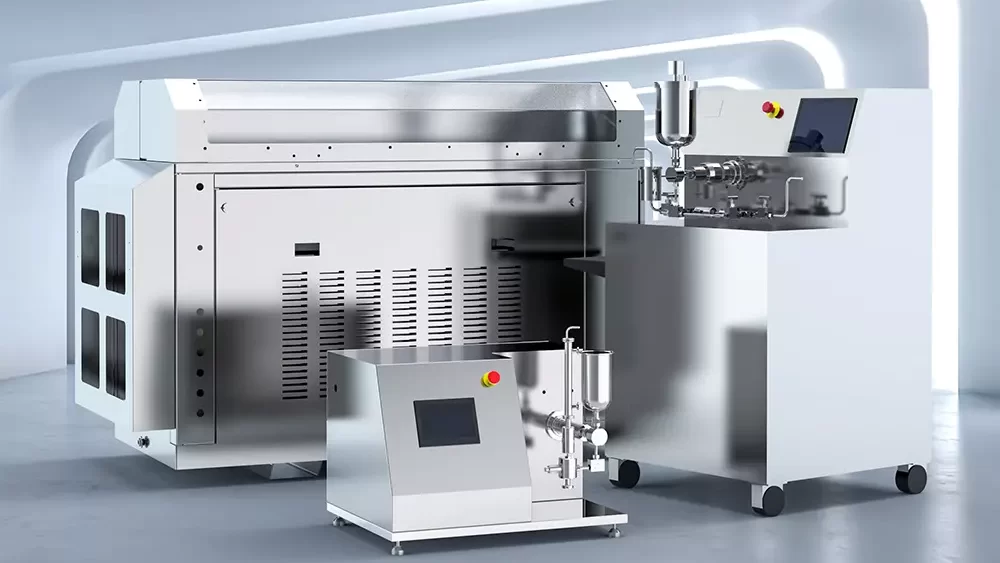
JUNJIE offers ultra-high-pressure micro-jet homogenizers covering the entire stage from R&D, pilot-scale, to mass production:
| Model | Capacity | Application Stage | Core Features |
|---|---|---|---|
| HPW-10 (Lab) | 10 L | Formulation R&D | Servo direct drive, min. 20 ml sample, precise temperature control |
| HPW-250 (Pilot) | 250 L | Process Scale-up | 37 kW hydraulic drive, CIP/SIP backflushing, bridges to production |
| HPW-500 (Production) | 500 L | Mass Production | 75 kW hydraulic drive, 420 MPa high pressure, 24h continuous operation |
| HPW-X (Custom) | Custom | Special Applications | Pressure/flow/materials/functions customized on demand |
The JUNJIE High Pressure Homogenizer provides a comprehensive end-to-end solution that seamlessly connects the entire process from small-scale laboratory validation to industrial mass production, delivering three core benefits to cream cheese manufacturers: first, it revolutionizes R&D efficiency, allowing rapid formulation screening and precise process parameter optimization with sample volumes as small as 20 mL, shortening new product launch cycles by 30%–50%; second, it eliminates process scale-up risks, as laboratory, pilot-scale, and production models use the same diamond interaction chamber and shear mechanism, ensuring direct transfer of process parameters and highly consistent product quality across batches; third, it achieves both quality and cost advantages, with nanoscale homogenization delivering an exceptionally smooth and creamy texture while reducing stabilizer usage, minimizing raw material waste, and extending shelf life, with the overall reject rate potentially reduced to below 0.5%, helping manufacturers establish both quality and cost advantages in the premium cream cheese market.
Conclusion
In conclusion, cream cheese production is a complex process that requires specialized equipment, professional expertise, and precise control at every stage. The high-pressure homogenizer plays an indispensable role in cream cheese production, making a critical contribution to product quality, texture, and flavor.
With its core technologies—including ultra-high-pressure precision control, diamond interaction chambers, precise temperature control, and intelligent control systems—the JUNJIE High Pressure Homogenizer effectively addresses common challenges in cream cheese production, such as fat separation, coarse texture, and poor stability. It helps manufacturers develop cream cheese products with high quality, excellent stability, and greater added value.
From laboratory R&D to industrial-scale mass production, JUNJIE provides a one-stop, end-to-end solution to help dairy manufacturers upgrade product quality while reducing costs and improving production efficiency.